 All Articles
100-Day Study Plan for WBJEE: A Phase-Wise Approach to the Final Stretch
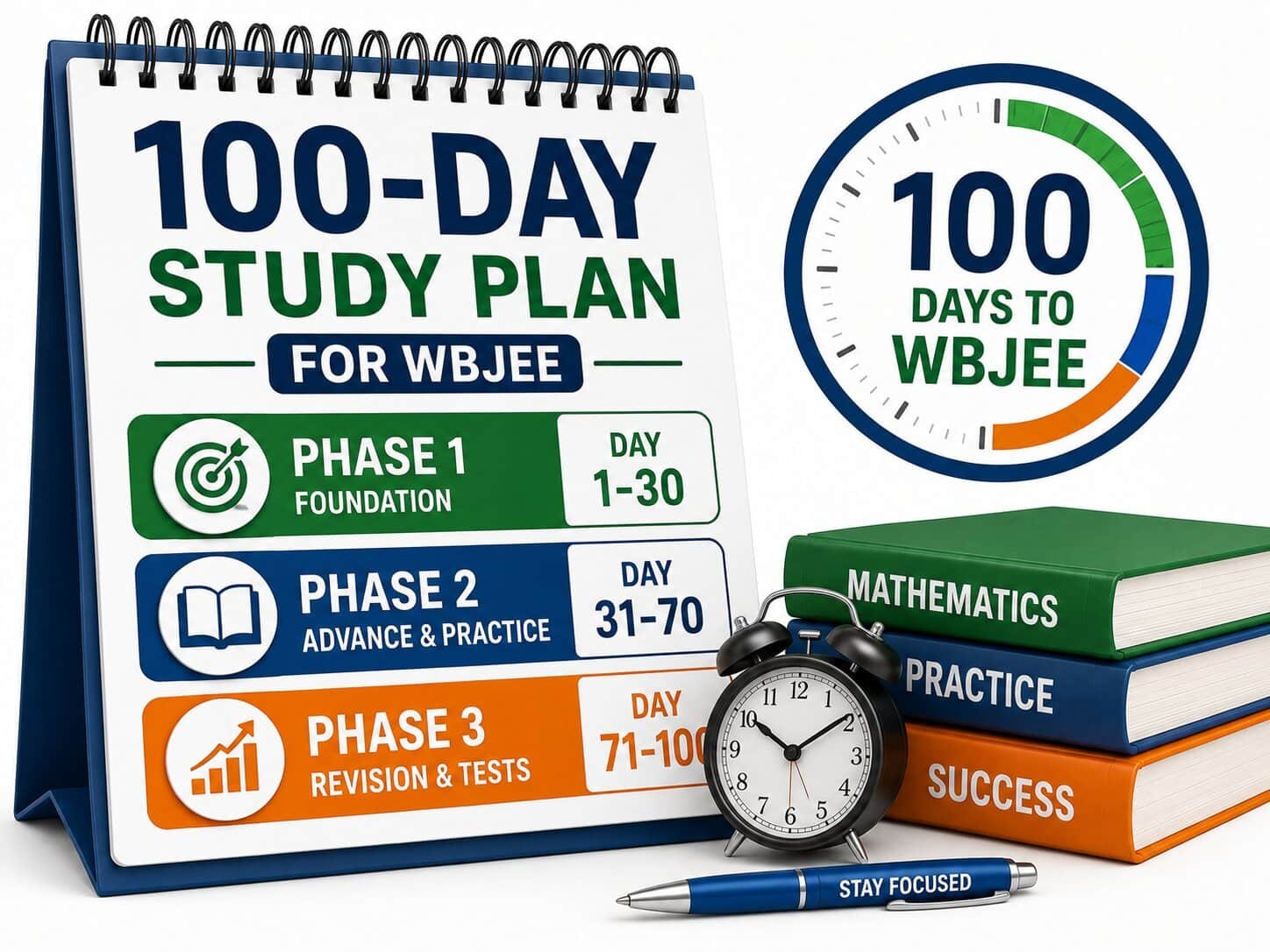
The final hundred days before WBJEE are where preparation either consolidates into exam-ready performance or stays scattered across half-finished revision cycles. Since Mathematics alone carries half the total marks in WBJEE, a generic, evenly-split study plan across all three subjects works against the exam's own structure. A phase-wise approach, moving from consolidation to timed practice to final revision, tends to produce far more reliable results than trying to do everything simultaneously across all hundred days.
Days 1 to 35: Consolidating the Full Syllabus
The first phase of a hundred-day plan should focus on closing any remaining syllabus gaps while beginning to shift from passive reading toward active problem-solving. Candidates entering this phase with the syllabus already fully covered should treat these five weeks as a first full revision cycle rather than fresh learning, while those with residual gaps should prioritise closing them here rather than carrying them into the exam's final weeks.
Dedicate roughly half of total weekly study hours to Mathematics, given its 50 percent weightage, while maintaining consistent daily contact with both Physics and Chemistry rather than deprioritising either
Complete any remaining high-weightage chapters first, specifically Calculus, Algebra, and Coordinate Geometry in Mathematics, Mechanics and Electrodynamics in Physics, and Physical and Organic Chemistry basics
Begin solving chapter-wise previous years' questions immediately after finishing each topic, rather than waiting until the full syllabus is complete, since this reinforces recall while the material is still fresh
Build a running formula sheet and error log from week one, since these become far more valuable when they carry a full hundred days of entries rather than being started late
Days 36 to 70: Shifting Toward Timed, Mixed-Chapter Practice
The middle phase should mark a clear shift from chapter-isolated study toward timed, mixed practice that mirrors how WBJEE actually blends topics within a single paper. This is also the phase where candidates should begin taking regular full-length mock tests under strict exam conditions, since building genuine exam-day stamina and pacing takes repeated practice rather than a handful of tests squeezed into the final weeks.
Take at least one full-length timed mock test per week, replicating WBJEE's actual paper structure with Mathematics as a separate timed section from the combined Physics and Chemistry paper
Practice mixed-chapter problem sets deliberately, since WBJEE frequently blends Coordinate Geometry into Calculus questions and Physical Chemistry into Organic Chemistry numericals
Review every mock test by category rather than only by overall score, tracking separately how many marks were lost to Category 1's smaller negative marking versus Category 2's steeper penalty
Revisit Class 11 foundational chapters in Trigonometry, Straight Lines, and Mole Concept during this phase if mock test errors are tracing back to these dependencies, since gaps here quietly undermine Class 12 topics built on top of them
Begin comparing performance trends across consecutive mock tests rather than judging each test in isolation, since a single test can be misleading if difficulty varies
Days 71 to 90: Targeted Weakness Elimination
With roughly three weeks remaining, the plan should shift almost entirely toward eliminating specific, identified weaknesses rather than continuing broad revision. By this stage, the running error log built over the previous two phases should clearly show which chapters and which question categories are costing the most marks, and this phase exists specifically to close those gaps.
Rank weak chapters by how frequently they appear in past WBJEE papers, and prioritise fixing the highest-weightage weak areas first rather than spending equal time on all flagged topics
Continue full-length mock tests at a similar or slightly reduced frequency, since stopping mock practice too early causes pacing and stamina to soften right before the exam
Focus specifically on Category 3 questions in Mathematics during this phase, since their zero-negative-marking structure makes them a genuinely low-risk area to sharpen further with targeted practice
Revisit previously solved mock tests rather than only attempting fresh ones, since re-solving a test after a few weeks reveals whether earlier mistakes have actually been corrected or merely noted
Days 91 to 100: Final Revision and Exam-Day Readiness
The last ten days should involve no new content whatsoever. This window exists purely to consolidate formula recall, maintain sharpness through light practice, and protect physical and mental readiness for exam day itself. Candidates who use this window to attempt unfamiliar problem types or new chapters typically enter the exam less confident than those who spend it reinforcing what is already known.
Revisit the complete formula sheet and error log built across the previous ninety days, cycling through them rather than reading passively
Solve one or two previous years' papers at a reduced pace, focused on reinforcing pacing and category-wise strategy rather than testing new material
Maintain a consistent sleep schedule and daily routine matching the actual exam day timing, since Mathematics as Paper 1 and Physics-Chemistry as Paper 2 both demand sustained focus across a four-hour total window
Avoid comparing preparation levels with peers during this window, since it tends to increase anxiety without improving readiness
Fitting This Plan Around Parallel Exam Preparation
Many WBJEE candidates in West Bengal are preparing for JEE Main simultaneously, and the two exams weight subjects differently enough that a hundred-day plan built purely around WBJEE's Mathematics-heavy structure needs slight adjustment for candidates targeting both. Reviewing how WBJEE's difficulty, pattern, and marking scheme compare with JEE Main early in this hundred-day window helps calibrate exactly how much of the extra Mathematics time should come at the expense of Physics or Chemistry, since JEE Main's equal three-subject weighting does not reward the same imbalance.
Candidates should also revisit their target rank range periodically through this window, since knowing roughly which colleges and branches a given score range realistically opens up helps keep daily effort anchored to a concrete, motivating goal rather than an abstract sense of "doing more."
The Bottom Line
A hundred days is enough time to move from a fully covered syllabus to genuine exam readiness, provided the time is structured in phases rather than spent on undifferentiated daily study. Consolidation in the early weeks, timed mixed practice through the middle stretch, targeted weakness elimination in the final three weeks, and pure revision in the last ten days together build the kind of layered readiness that a single, unstructured hundred-day grind rarely achieves.
Article Stats