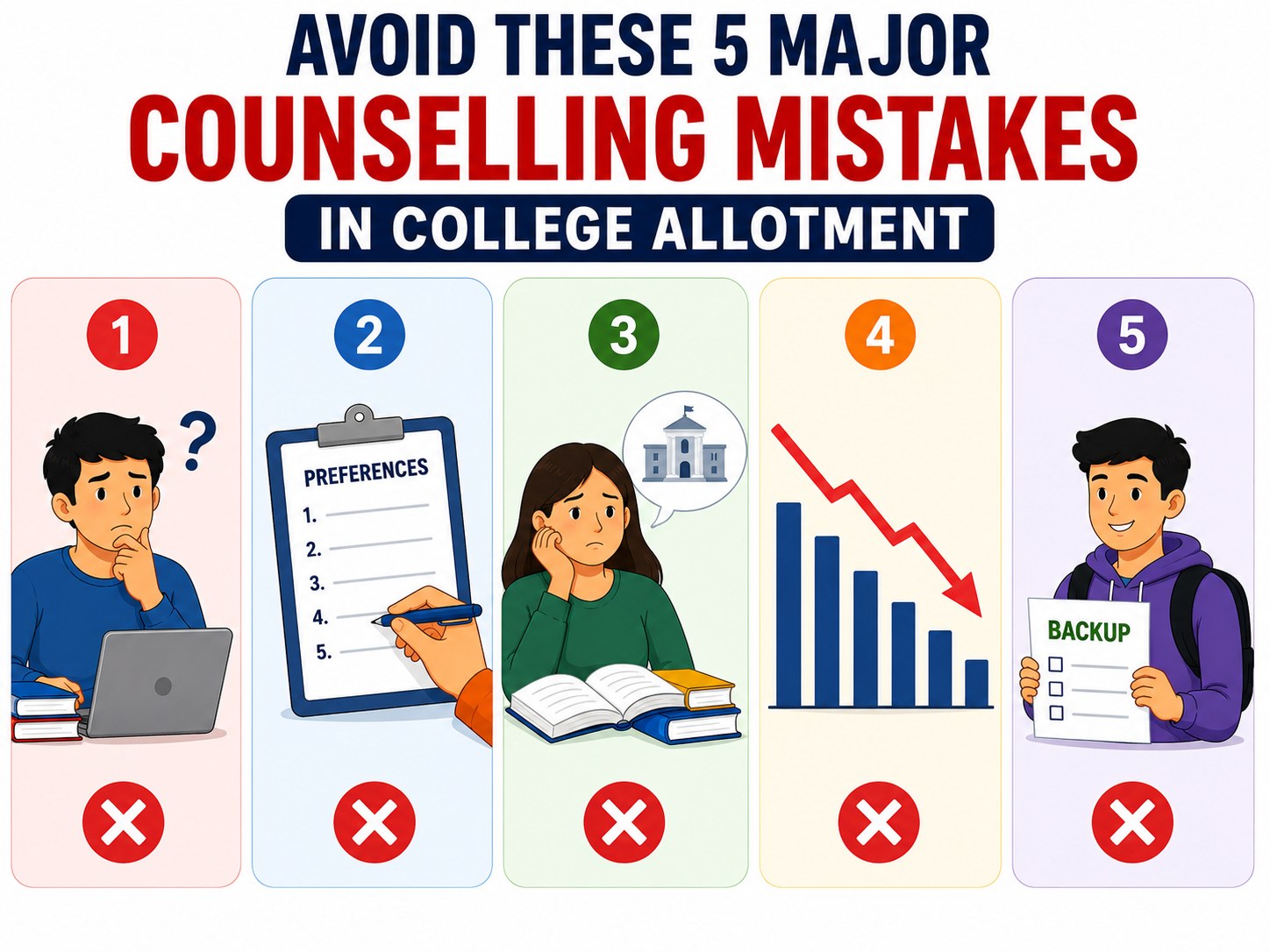
Every year, thousands of NEET aspirants secure good ranks yet end up dissatisfied with their allotted college — not because they scored poorly, but because they made avoidable NEET counselling errors. The counselling phase is just as important as the exam itself, and a single wrong step during choice filling can lead to a wrong college choice that impacts your career for years to come. Unfortunately, many students rely on incomplete information, outdated cut-off data, or unverified advice, which often leads to regret after allotment.
Proper counselling guidance can make the difference between getting into your dream college and settling for an option you never wanted. This is especially true for students seeking NEET counselling in Kolkata, where competition is intense, and seat availability changes rapidly across rounds. In this blog, we will uncover the most common counselling mistakes students make and show you how to avoid them — so you can choose the right college with confidence and clarity.
Common NEET Counselling Mistakes Made by the Students
1. Not Researching Colleges Properly
Not sufficiently researching colleges is probably the single most common mistake students make when applying to universities. A great number of students base their choices on popularity, make guesses, or ask their friends for advice without checking very important factors such as:
whether the course is accredited and if the curriculum is up-to-date
records of placements and partnerships with the industry
campus facilities, location, and faculty qualifications
The availability of internships and study abroad programs
2. Ignoring Course Curriculum and Scope
One of the most common errors that students make when applying to college is deciding to take a course just because their friends are taking it or the course sounds nice. Students, not knowing the university syllabus, subjects, skills needed or the future of the field, often find themselves in a program that does not match their interests or long-term career goals. This not only has an impact on learning but also limits the possibilities for career growth later on.
3. Missing Application Deadlines
Among the errors that can severely damage the chance of getting into the college are disregarding critical deadlines. The admission timeline to application, entrance exam, counselling rounds, and document verification is strict. There are even qualified students who are unable to make it because they do not track college application deadlines, entrance exam dates, or submission cut-offs. These may result in losing your place at the college or in the course of your dreams.
4. Submitting Incomplete or Incorrect Applications
Another major mistake that students make when applying for college is to submit incomplete or inaccurate application forms. A tiny spelling mistake, a wrong category selection, or a missing detail from the mandatory fields may lead to the rejection of the application. A large number of students hurry through online forms and do not check the information, thus their chances of getting into the best colleges in India or getting admission after 12th are reduced.
5. Underestimating the Importance of Entrance Exams
It is one of the most frequent Errors in college admission that students underestimate the importance of entrance exams. A large number of top colleges and universities use entrance tests as a tool to measure a student's aptitude, subject knowledge, and capacity for the course. Still, some students consider these tests as a joke, rely only on last-minute study, or concentrate on only one exam while disregarding other equally important tests. Consequently, they lose their chances of obtaining seats in top colleges in Bangalore or India and competitive UG courses after 12th.
6. Choosing a College Solely Based on Friends or Family
It is one of the most frequent errors in college admission that students underestimate the importance of entrance exams. Many top colleges and universities use entrance tests as a tool to measure a student's aptitude, subject knowledge, and capacity for the course. Still, some students consider these tests as a joke, rely only on last-minute study, or concentrate on only one exam while disregarding other equally important tests. Consequently, they lose their chances of obtaining seats in top colleges in Bangalore or India and competitive UG courses after 12th
7. Ignoring Financial Planning
Many students and their parents fail to account for the complete cost of education, which comprises tuition fees, hostel charges, transportation, and other living expenses. Without financial planning, study costs in India or even in the top cities like Bangalore can become so expensive that one may not be able to afford them. Such financial stress may disrupt your academic journey and lead to poor performance.
8. Not Preparing for College Interviews or Counselling Rounds
These are the often-overlooked student mistakes that will probably cost you a seat at a top college in India or admission into a competitive course at a Bangalore college. Interviews, which include counselling sessions, are the third most important factor after grades and recommendation letters. These are the main ways top colleges get to know you personally and evaluate your communication skills, confidence, and clarity of goals. Poorly prepared candidates will most definitely face rejection from the best colleges in Bangalore as well as India.
9. Overlooking Alternative Options or Backup Plans
Students often limit their choice of colleges by applying to only one or two institutions. As a result, when they fail to get admission, they become unnecessarily stressed and also miss out on other opportunities. It is necessary to have a well-planned college admission strategy, particularly when you are applying to the top colleges in India or to the highly competitive colleges in Bangalore.
10. Not Seeking Proper Guidance
The whole college admission journey might be very confusing at first glance. There are so many things you have to consider - entrance exams, eligibility, documentation, scholarships, cut-offs, and application procedures. Students who hesitate to ask for assistance may, in most cases, commit errors, which, if they had the proper support, could be avoided easily.
How to Avoid Choosing the Wrong College Allotment – Complete Guide
1. Understand the NEET Counselling Process Completely
Many students enter counselling without clearly understanding how the system works. NEET counselling involves multiple rounds, different exit rules, and changing seat availability. If you do not know when you can upgrade, exit safely, or participate in later rounds, you risk losing better options. Reading the official brochure and knowing the rules of each round helps you avoid costly technical mistakes.
2. Be Realistic About Your Rank
Students often assume their rank will fetch top colleges without checking actual trends. This leads to disappointment and wrong expectations. Instead of emotional decisions, analyse previous years’ cut-offs and understand where you realistically stand. Being honest with your rank helps you choose colleges where you actually have a chance.
3. Research Colleges Before Making a Choice
Choosing a college based only on reputation or hearsay can lead to regret later. Every college differs in academics, hospital exposure, infrastructure, and environment. Without proper research, you may end up in a college that doesn’t suit you, even if it looks good on paper. Knowing what each college truly offers helps you choose wisely.
4. Fill Your College Preferences Carefully
Many students lose better seats simply because they arrange their preference list incorrectly. The counselling system only follows the order you submit, not your intentions. If your dream college is placed lower or missing, you will never be considered for it. Correct preference order ensures you get the best possible option based on your rank.
5. Avoid Blind Advice From Others
Friends, relatives, and seniors may offer advice based on their own experience, but your situation is different. Their rank, year, and category may not match yours. Following unverified advice can confuse you and lead you away from better options. Personalised decision-making always works better than copying others.
6. Look at More Than One Year of Cut-Off Data
Depending only on last year’s cut-off is risky because trends change every year due to seat changes, competition, and policy updates. Looking at multiple years gives you a broader understanding and helps you make safer choices rather than risky guesses.
7. Prepare Your Documents in Advance
Even one missing document can ruin an entire counselling year. Many students lose seats due to late upload, mismatch, or incorrect certificates. Preparing documents early and verifying them carefully reduces the chances of disqualification or last-minute panic.
8. Understand Quota and Reservation Rules
A poor understanding of quotas and category reservations leads many students to apply incorrectly. This results in missed opportunities or selections they were not even eligible for. Knowing exactly where you qualify helps you fill choices without confusion or risk.
9. Do Not Assume You Will Be Automatically Upgraded
Upgradation is not guaranteed. It depends on many factors like vacancy, your rank, and your preference list. Assuming you will automatically get a better college is risky and often leads to disappointment. Always choose colleges you are willing to accept.
10. Take Professional Counselling Guidance If Needed
NEET counselling is complex and dynamic, and expert guidance can significantly reduce errors. A professional counsellor analyses your rank, category, and options in detail to create a strategy that avoids wrong allotments. Investing in the right guidance can save you from lifelong regret.
Conclusion: Right Counselling = Right College = Right Career
NEET counselling mistakes can cost you the college you deserve, even after scoring well. Ignoring rules, making careless choices, or depending on wrong advice often leads to regret. With proper planning and expert guidance, you can avoid these errors and make confident decisions. Remember, your future depends not just on your rank, but on the choices you make during counselling — choose wisely and seek help when needed.
Article Stats