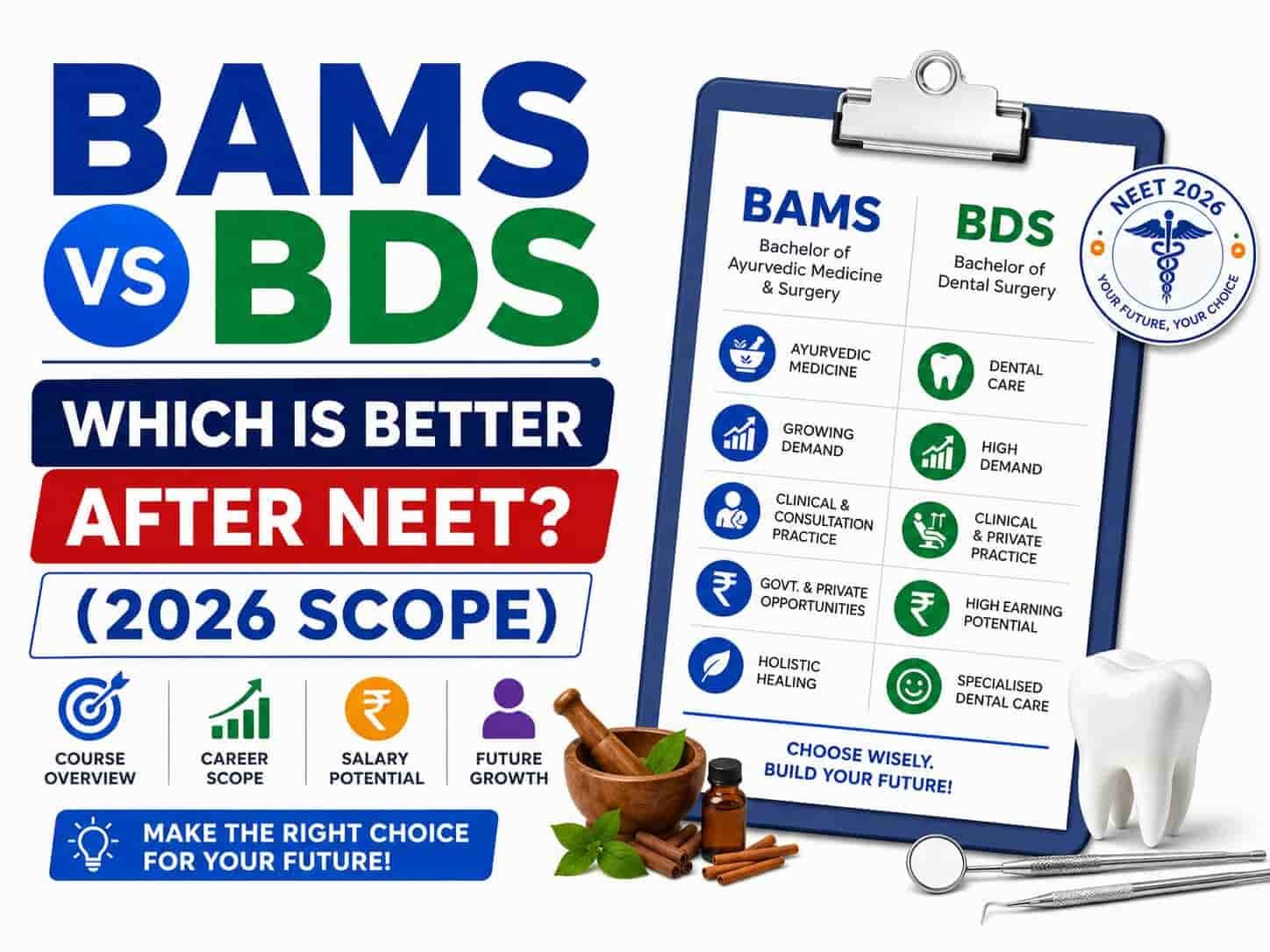
The National Eligibility cum Entrance Test (NEET) results bring a familiar crossroads for hundreds of thousands of medical aspirants. While securing an MBBS seat is the initial dream for many, the reality of competitive cutoffs means making a strategic alternative pivot. Two of the most sought-after, professional, and heavily debated medical degrees after MBBS are BAMS (Bachelor of Ayurvedic Medicine and Surgery) and BDS (Bachelor of Dental Surgery).
But as we look at the healthcare landscape in 2026, the old assumptions no longer hold true. Choosing between fixing dental structures or tapping into a global holistic wellness revolution requires a clear understanding of reality.
This guide will break down the structural differences, current cutoffs, daily realities, financial outcomes, and modern shifts shaping the BAMS vs BDS decision.
The 2026 Reality Check: Market Shifts
Understanding how the healthcare landscape has transformed over recent years is crucial for making an informed choice. Both fields have experienced major changes that directly impact job availability and career trajectories.
The BDS Urban Saturation & Digital Renaissance
For years, the running joke—and unfortunate reality—was that Tier-1 cities had a dental clinic on every corner. India produces over 27,000 dentists annually, leading to intense competition in urban areas.
However, 2026 has introduced a distinct Digital & Cosmetic Renaissance within dentistry. The explosion of aesthetic awareness, clear aligners (like Invisalign models), smile correction trends, and dental tourism has injected high-value cash flow back into private dental practices. While general dentistry in cities is competitive, specializing in aesthetic dentistry or oral surgery offers massive financial upside.
The BAMS Global Wellness & Policy Integration
Conversely, BAMS is experiencing an unprecedented "Gold Rush." Driven heavily by the Ministry of AYUSH, Ayurveda is no longer perceived as just home remedies. It has evolved into a scientific, multi-billion-dollar global wellness economy.
Crucially, policy shifts have empowered BAMS practitioners. In several states (such as Maharashtra, Karnataka, and Uttar Pradesh), BAMS doctors who complete designated pharmacology bridge modules are legally permitted to practice integrated medicine. This allows them to prescribe specific allopathic medicines and manage basic emergency care in rural areas, vastly expanding their practical utility in the healthcare system.
NEET Cutoffs and Seat Accessibility
If your NEET score is resting in the middle tier, your choice may be heavily influenced by seat matrix availability and cutoffs.
BDS Cutoff Dynamics
Securing a government dental seat remains highly competitive. For the General category under the All India Quota (AIQ), you typically require a NEET score of 540–570+. State quotas can pull this down slightly to around 500–530. There are roughly 3,000 government dental seats nationwide, meaning the buffer is relatively narrow.
BAMS Cutoff Dynamics
BAMS offers much broader accessibility due to a massive expansion of AYUSH infrastructure. Total seats across the country exceed 50,000. A NEET score between 450 and 520+ will place you in a strong position for a government AYUSH college. Top-tier institutional giants like Banaras Hindu University (BHU) or the National Institute of Ayurveda (NIA), Jaipur, still command scores upwards of 530–560, but the overall floor for a government BAMS seat is more accessible than BDS.
The Cutoff Trap: Never select your life's profession solely because your NEET score "perfectly fits" the cutoff. If you choose BAMS simply to secure a government seat but possess zero interest in learning Sanskrit or traditional holistic diagnostics, academic burnout can happen quickly.
Financial Outlays: Education vs. Setup Costs
An often-overlooked factor during counseling is the total capital required—not just to graduate, but to successfully begin practicing.
1. Course Fees
Government Colleges: Both BDS and BAMS are highly affordable here, ranging from ₹20,000 to ₹1 Lakh per annum.
Private Institutions: Private BDS fees can quickly scale from ₹3 Lakhs to over ₹12 Lakhs per annum depending on clinical reputation. Private BAMS colleges generally maintain a slightly lower pricing bracket, ranging from ₹2 Lakhs to ₹5 Lakhs per year.
2. Infrastructure Setup Costs
This is where the financial trajectories diverge dramatically.
To establish a Private BDS Clinic: You require precision equipment. Dental chairs, digital X-ray setups, autoclaves, and specialized surgical handpieces require a substantial initial investment, often ranging from ₹15 Lakhs to ₹25 Lakhs.
To establish an Ayurvedic Clinic: A BAMS practitioner can establish a consulting clinic with an initial investment of ₹2 Lakhs to ₹5 Lakhs, as the primary requirements are diagnostics, patient consultation space, and a well-stocked herbal pharmacy. Costs only scale if you expand into full-scale Panchakarma treatment beds.
Career Trajectories & Salary Realities
What happens after you earn the degree? Let's analyze the true entry-level and long-term income horizons across both sectors.
Starting Salaries (Years 1-3)
At the entry level, BAMS holds an unexpected edge in stability. A freshly graduated BAMS doctor entering a government facility as an Ayurvedic Medical Officer (AMO) or joining an established wellness brand (like Himalaya, Dabur, or Patanjali) typically secures a starting package of ₹30,000 to ₹50,000 per month.
Junior BDS graduates joining established private clinics often face lower starting offers, typically ranging between ₹15,000 and ₹25,000 per month. This is due to the intense urban labor supply and the fact that dental revenue scales directly with hands-on, independent clinical experience.
Long-Term Earning Potential (Years 5+)
Over a longer horizon, BDS has a significantly higher financial ceiling, provided the practitioner pursues specialization or establishes a successful practice. An experienced dentist or Master of Dental Surgery (MDS) specialist executing advanced root canals, implants, and orthodontic procedures can reliably generate ₹10 Lakhs to ₹25 Lakhs+ annually.
BAMS earnings tend to grow at a steady, predictable rate. While exceptional Ayurvedic doctors with a reputation for managing lifestyle disorders (such as diabetes, PCOD, and auto-immune issues) can build incredibly lucrative consulting practices, the average mid-career income stabilizes around ₹6 Lakhs to ₹12 Lakhs annually, frequently anchored by secure government jobs or institutional research positions.
Advanced Options: Postgraduate Specializations
Both fields offer excellent pathways for advancing your education, allowing you to transition out of general practice and into specialized care.
MDS Specialization Pathways
If you choose the dental route, a Master of Dental Surgery (MDS) is highly recommended to stand out in urban markets. Key specialized branches include:
Orthodontics & Dentofacial Orthopedics: Managing jaw alignment and braces.
Oral & Maxillofacial Surgery: Executing complex extractions, trauma management, and jaw reconstructions.
Endodontics: Specialized root canal treatments and microscopic dentistry.
MD / MS (Ayurveda) Specialization Pathways
BAMS graduates clear the AIAPGET (All India AYUSH Post Graduate Entrance Test) to pursue 3-year specializations that mirror allopathic structures:
Shalya Tantra: Ayurvedic surgery and minimal-access wound-healing procedures.
Kaya Chikitsa: General internal medicine focusing on holistic therapies.
Kaumarbhritya: Ayurvedic pediatrics and child development care.
The Ultimate Decision Framework
To determine which medical path aligns best with your professional and personal goals, consider this structured decision matrix:
You should choose BDS if:
You love manual precision: Dentistry functions as a blend of micro-surgery, engineering, and fine art. A steady hand and a passion for procedure-oriented work are essential.
You desire clear work-life boundaries: Dentists rarely deal with 2 AM medical emergencies. Most practices operate on standard clinic hours.
You aim to go abroad: BDS features strong international validation. Clearing examinations like the NBDE (USA) or ADC (Australia) provides structured pathways to practice globally.
You want to build a premium brand: If cosmetic design, smile transformations, and modern boutique clinic ownership excite you, dentistry is an excellent fit.
You should choose BAMS if:
You want immediate government job stability: The expansion of state-level AYUSH openings makes securing a stable, pensionable public health job easier than in dentistry.
You are passionate about holistic, preventative health: If you prefer uncovering root causes, modifying lifestyles, and managing chronic metabolic disorders over localized physical operations, BAMS is the ideal space.
You are comfortable learning languages: You will be reading classic texts written in Sanskrit. Embracing this linguistic aspect is crucial for your academic success.
You intend to practice in semi-urban or rural areas: These markets remain highly receptive to general medical consultation and are far less saturated than urban dental markets.
Conclusion: Making the Final Choice
Neither BAMS nor BDS is universally "better" than the other. Your choice depends entirely on your personal strengths and career vision.
If you prefer specialized, high-precision surgical procedures, value an urban lifestyle, and are prepared to invest in a premium private practice or postgraduate specialization, BDS remains an exceptional medical profession.
If you want to be part of the modern wellness movement, prefer general medicine over localized procedures, value corporate R&D or government job security, and want to keep your practice setup costs lean, BAMS stands out as a highly resilient choice.
Take a close look at your NEET options, evaluate your long-term risk tolerance, and pick the system of medicine you truly believe in. Both paths offer deeply rewarding careers that play a vital role in patient care.
For students currently navigating options after NEET counseling, this NEET Counseling Career Comparison Video provides an excellent breakdown of the day-to-day lifestyle and academic expectations between BDS, BAMS, and other medical paths.
Article Stats