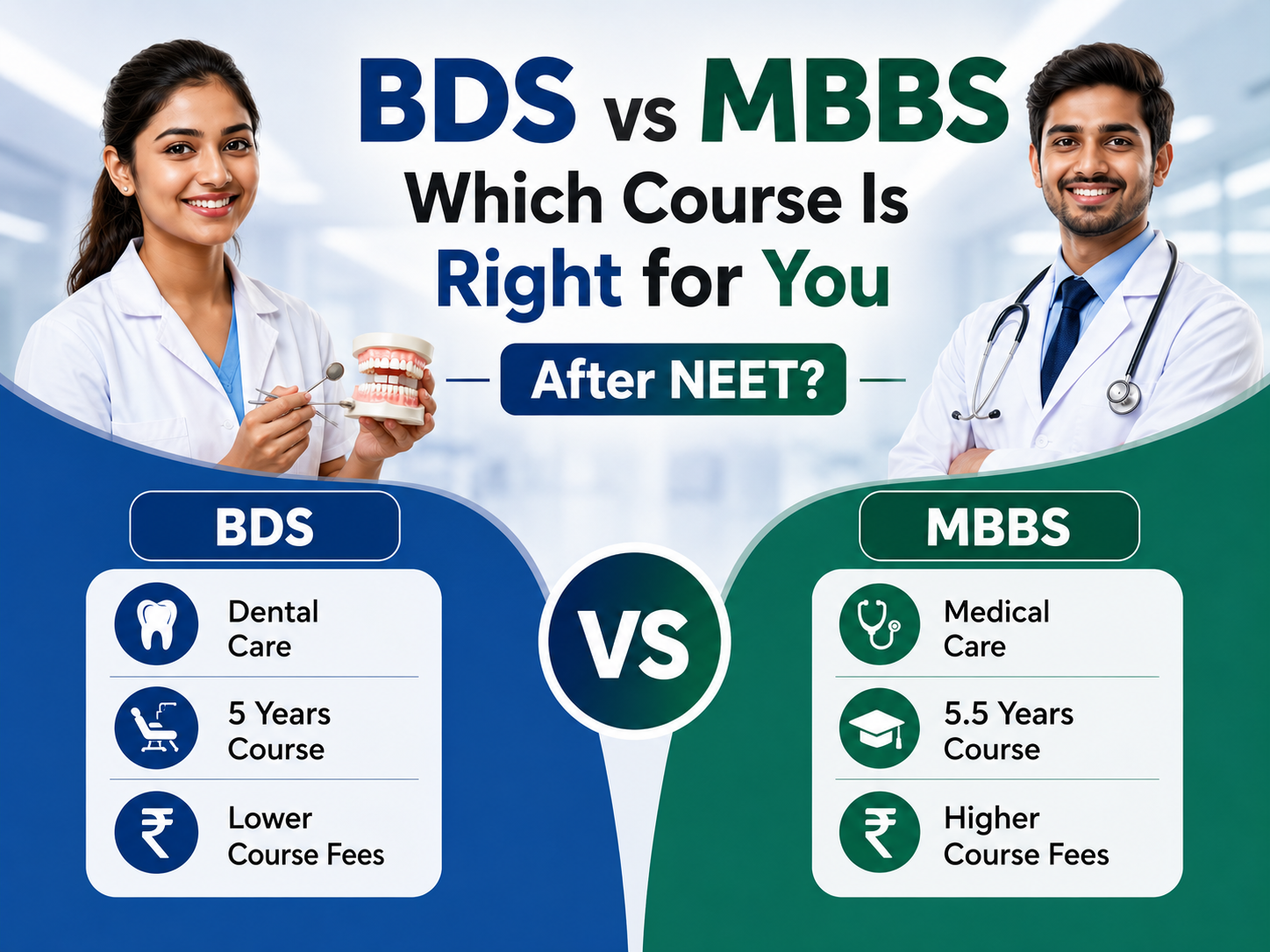
Choosing a course after the NEET exam itself can be confusing. Aspirants passing Class 12 are often unsure whether to opt for the MBBS or BDS. Picking between MBBS and BDS is crucial for students aiming to enter the medical field, and understanding the differences between the courses is important. This choice impacts future career paths, responsibilities, and personal interests. Making the wrong decision may lead to regret and uncertainty.
MBBS vs BDS is a popular topic and one of the most sought-after career options for medical students in India. Admission to these courses is possible after qualifying for NEET, which is not just an exam but also the gateway to the dreams of many future doctors.
Today, let’s explore these two popular courses that many science students consider after 12th: the MBBS (Bachelor of Medicine, Bachelor of Surgery) course and the BDS (Bachelor of Dental Surgery) course. We will cover all aspects of these fields to help you make an informed decision and choose the right medical course.
UNDERSTANDING THE BDS VS MBBS COURSES
Before we go further, let us understand what these medical terms stand for!
MBBS stands for Bachelor of Medicine and Bachelor of Surgery. It’s the degree needed to become a doctor, the one who diagnoses illnesses, prescribes treatments, and saves lives.
BDS stands for Bachelor of Dental Surgery. This course is for those who want to become dentists. It covers dental sciences, oral surgery, dental anatomy, and more. Dentists are experts in taking care of our teeth, gums, and overall oral health.
Both medical courses are respected and offer rewarding careers, but they are quite different in terms of what you will do in the long run.
What is MBBS?
MBBS, or Bachelor of Medicine and Bachelor of Surgery, is designed for those who want to become medical doctors in the future. It is an undergraduate course that provides students with both practical and theoretical knowledge about the human body.
Eligibility criteria for MBBS
MBBS admission isn’t too difficult; it just requires sincerity and dedication.
First, you must complete your Class 12 (high school) with the science stream. This means your main subjects should be Physics, Chemistry, and Biology. English is also usually required. You should score at least 50% marks in these subjects to become eligible for pursuing a bachelor’s degree in medicine.
The most important step after this is to qualify for the entrance exam, i.e. NEET-UG exam. It is the entrance exam to get admission into an MBBS degree or other medical courses in India.
This exam is a mandatory one, whether you want to study in a government or a private medical college. Every year, there is a head-to-head competition for MBBS seats, especially in top institutions, so preparing well is very crucial.
You can apply for NEET if you are at least 17 years old by the end of the year in which you’re taking the exam. NEET is a competitive exam, so even though passing is important, getting a high rank is what helps you get into a good college. There’s no limit to the number of attempts for NEET, so you can try again if you don’t get through the first time. The admission process becomes easier once you clear NEET with a good rank. If anyone wants to study MBBS abroad, they still need to qualify for NEET to get their degree recognised in India
Duration Of the Course
MBBS involves studying general medicine and human anatomy, is a longer course (5.5 years including internship), and offers diverse career opportunities with higher earning potential and specialisation options.
In India, the medicine bachelor's course in medicine is 5.5 years. Out of this, 4.5 years are for learning through classes, labs, hospital visits, and many more. Subjects include anatomy, physiology, surgery, medicine, and more.
The course is divided into three key phases:
Pre-Clinical Phase (1st year) – Subjects include Anatomy, Physiology, and Biochemistry.
Para-Clinical Phase (2nd year) – Focuses on subjects such as Pathology, Pharmacology, Microbiology, and Forensic Medicine.
Clinical Phase (3rd to final year) – Involves hands-on training with subjects like General Medicine, Surgery, Pediatrics, Orthopaedics, ENT, and Ophthalmology.
After the academic portion, students must complete a one-year rotating internship, gaining hospital-based, supervised clinical experience before receiving the MBBS degree. It’s hands-on experience, and it helps future doctors become confident and skilled.
Career scopes
MBBS opens numerous professional and academic paths. Graduates may choose between clinical roles, postgraduate education, research, or administrative healthcare positions.
1. Postgraduate Specialisations:
After MBBS, most doctors pursue advanced studies like MD (Doctor of Medicine) or MS (Master of Surgery) to specialise in fields such as Pediatrics, Radiology, Dermatology, Orthopaedics, or General Surgery.
2. Career Opportunities in India:
Government hospitals (as Junior Residents or Medical Officers)
Private hospitals and clinics
Research and medical education (as Tutors or Lecturers)
Defence services and public health departments.
3. Abroad and Global Prospects:
MBBS graduates can take international licensing exams such as USMLE (USA), PLAB (UK), or AMC (Australia) to practice globally. Foreign postings and higher qualifications abroad are popular career expansion options.
MBBS Fee Structure
MBBS fees vary according to the institutions and regions. Government medical colleges typically charge between INR 10,000 - INR 1,00,000 annually, whereas the private institutions may demand about INR 10,00,000 to INR 25,00,000 per year. International medical programs can cost significantly more, often exceeding INR 30,00,000 annually.
Top Medical Colleges in India 2025
Although this response focuses on dental colleges, here is a concise selection of the best MBBS colleges per recent NIRF rankings and national consensus:
All India Institute of Medical Sciences (AIIMS), New Delhi
Postgraduate Institute of Medical Education and Research (PGIMER), Chandigarh
Christian Medical College (CMC), Vellore
National Institute of Mental Health & Neurosciences (NIMHANS), Bengaluru
Armed Forces Medical College (AFMC), Pune
Jawaharlal Institute of Postgraduate Medical Education & Research (JIPMER), Puducherry
What is BDS?
BDS stands for Bachelor of Dental Surgery, a professional degree that trains students to become dentists. This course focuses on dental sciences, including subjects like oral medicine, tooth care, and treating dental diseases. After completing BDS, graduates can work in clinics, hospitals, or even set up their own dental practice.
Eligibility criteria for BDS
Admission to BDS colleges is possible only after clearing the NEET-UG, which acts as the main BDS entrance exam across India.
Without qualifying for NEET, getting into a recognised dental college is not possible.
Aspiring dental students need to prepare well for NEET to secure a seat in good institutions.
BDS duration
The Bachelor of Dental Surgery course usually takes five years to complete, which includes four years of academic study and one year of compulsory internship. During academic years, students receive theoretical knowledge combined with clinical exposure, where they interact with patients and develop practical skills. The internship year focuses more on hands-on experience, helping students perform dental surgeries under supervision and manage real-world dental cases.
Career opportunities after BDS
As a BDS graduate, there are plenty of career opportunities:
Private Dental Clinic: Many BDS graduates open their own dental clinic or join an established one after gaining some experience.
Public Health Dentistry: Work with government agencies and NGOs to promote oral health awareness and conduct dental camps.
Teaching & Research: You can teach in dental colleges or engage in research to discover new treatments and technologies in the field of dental sciences.
Specialisation: After BDS, you can pursue MDS (Master of Dental Surgery) in fields like Orthodontics, Periodontics, Oral and Maxillofacial Surgery, and more, significantly boosting career prospects and salary potential.
Overall Fee Range
BDS course fees typically range from ₹1 lakh to ₹6 lakhs per year, with the total program cost varying dramatically:
Government Colleges: ₹75,000 to ₹3 lakhs for the entire 5-year course
Private Colleges: ₹10 lakhs to over ₹50 lakhs for the complete program
Elite Private Institutions: Up to ₹80 lakhs to ₹1 crore for the full course
Government BDS Colleges Fees
Government dental colleges offer highly affordable education with excellent clinical exposure. The annual fees typically range from ₹15,000 to ₹60,000 per year.
Top Dental Colleges in India 2025
Here is a ranked list of the highest-performing dental colleges for BDS and MDS courses:
All India Institute of Medical Sciences, Delhi (AIIMS) [No.1, NIRF 2025]
Saveetha Institute of Medical and Technical Sciences, Chennai [Best Private College]
Maulana Azad Institute of Dental Sciences, New Delhi
Dr. D. Y. Patil Vidyapeeth, Pune
Manipal College of Dental Sciences, Manipal
A.B. Shetty Memorial Institute of Dental Sciences, Mangaluru
King George’s Medical University, Lucknow
SRM Dental College, Chennai
Siksha ‘O’ Anusandhan University, Bhubaneswar
JSS Dental College and Hospital, Mysuru
Choose MBBS If
You want broader medical knowledge.
You aim for specialisation or research.
You’re willing to study longer (8-10 years).
Choose BDS If
You prefer early earnings & work-life balance.
You want to start a clinic quickly.
You enjoy hands-on dental procedures.
Article Stats
You Might Also Like
What Is the MS Course? A Complete Guide to Introduction, Eligibility, NEET PG Counselling and Preparation
What Is the MD Course? A Complete Guide to Introduction, Eligibility, NEET PG Counselling and Preparation
Tripura MBBS BDS Round 3 Re-Revised Schedule 2026: Choice Filling, Merit List, Allotment and Admission Dates