 All Articles
Class 11 vs Class 12 Syllabus Weightage in JEE Main: Where Should You Focus More?
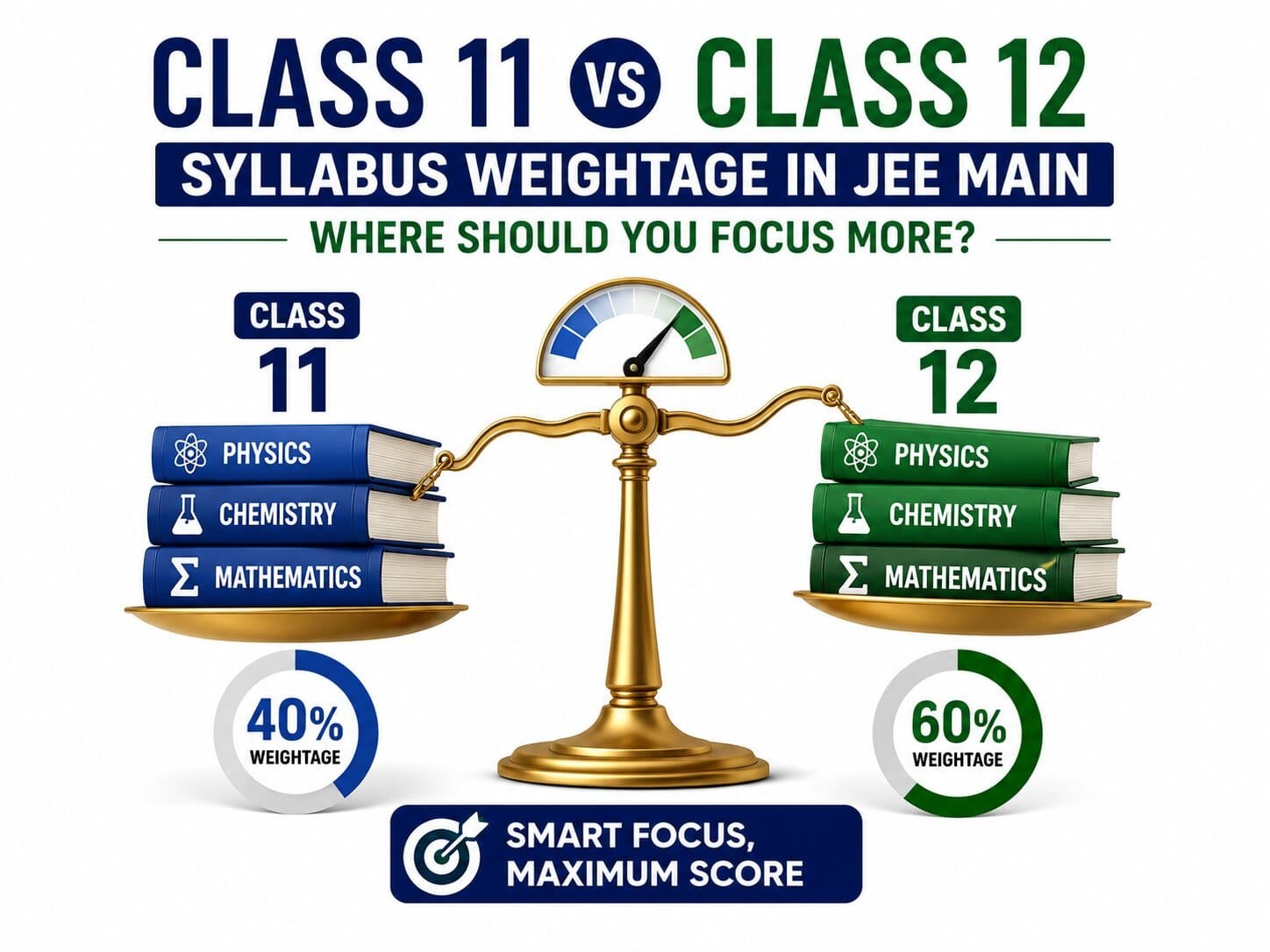
JEE Main weightage between Class 11 and Class 12 syllabus is not equal, and this single fact changes how a serious aspirant should plan revision. Class 12 topics carry a slightly higher share of questions in Physics, Chemistry, and Mathematics, but Class 11 concepts form the base on which almost every Class 12 chapter depends. Students who ignore Class 11 to "save time" for Class 12 end up losing marks in exactly the areas they thought they had covered, because the exam rarely tests a Class 12 chapter in isolation from its Class 11 prerequisite.
This imbalance in preparation is one of the most common reasons rank improvement stalls between attempts. A student can spend six months exclusively on Class 12 chapters, feel fully prepared on paper, and still see their score plateau, simply because the Class 11 base required to solve advanced Class 12 problems was never refreshed. Understanding subject-wise and chapter-wise weightage, and building a revision plan around it, is what separates a 95-percentile aspirant from a 99-percentile one.
Overall Class 11 vs Class 12 Weightage in JEE Main
Across the last several years of JEE Main question papers, the general split has stayed fairly consistent: Class 12 syllabus contributes roughly 55 to 60 percent of the paper, while Class 11 syllabus accounts for the remaining 40 to 45 percent. This ratio, however, varies noticeably by subject, and treating all three subjects the same way is itself a planning mistake many aspirants make.
Physics: Class 12 topics dominate, especially Electrodynamics, Modern Physics, and Optics, but Class 11 Mechanics remains the single most-tested chapter group when counted across years • Chemistry: Physical Chemistry from Class 11 (Mole Concept, Equilibrium, Thermodynamics) remains heavily tested and often carries more direct weightage than several Class 12 chapters combined • Mathematics: Class 11 chapters like Sets, Relations, Sequences and Series, and Straight Lines form the backbone of Class 12 Calculus and Coordinate Geometry questions, meaning a Class 11 gap shows up as a Class 12 score loss • Class 11 concepts often appear indirectly, embedded inside Class 12 numericals, rather than as standalone questions, which is why students underestimate how much Class 11 actually matters • The weightage split can shift by a few percentage points year to year depending on paper-setting trends, but the underlying dependency structure between the two years does not change
Physics: Class 11 vs Class 12 Chapter Weightage
Physics is where the Class 11 foundation matters the most, even though the highest-weightage chapters technically belong to Class 12. Mechanics, taught entirely in Class 11, underpins almost every rotational motion and gravitation problem asked from the Class 12 portion. Skipping Class 11 Mechanics revision is one of the fastest ways to lose 8 to 12 marks, because Rotational Motion, System of Particles, and Gravitation in Class 12 are essentially extensions of Class 11 force and energy concepts rather than new topics.
High-weightage Class 12 chapters: Current Electricity, Electrostatics, Magnetism, Modern Physics, Optics • High-weightage Class 11 chapters:
Kinematics, Laws of Motion, Work Energy Power, Rotational Motion, Gravitation, Thermodynamics and Kinetic Theory of Gases (Class 11) frequently combine with Class 12 Thermodynamics questions in mixed-concept problems, and examiners often test both in a single multi-part numerical • Waves and Oscillations (Class 11) is a direct prerequisite for Class 12 Optics and Electromagnetic Waves, since wave behaviour, frequency, and interference concepts carry over directly • Units, Dimensions, and Error Analysis from early Class 11 continue to appear as short, easy-to-miss questions throughout the paper, and are frequently ignored during Class 12-focused revision • Numerical-heavy chapters like Rotational Motion draw on Class 11 concepts of torque, moment of inertia, and center of mass, so a weak Class 11 base directly caps performance in what is otherwise a high-scoring Class 12 chapter
Chemistry: Class 11 vs Class 12 Chapter Weightage
Chemistry rewards aspirants who treat Class 11 and Class 12 as one continuous syllabus rather than two separate years. Physical Chemistry, largely built in Class 11 through Mole Concept, Atomic Structure, Chemical Bonding, and Equilibrium, is tested almost every year with 4 to 6 direct questions, and its formulas resurface inside Class 12 Electrochemistry and Chemical Kinetics numericals. A student who has not internalised Mole Concept calculations from Class 11 will struggle to solve even straightforward Class 12 Electrochemistry problems, since both rely on the same underlying stoichiometric logic.
High-weightage Class 12 chapters: Coordination Compounds, Electrochemistry, Chemical Kinetics, p-Block Elements • High-weightage Class 11 chapters: Mole Concept, Chemical Bonding, Equilibrium, Redox Reactions, Periodic Table • Organic Chemistry basics from Class 11 (IUPAC Nomenclature, GOC) are non-negotiable for scoring in Class 12 Organic reactions, since reaction mechanisms in Class 12 assume fluency with Class 11 fundamentals • Inorganic Chemistry is memory-heavy across both years and should be revised together, not split by class, because periodic trends taught in Class 11 directly explain the reactivity patterns tested in Class 12 • States of Matter and Chemical Thermodynamics from Class 11 build the conceptual base for Class 12 Solutions and Electrochemistry, two chapters that together carry significant weightage • Equilibrium, one of the most conceptually dense Class 11 chapters, resurfaces almost every year in questions that blend Ionic Equilibrium with Class 12 Electrochemistry concepts
Mathematics: Class 11 vs Class 12 Chapter Weightage
Mathematics has the tightest dependency chain of the three subjects. Calculus, which carries the single largest weightage in Class 12, is built entirely on Class 11 foundations in Functions, Limits, and Trigonometry. A student weak in Class 11 Trigonometric Identities will consistently struggle with Class 12 Integration, regardless of how much time they spend on Class 12 alone. This is arguably the subject where Class 11 revision has the highest return on time invested, because nearly every high-weightage Class 12 chapter traces back to a specific Class 11 chapter.
High-weightage Class 12 chapters: Integral Calculus, Differential Equations, Vectors and 3D Geometry, Matrices and Determinants • High-weightage Class 11 chapters: Sequences and Series, Permutations and Combinations, Straight Lines, Conic Sections, Trigonometric Functions • Complex Numbers and Quadratic Equations (Class 11) directly feed into Class 12 Algebra questions, particularly in problems combining roots, coefficients, and inequalities • Statistics and Probability, though smaller in weightage, are almost always asked from a Class 11 base with Class 12 extensions, so revising both together avoids duplicated effort • Straight Lines and Conic Sections in Class 11 form the geometric groundwork for Class 12 Three-Dimensional Geometry, and students who rush through 2D geometry often find 3D Geometry disproportionately difficult • Binomial Theorem, taught in Class 11, is a recurring standalone topic and also supports several Class 12 Calculus approximations, making it a high-leverage chapter to keep sharp through the year
Common Preparation Mistakes Around This Weightage
Most aspirants do not lose marks because they lack knowledge of Class 12 chapters. They lose marks because their Class 11 base has quietly eroded by the time the exam approaches, and this gap only becomes visible when a mixed-concept question exposes it. A few patterns show up repeatedly among students whose scores plateau despite consistent effort.
Treating Class 11 as "done" after board exams and never returning to it until the final few weeks before JEE Main, by which point the concepts have faded • Solving Class 12 numericals mechanically without recognising which Class 11 formula or concept the question is quietly testing underneath • Spending disproportionate time on high-weightage Class 12 chapters while completely skipping lower-weightage but foundational Class 11 chapters like Units and Measurements or Thermal Properties of Matter • Revising Class 11 and Class 12 as two separate syllabi with separate timelines, instead of mapping dependent chapters together in one integrated schedule • Assuming that because a Class 11 chapter carries fewer direct questions, it is less important, without accounting for how often it appears indirectly inside Class 12 problems
How to Structure Your Revision Around This Weightage
The most efficient JEE Main revision plan does not treat Class 11 and Class 12 as separate blocks of time. Instead, it links them chapter by chapter, so that a Class 11 topic is revised right before its dependent Class 12 topic. For instance, revising Straight Lines and Conic Sections just before starting 3D Geometry, or revisiting Mole Concept before Electrochemistry, creates a compounding effect on recall and problem-solving speed. This kind of paired revision also makes practice sessions far more efficient, since solving a Class 12 question immediately reinforces the Class 11 concept it depends on.
Allocate roughly 55 percent of revision time to Class 12 chapters and 45 percent to Class 11 chapters, not the reverse, since the dependency runs from Class 11 into Class 12 rather than the other way around • Never skip Class 11 Physical Chemistry and Class 11 Trigonometry, since these silently determine Class 12 scores across multiple chapters • Attempt previous years' questions chapter-wise to identify which Class 11 concepts keep reappearing inside Class 12 problems, and build a personal list of these recurring dependencies • Keep a single formula sheet spanning both years for Physics and Mathematics, since JEE Main rarely tests a concept in isolation and mixed-chapter problems are increasingly common • Schedule at least one Class 11 revision cycle in the final two months before the exam, even if Class 12 chapters feel like the priority, so that foundational recall stays sharp under exam conditions • Use mock tests specifically to flag which errors trace back to a weak Class 11 concept rather than a Class 12 one, since the fix for each is different
Once the syllabus weightage is clear, the next question most aspirants ask is how their expected score converts into rank and percentile. This is where preparation planning should shift from syllabus coverage to score interpretation, and understanding how JEE Main marks translate into rank and percentile helps set realistic, chapter-linked targets rather than vague overall goals.
Don't Miss the Deleted Syllabus Topics
Weightage patterns also shift whenever NTA revises the syllabus, and preparing from an outdated chapter list is a common, avoidable mistake that wastes valuable revision time on both Class 11 and Class 12 fronts. Before finalising a revision plan across Class 11 and Class 12, it is worth cross-checking the current syllabus against the officially removed topics from Physics, Chemistry, and Mathematics, so that no time is spent revising chapters that will not appear in the exam at all. This is especially relevant for Class 11, where older reference material and coaching notes sometimes still include chapters that have since been trimmed from the official syllabus.
West Bengal Aspirants: WBJEE Runs Parallel
Students preparing in West Bengal are usually attempting JEE Main alongside WBJEE, and the Class 11 vs Class 12 weightage differs slightly between the two exams, which makes a shared revision strategy even more valuable than preparing for each exam separately. Before splitting revision hours, it helps to review this detailed WBJEE vs JEE Main comparison of difficulty level, question pattern, and marking scheme, so that chapter-wise preparation serves both exams instead of only one. For those also mapping out admission options within the state, this guide to the best engineering colleges in West Bengal via WBJEE is a useful companion resource once the exam-side planning is in place.
The Bottom Line
Class 12 syllabus carries a marginally higher share of JEE Main questions, but Class 11 is what makes those Class 12 questions solvable. Aspirants who revise both years as one connected syllabus, rather than two separate ones, consistently outperform those who treat Class 11 as "finished business." The highest-scoring students are rarely the ones who know the most Class 12 formulas; they are the ones whose Class 11 foundation is strong enough that Class 12 concepts click quickly and stay retained under exam pressure.
Article Stats
You Might Also Like

What Is the MS Course? A Complete Guide to Introduction, Eligibility, NEET PG Counselling and Preparation

What Is the MD Course? A Complete Guide to Introduction, Eligibility, NEET PG Counselling and Preparation
Tripura MBBS BDS Round 3 Re-Revised Schedule 2026: Choice Filling, Merit List, Allotment and Admission Dates