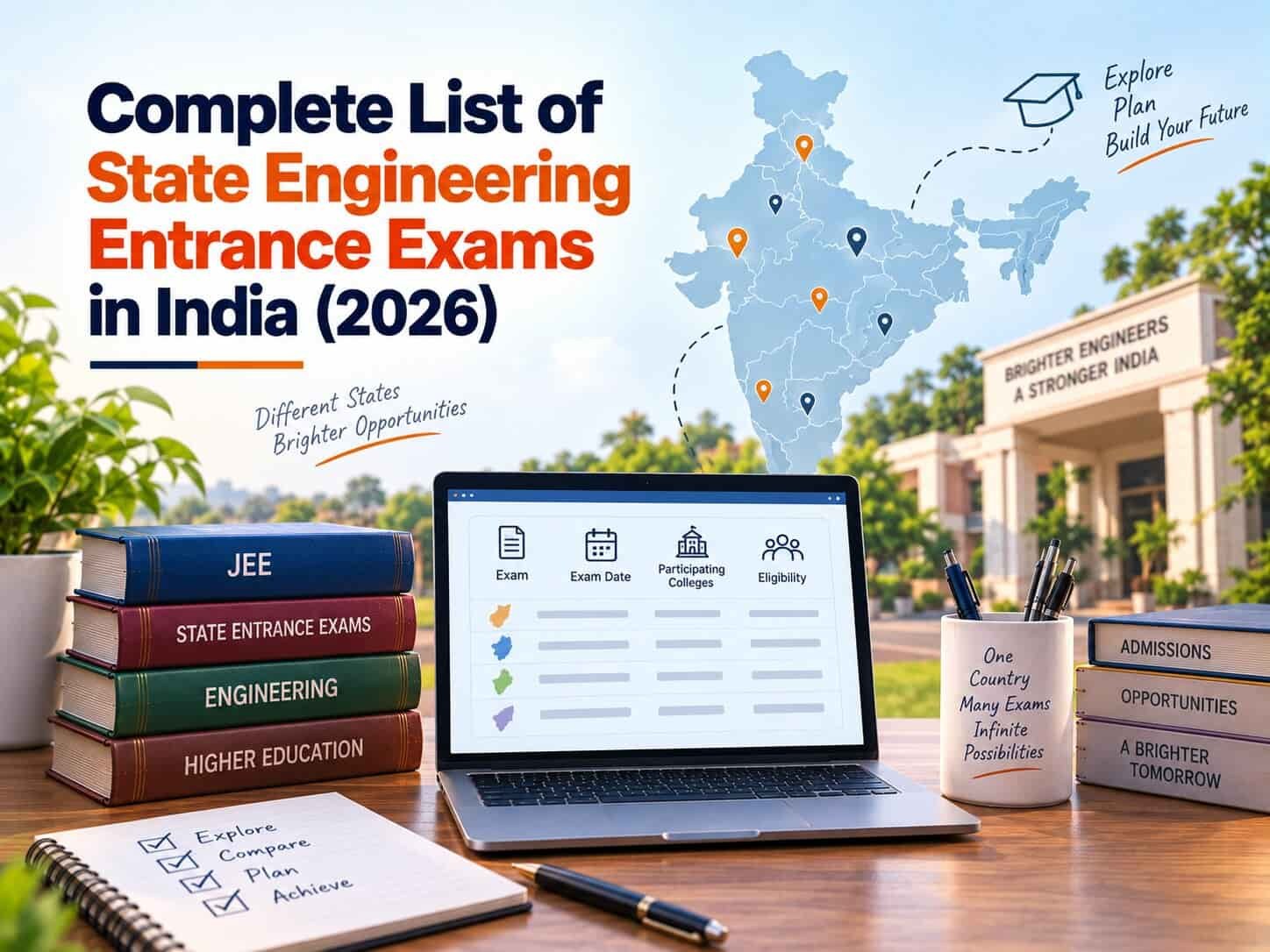
Overview
Beyond JEE Main and JEE Advanced, nearly every Indian state conducts its own engineering entrance exam, commonly called a state CET (Common Entrance Test), to admit students into state government and state-quota private engineering colleges. These state-level exams are typically based on the respective state board's Class 11-12 syllabus, often carry no negative marking, and remain the primary admission route for students targeting colleges within their home state specifically. Here's a complete, state-wise list of the major engineering entrance exams active in India for 2026.
Type
These are state-level, government-conducted entrance exams for undergraduate engineering (B.E./B.Tech) admission.
Most are valid only within the conducting state, unlike JEE Main, which has nationwide validity for NITs, IIITs, and GFTIs.
Several states also run a separate exam specifically for private engineering colleges within the state, distinct from the main state CET.
State-Wise List of Engineering Entrance Exams (2026)
Maharashtra – MHT CET (Maharashtra Common Entrance Test): Conducted by the State Common Entrance Test Cell/DTE Maharashtra, held across two sessions (April and May), with the first session mandatory and the second optional for score improvement.
West Bengal – WBJEE (West Bengal Joint Entrance Examination): Conducted by the West Bengal Joint Entrance Examinations Board (WBJEEB) for Engineering, Technology, Pharmacy, and Architecture courses; held as a pen-and-paper exam, unlike most other state CETs which have moved to computer-based testing.
Karnataka – KCET (Karnataka Common Entrance Test): Conducted for admission to engineering, medical, dental, and other professional courses in Karnataka, typically held in April.
Karnataka – COMEDK UGET: A separate entrance test specifically for private engineering, medical, and dental colleges in Karnataka under the COMEDK consortium, typically held in May.
Kerala – KEAM (Kerala Engineering, Architecture, Medical): Conducted for engineering and allied courses across Kerala, typically held in April.
Andhra Pradesh – AP EAPCET (formerly AP EAMCET): The state-level entrance exam for engineering, agriculture, and pharmacy courses in Andhra Pradesh.
Telangana – TS EAMCET: The state-level entrance exam for engineering, agriculture, and pharmacy courses in Telangana.
Gujarat – GUJCET: Conducted for admission to engineering and pharmacy courses within Gujarat.
Odisha – OJEE (Odisha Joint Entrance Examination): Conducted for engineering, pharmacy, and lateral-entry admissions in Odisha; also handles JELET-equivalent lateral entry routes for diploma holders.
Jammu & Kashmir – JKCET: The state-level engineering entrance exam for Jammu & Kashmir.
Tamil Nadu – TNEA (Tamil Nadu Engineering Admissions): Distinct from most other states, TNEA does not use a separate written entrance test - admission is based directly on Class 12 marks under the Tamil Nadu Engineering Admissions counselling process.
Key Details Worth Knowing
Most state CETs – including MHT CET, KCET, COMEDK UGET, and SRMJEEE-style private exams – carry no negative marking, unlike JEE Main and JEE Advanced
WBJEE remains a pen-and-paper exam, while most other state CETs have shifted to Computer-Based Testing (CBT) format.
State CET scores are generally valid only for colleges within that specific state — an MHT CET score, for instance, is not accepted by Karnataka or West Bengal colleges, and vice versa.
Some states no longer run their own separate state-level exam and instead admit engineering students directly using JEE Main scores through their own state counselling process – Uttar Pradesh and Bihar are commonly cited examples of this approach in recent cycles.
Several private universities – including VIT (VITEEE), SRM (SRMJEEE), BITS Pilani (BITSAT), and KIIT (KIITEE) - conduct their own separate institute-level entrance tests that exist alongside, not instead of, state CETs.
Domicile or residency requirements typically apply for a candidate to be eligible for a given state's home-state quota seats through that state's CET.
Key Eligibility (General Pattern Across Most State CETs)
Candidates must have passed or be appearing for Class 12 (or equivalent) with Physics, Chemistry, and Mathematics as core subjects.
A minimum aggregate percentage, commonly in the range of 45-50% in Mathematics and Physics/Chemistry combined, is typically required, varying by state.
Most state CETs additionally require the candidate to be a domicile or resident of that specific state to be eligible for state-quota seats, though some allow limited participation from outside-state candidates under separate quotas.
Exact eligibility criteria, minimum percentage requirements, and category-wise relaxations differ from state to state and should be verified against each exam's official notification.
What to Do Now
Identify which state CET applies to your home state, and check its specific eligibility criteria and exam pattern on the official conducting body's website.
If you're open to colleges in more than one state, consider appearing for JEE Main alongside your relevant state CET, since JEE Main additionally opens up NIT, IIIT, and GFTI admissions nationwide.
Since most state CETs follow the respective state board's syllabus closely, tailor your preparation resources accordingly rather than relying solely on generic, JEE-focused study material.
Once your state CET result is out, comparing realistic college and branch options against verified cutoff trends can help you build a well-grounded counselling choice list.
Keep exam dates for your relevant state CET and any parallel exams (JEE Main, private university tests) clearly noted, since application windows across these exams often overlap.
Key Things to Remember
Major state engineering entrance exams for 2026 include MHT CET (Maharashtra), WBJEE (West Bengal), KCET & COMEDK UGET (Karnataka), KEAM (Kerala), AP EAPCET (Andhra Pradesh), TS EAMCET (Telangana), GUJCET (Gujarat), OJEE (Odisha), and JKCET (Jammu & Kashmir).
Tamil Nadu (TNEA) admits based on Class 12 marks rather than a separate written entrance exam.
Most state CET scores are valid only within that specific state, unlike JEE Main's nationwide validity for centrally-funded institutes.
Some states, including Uttar Pradesh and Bihar, have moved to admitting engineering students directly through JEE Main scores rather than running their own separate state exam.
This article is based on commonly reported state-level engineering entrance exams active for the 2026 admission cycle. Candidates should verify exact exam dates, eligibility criteria, and any changes to a state's admission process directly through the official conducting body's website for their specific state.
Article Stats
You Might Also Like

What Is the MS Course? A Complete Guide to Introduction, Eligibility, NEET PG Counselling and Preparation

What Is the MD Course? A Complete Guide to Introduction, Eligibility, NEET PG Counselling and Preparation
Tripura MBBS BDS Round 3 Re-Revised Schedule 2026: Choice Filling, Merit List, Allotment and Admission Dates