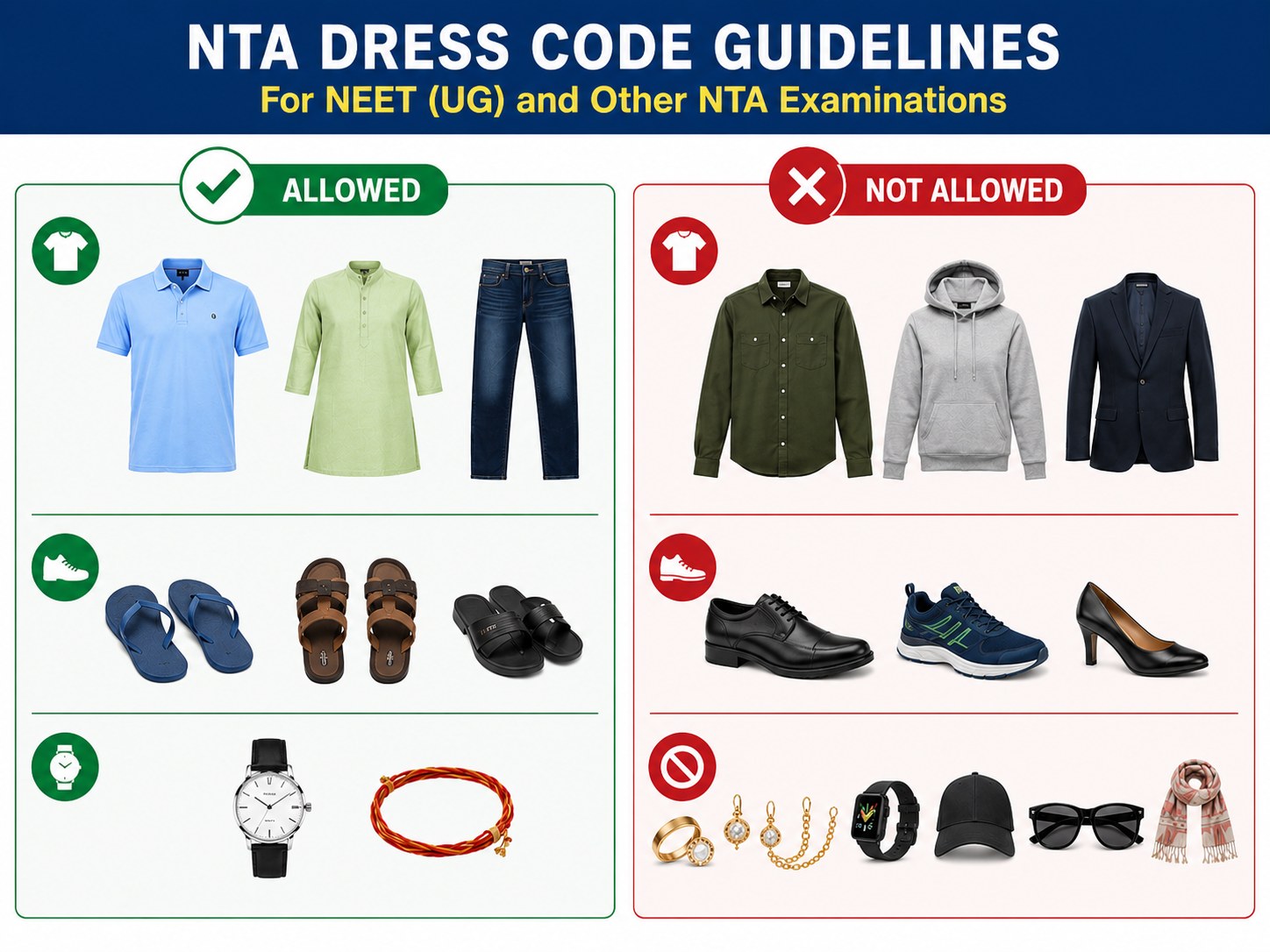
NTA Issues Strict Dress Code for NEET UG 2026, Violations May Cost Students their seats with NEET UG 2026 approaching, the National Testing Agency has drawn a hard line on what students can and cannot wear inside exam centres this year. The rules are detailed, the enforcement will be strict, and for the thousands of medical aspirants preparing across the country, ignoring them is not an option.
The NTA has made it clear that candidates found violating the dress code on exam day risk being denied entry or facing outright disqualification. For students who have spent months, sometimes years, preparing for one of India's most competitive exams, a wardrobe mistake on exam day would be nothing short of a disaster.
Why the NTA Is Cracking Down
The dress code is not new, but enforcement has grown stricter in recent years, and for good reason.
Past NEET cycles have seen reported attempts at organised cheating, including the use of hidden Bluetooth devices, micro earphones tucked into clothing, and electronic gadgets disguised as everyday accessories. The 2024 NEET paper leak controversy, which shook the country and triggered widespread protests, only increased the pressure on NTA to tighten examination security at every level.
The dress code is one part of that larger security effort. When students wear simple, light clothing with no metallic accessories, security personnel can complete frisking quickly, efficiently, and without ambiguity. Complicated clothing means complicated checks, and that, the NTA has decided, is a risk it is no longer willing to take.
What Candidates Must Wear
The NTA's instructions are straightforward: dress light, dress plain, dress simple.
Half-sleeve clothing is strongly recommended; full sleeves slow down security checks and may invite extra scrutiny
Light, thin fabric such as cotton is ideal; heavy or padded material is not
Plain outfits without decorative layers, thick lining, or complex stitching
No large buttons, metallic fasteners, or heavy embroidery on any garment
Slippers or sandals with flat, low soles, the simpler, the better.
On footwear specifically, the NTA has been explicit. Shoes, especially those with thick soles, are not permitted. The concern is that thick-soled footwear can be used to conceal items. Candidates who habitually wear sports shoes or formal shoes should switch to flat sandals or slippers and get comfortable wearing them well before exam day.
What Candidates Cannot Wear
The following are either prohibited or strongly advised against:
Full-sleeve shirts, jackets, hoodies, or any layered clothing
Clothes with heavy embroidery, large decorative buttons, or metallic design elements
Shoes or thick-soled footwear of any kind
Caps or head coverings (except those worn for religious reasons, see below)
Scarves or stoles that are not part of religious or customary dress
The Accessory Ban: No Exceptions
Perhaps the strictest part of the dress code concerns accessories, and the NTA has left no room for negotiation here.
Every kind of accessory is banned. This includes:
Wristwatches, digital watches, smartwatches, and fitness bands.
Chains, necklaces, rings, bracelets, bangles, and earrings.
Metallic hairpins, clips, or hair accessories
Belt buckles or any metallic clothing fasteners.
The reasoning is straightforward. Modern cheat devices have become remarkably small. A ring can carry a microchip. A fitness band can double as a receiver. Even hairpins have been flagged at exam centres in past years. The NTA is not taking chances, and candidates should not either.
The advice is simple: leave everything at home. If you wear religious jewellery daily, make alternate arrangements for exam day. If you wear a watch out of habit, get used to going without it.
Religious and Customary Dress: You Can Wear It, But Come Early
The NTA has explicitly made room for students who wear religious or customary clothing, including the hijab, turban, dupatta, or similar garments. These candidates will not be asked to remove their religious attire.
However, there is one firm condition attached:
These candidates must arrive at the exam centre by 12:30 PM a full hour before the standard reporting time.
This additional hour is set aside for a more thorough security check. It is not a penalty, it is a process. But it is non-negotiable. Students who arrive at the standard reporting time wearing religious dress may face delays that could affect their ability to sit the exam.
If this applies to you, plan your commute accordingly. Add extra buffer time. Do not rely on arriving exactly at 12:30 PM; aim to be there earlier.
What You Cannot Bring Into the Exam Hall
The restrictions go beyond clothing. The following items are completely banned from the examination room:
Electronic devices:
- Mobile phones and feature phones
- Bluetooth devices, wireless earphones, earbuds
- Calculators
- Smartwatches and digital watches
- Any portable electronic gadget of any kind
Personal items:
Handbags, backpacks, purses, and wallets
Belts
Sunglasses and spectacle cases (prescription glasses for vision are generally allowed, but will be checked)
Study and stationery materials:
Books, notes, printed papers, or rough sheets of any kind
Any loose paper
Food and drink:
Water bottles and food items are not permitted inside the exam room
Candidates with medical conditions requiring food or medication must obtain written prior approval from the NTA
What Happens at the Gate: The Security Process
Every candidate, without exception, will be frisked at the exam centre entrance using handheld metal detectors. Separate arrangements will be in place for male and female candidates.
For those who have followed the dress code, this process should take no more than a minute or two. For those wearing restricted items or carrying banned accessories, it will take significantly longer and may result in being turned away.
The admit card matters here, too. Candidates must read their admit card carefully before exam day. It contains centre-specific instructions that are binding, and any special guidelines printed on it take precedence over general rules.
Students With Medical Conditions
Students who require special accommodation, whether that means wearing specific clothing, carrying medical devices, or bringing food or medication into the exam, must contact the NTA in advance and secure written permission.
There will be no on-the-spot exceptions made at exam centres. Security personnel at the gate are following fixed protocols and do not have the authority to override them for individual cases. Approaching the centre on exam day without prior clearance and expecting an exception is a risk no student should take.
The Bottom Line
NEET UG 2026 is, for many students, the most important exam of their lives so far. The NTA's dress code rules exist to protect the exam, to ensure that no candidate gains an unfair advantage, and that every student who has worked hard gets a fair shot.
The rules are not complicated. Half-sleeve, light, plain clothing. Flat sandals. No jewellery. No accessories. No electronics. No bags.
Plan your exam-day outfit now, not the night before, and certainly not the morning of. Wear it a day or two in advance if needed, just to make sure everything feels right and nothing needs to be reconsidered.
Walk into that exam hall with nothing on your mind except the paper in front of you. That is exactly what all of this is designed to make possible.
Article Stats
You Might Also Like
What Is the MS Course? A Complete Guide to Introduction, Eligibility, NEET PG Counselling and Preparation
What Is the MD Course? A Complete Guide to Introduction, Eligibility, NEET PG Counselling and Preparation
Tripura MBBS BDS Round 3 Re-Revised Schedule 2026: Choice Filling, Merit List, Allotment and Admission Dates