More than 22 lakh students appeared for the Re-NEET UG 2026 on June 21. The result is expected by July 20. And the question that sits behind every score calculation, every rank estimate, and every counselling conversation is a simple one: how many seats are actually available?
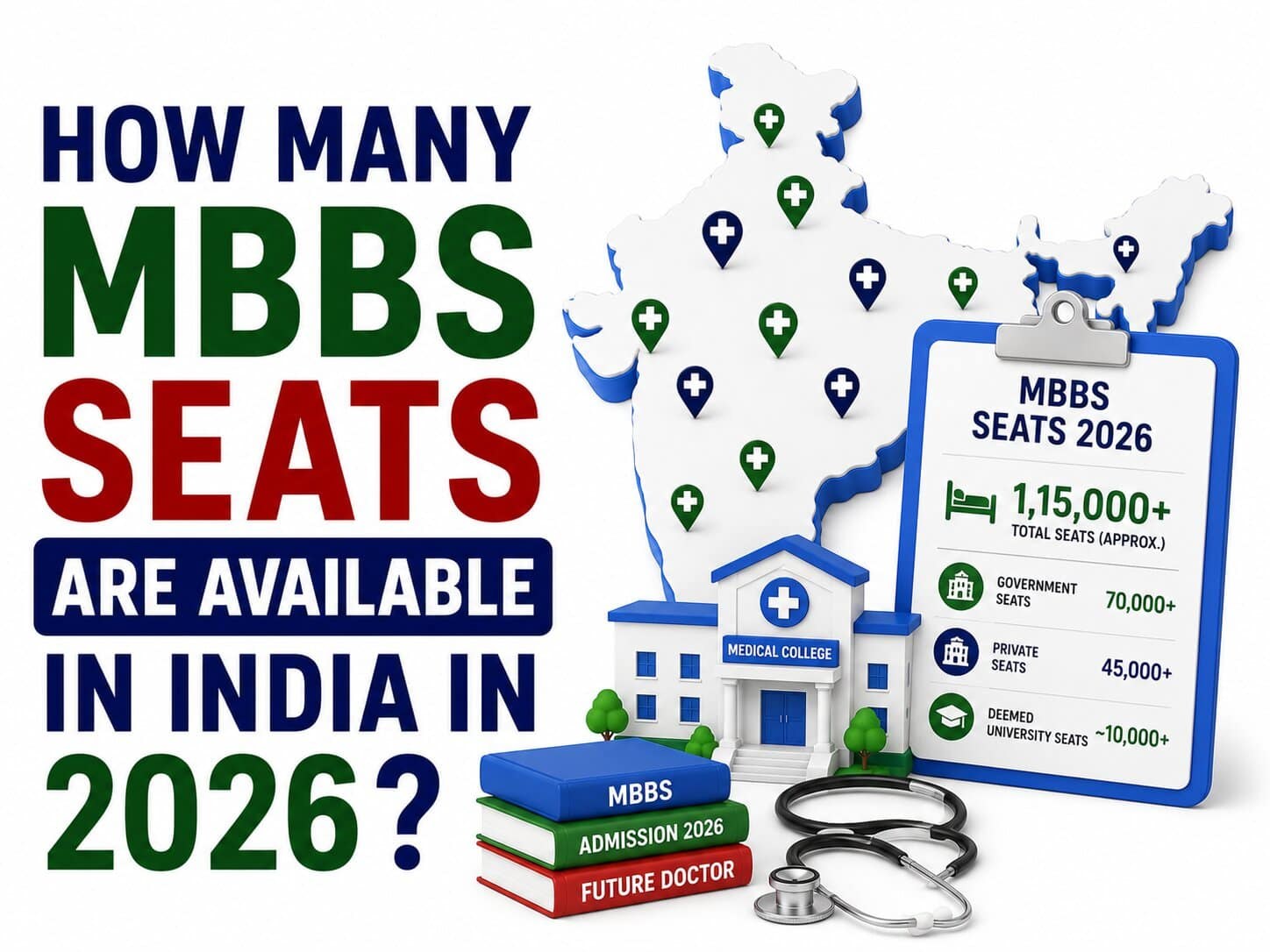
The answer, as of the 2026 academic session, is 1,29,603 MBBS seats across 824 medical colleges in India. That figure is the highest in the country's history, and it represents a significant expansion from the 1,18,190 seats available in the previous session. The National Medical Commission added 11,413 new seats and approved 43 new medical colleges in a single cycle — the largest single-year increase in recent memory.
Understanding what is inside that number — how many are in government colleges, how they are distributed across states, how they flow through different quota categories, and what seat availability actually means for your specific rank and category — is the foundation of any serious counselling strategy. Here is the complete breakdown.
The Top-Line Numbers: Government vs Private
Of the 1,29,603 total MBBS seats in India in 2026, approximately 63,683 are in government medical colleges — including all AIIMS campuses, JIPMER, ESIC institutions, AFMC, and central universities — and approximately 65,920 are in private and deemed universities. For the first time, private and deemed university seats marginally outnumber government seats in the overall national count. This does not mean private MBBS is more accessible — it means the private sector has grown faster, and with it, the gap in fee structures between the two tracks has become even more pronounced.
Government seats are distributed across approximately 456 government medical colleges. Private and deemed seats span 368 private institutions. The colleges range from the country's most prestigious central institutions — AIIMS New Delhi, JIPMER Puducherry — down to recently established private medical colleges in Tier 2 and Tier 3 cities still building out their hospital infrastructure and faculty strength.
The important qualifier on all these numbers: the NMC seat matrix is updated periodically, and individual college seat counts can change between the time of NMC approval and the actual MCC counselling round. The seat matrix released by MCC on mcc.nic.in at the time of counselling is the authoritative final figure. The national numbers provide a landscape view. The college-specific and state-specific counselling seat matrix provides the actionable data.
How These Seats Are Divided: AIQ, State Quota, and Institutional Quota
The 1,29,603 total seats do not all flow through the same admission pipeline. Understanding how they are divided across different counselling authorities is essential for building a realistic strategy.
All India Quota (AIQ) — 15% of government seats: Approximately 9,553 government MBBS seats are pooled under the All India Quota and allotted through centralised MCC counselling at mcc.nic.in. These seats are open to candidates from any state on the basis of NEET AIR. AIQ also covers 100% of seats in AIIMS (2,257 seats across 20 campuses), both JIPMER campuses (243 seats), ESIC institutions, AFMC, and central universities including BHU and AMU. For the most competitive seats in Indian medical education — AIIMS Delhi's 132 seats requiring AIR within the top 100 for General category — AIQ is the only pathway.
State Quota — 85% of government seats: The remaining 85% of government college seats — approximately 54,130 seats — are allotted through respective state counselling authorities and are primarily reserved for domicile candidates of that state. For West Bengal, this means WBMCC manages state quota admissions across government medical colleges in the state. For Karnataka, it is KEA. For Tamil Nadu, the DME. Each state runs its own registration, choice-filling, and allotment process on a schedule that runs parallel to or immediately after MCC AIQ rounds.
Private and Deemed University Seats: The 65,920 private seats flow through both MCC (for deemed universities under the central pool) and state counselling authorities (for state-private colleges). Management quota seats within private colleges — typically 15% of sanctioned intake — are filled through institutional admission processes rather than centralised counselling, with fees substantially higher than NRI or government quota.
NRI Quota: 15% of seats in private and deemed universities are reserved for NRI candidates, filled through MCC or institutional processes depending on the college type.
Reservation Distribution: How Seats Are Allocated by Category
The constitutional reservation framework applies across all government college seats in both AIQ and state quota, with slight variations between the two tracks.
Under the central government framework governing AIQ and centrally funded institutions, the reservation breakdown is:
OBC (Other Backward Classes): 27% of seats
SC (Scheduled Caste): 15% of seats
ST (Scheduled Tribe): 7.5% of seats
EWS (Economically Weaker Section): 10% of seats
General/UR: 40.5% of seats
PwD (Persons with Disability): 5% horizontal reservation across all categories
State quota reservation norms follow state government policy, which may differ from the central framework — particularly for OBC sub-categories, which vary significantly by state. Some states have their own OBC-A and OBC-B sub-classifications, as West Bengal does, with different percentage allocations. Understanding the specific reservation structure in your target state is essential before mapping realistic seat availability at your category rank.
For the 1,29,603 total seats, this reservation framework means that a General category candidate with a strong NEET AIR is competing for approximately 40% of government seats — roughly 25,473 government seats nationally — while OBC candidates access approximately 17,194 reserved government seats through their category rank. These numbers underscore why category rank is often more strategically important than AIR for reserved category candidates, particularly at mid-range NEET scores.
Several patterns in this data matter for counselling strategy.
Karnataka dominates in total seats primarily because of its private medical sector — 9,845 private seats, the highest of any state in India. For candidates who miss government cutoffs but can manage private MBBS fees, Karnataka's 49 private colleges offer the widest range of options of any state. However, Karnataka also has some of the highest private MBBS fee structures in the country, with total course costs at premium institutions exceeding ₹80 lakh.
Uttar Pradesh leads in government seats at 5,925 across 51 government medical colleges — the highest government seat count of any state. This makes UP particularly important for mid-range NEET scorers targeting affordable government MBBS through AIQ, since more seats means more rank positions at which the state's colleges close.
Tamil Nadu is notable for having 78 government medical colleges — the highest number of government colleges in any single state — though some do not participate in AIQ, making Tamil Nadu state quota seats primarily accessible to Tamil Nadu domicile candidates.
Delhi has only approximately 200 private MBBS seats, which explains why Delhi-domicile students face some of the fiercest competition in the country for government seats. A rank that might secure a government seat in UP or Rajasthan through AIQ will not secure a government seat in Delhi.
For West Bengal students, the state has approximately 3,800 total MBBS seats — roughly 2,300 in government institutions and 1,500 in private colleges. Understanding the top medical colleges in West Bengal and their specific seat intake, category-wise cut-offs, and historical closing ranks is essential context before building a West Bengal-focused choice list. The WBMCC counselling guide covers the state quota process in detail, including how state quota seats at West Bengal government institutions are allotted separately from MCC AIQ rounds.
AIIMS: The Most Competitive Seats in India
The 20 AIIMS campuses currently operational across India collectively offer 2,257 MBBS seats. These are among the most sought-after seats in the Indian medical education system — fully government-funded, with fees under ₹2,000 per year, exceptional faculty, and the strongest brand recognition in Indian medicine.
AIIMS New Delhi has 132 seats — the largest intake of any AIIMS campus. For General category candidates, securing a seat at AIIMS Delhi has historically required an AIR within the top 100. The newer AIIMS campuses — Bhopal, Jodhpur, Patna, Bhubaneswar, Raipur, Rishikesh — are accessible at AIRs ranging from approximately 200 to 2,200 for General category, depending on the campus and the category. All AIIMS seats are filled through MCC AIQ counselling; there is no state quota at AIIMS institutions.
For the 2026 cycle, AIIMS seats will be allotted in Round 1 alongside other AIQ seats. Candidates who qualify the AIIMS cutoff should prioritise AIIMS choices at the top of their preference list if they genuinely want to attend — the algorithm will not assign an AIIMS seat unless it appears in the preference list above the actual allotment.
The Seat Growth Story: A Decade of Expansion
The expansion of MBBS capacity in India over the past decade is substantial by any measure. In 2014–15, total MBBS seats in India stood at approximately 54,348. By 2026, that number has grown to 1,29,603 — a 138% increase in twelve years. Government seat growth in the same period went from approximately 30,000 to over 63,000, driven by the establishment of new AIIMS campuses, ESIC colleges, and state government colleges across underserved regions.
The pace of expansion has accelerated in recent years. In 2021–22, total seats were 92,065. By 2025–26, they had reached 1,28,976. The 2026 addition of approximately 5,000 new seats — on top of the 11,220-seat jump in 2025–26 — continues this trajectory. The government has announced plans to establish 157 additional medical colleges in three phases at a total investment of ₹41,332 crore, which will add tens of thousands more seats over the next five to seven years.
This growth matters for current candidates in two ways. More seats means slightly more opportunities at every rank level — particularly in the mid-range where government MBBS is competitive but not impossible. But more seats also means more candidates reach the qualifying threshold each year, and the number of NEET aspirants — over 22 lakh in 2026 — has grown alongside seat expansion. More seats with more candidates does not automatically mean easier admission. It means the competition landscape is larger but proportionally intense.
What Seat Availability Means for Your Rank
The national total of 1,29,603 seats is a useful headline, but the number that actually matters for a given candidate is far smaller and more specific. Your realistic seat universe is determined by:
Your NEET AIR and category rank — which determine which seats you can access at all
Your state domicile — which determines whether you can access state quota seats in your home state
Your category — which determines the reservation bracket you compete in for each seat pool
Your quota eligibility — AIQ, state quota, management quota, or NRI quota
For a General category candidate from West Bengal with an AIR of 30,000, the realistic universe is not 1,29,603 seats. It is a specific subset of AIQ seats at institutions where General category closes at or above AIR 30,000, plus West Bengal state quota seats at institutions where the state merit list closing rank matches the candidate's West Bengal state rank. Understanding how marks translate to rank and which college types are accessible at different rank levels gives that subset a concrete shape.
For an OBC candidate from Rajasthan at a category rank of 8,000, the picture is different — Rajasthan's strong government seat count and a favourable category rank may make government MBBS genuinely accessible in a way that the same AIR might not suggest for a General category student.
The seat matrix — the official document listing every participating college, its seat count by category and quota, and the counselling authority administering it — is the document that converts national seat numbers into actionable intelligence for your specific profile. MCC releases the AIQ seat matrix on mcc.nic.in at the time of counselling. State authorities release their own matrices separately. Understanding how mop-up and stray vacancy rounds work within this matrix — where unfilled seats from Rounds 1 and 2 go, and how they become accessible at lower closing ranks in later rounds — is part of building a complete picture of your actual options.
The Government vs Private Decision: What the Seat Numbers Mean
The near-equal split between government seats (63,683) and private seats (65,920) in 2026 reflects a structural reality in Indian medical education: the government sector cannot alone absorb the demand generated by NEET's massive candidate pool. Private medical colleges exist because there is genuine excess demand for MBBS training that government infrastructure cannot meet.
For students, this split means the government-private decision is unavoidable for a large portion of candidates. The criteria for making it well are not complicated, but they require honest analysis.
Government MBBS costs as little as ₹10,000 to ₹1,00,000 per year in tuition at most state government colleges. Private MBBS costs typically range from ₹8 lakh to ₹20 lakh per year in tuition alone, with total course costs across the full programme landing between ₹60 lakh and over ₹1 crore at premium institutions. The financial gap is not incidental — it is the primary reason government seats are the first choice for the overwhelming majority of NEET aspirants, and why competition for them is so intense.
For candidates whose rank places them in the zone where government MBBS is uncertain and private MBBS is the realistic backup, the evaluation criteria extend beyond fee: clinical exposure (measured by hospital bed strength and patient load), NMC compliance status, NAAC accreditation, faculty strength, exit exam performance of previous batches, and bond obligations imposed by some private colleges all matter and vary significantly across institutions. A private college with strong infrastructure and genuine clinical exposure at ₹12 lakh per year is a categorically different proposition from one charging the same fees with a teaching hospital that sees limited patient flow.
For West Bengal candidates weighing private MBBS options within the state, understanding the WBMCC seat matrix and the real cost differences between government and private MBBS in West Bengal provides the data layer needed to make this evaluation with facts rather than assumptions.
The Seat You Are Looking For Is in Here
India has 1,29,603 MBBS seats in 2026. For 22.79 lakh candidates who appeared for the Re-NEET, that translates to roughly 1 seat for every 17.5 candidates. Competition for government seats is sharper: approximately 63,683 government seats for 22.79 lakh candidates means roughly 1 government seat for every 35 aspirants.
These ratios make NEET one of the most competitive undergraduate entrance examinations in the world by seat-to-candidate ratio. But ratios are aggregate figures. Your individual seat universe is determined by your specific rank, category, domicile, and quota eligibility — and within that universe, the competition is meaningfully narrower than the national aggregate suggests.
The Re-NEET 2026 result arrives by July 20. When it does, your AIR and category rank will convert the abstract national seat count into a specific, personalised list of realistic options. The counselling process that follows — from MCC AIQ registration to WBMCC state quota choice-filling — moves quickly from that point. Candidates who understand the seat landscape before results arrive are in a materially better position to build a counselling strategy than those who begin researching from zero after the result is declared.
Understanding what your score means for your rank and college options is the natural next step from here. The seat numbers tell you what exists. Your rank tells you what is accessible. And a well-built counselling strategy — grounded in both — is what converts accessibility into a confirmed admission.
For students also navigating WBJEE 2026 counselling alongside NEET, the timeline coordination between these two processes in 2026's compressed calendar is an additional planning variable worth addressing before either window opens.
All seat figures in this article are based on the latest available NMC data and published analyses as of July 2026. The official NEET UG 2026 seat matrix will be published by MCC on mcc.nic.in at the time of counselling registration. Individual college and state-wise seat counts may change as new approvals are processed by NMC. Always verify final seat availability from the official counselling authority notification before making admission decisions.
Article Stats
You Might Also Like
What Is the MS Course? A Complete Guide to Introduction, Eligibility, NEET PG Counselling and Preparation
What Is the MD Course? A Complete Guide to Introduction, Eligibility, NEET PG Counselling and Preparation
Tripura MBBS BDS Round 3 Re-Revised Schedule 2026: Choice Filling, Merit List, Allotment and Admission Dates