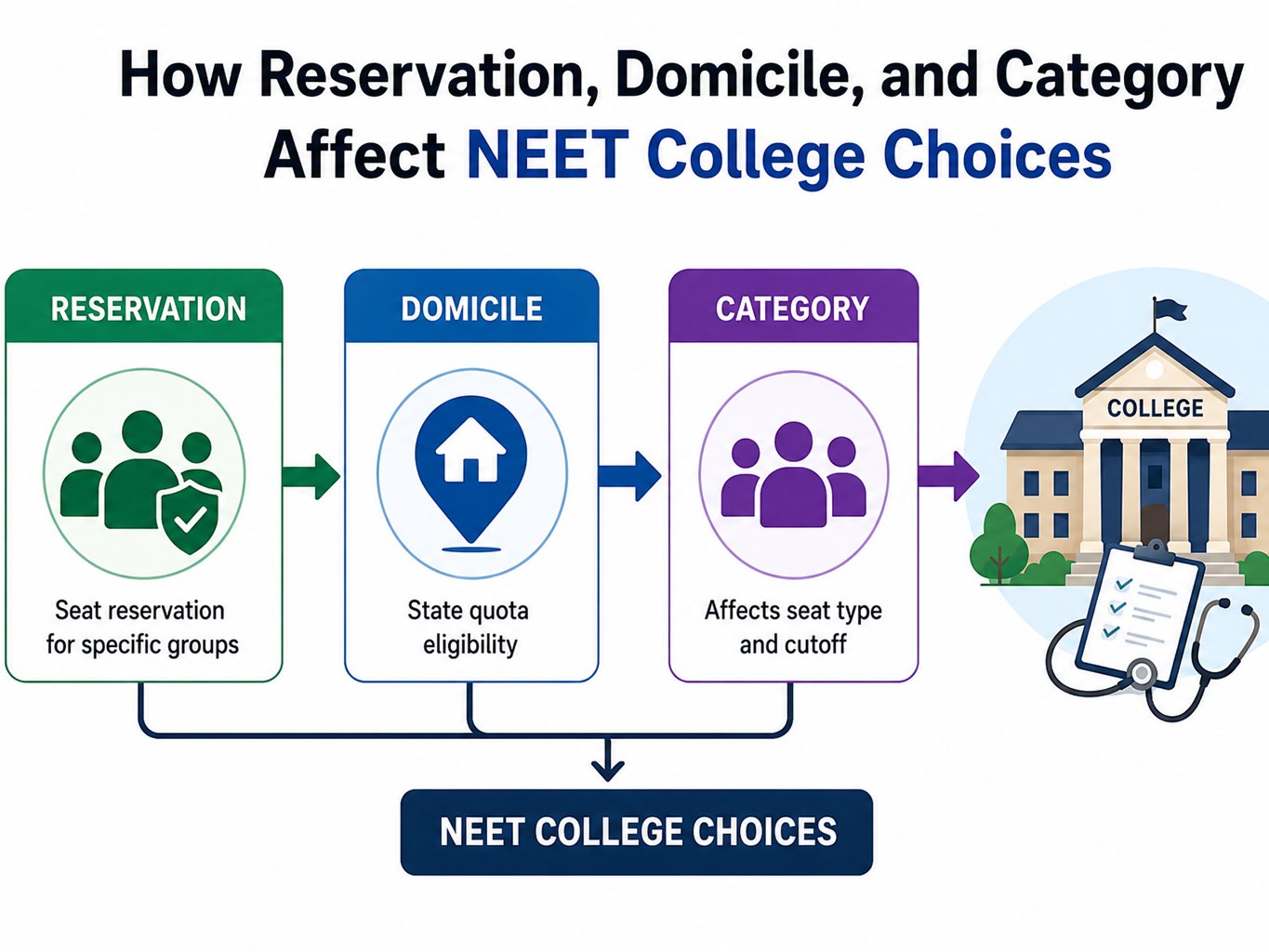
Getting a good NEET score is only the first step in your medical journey. What comes next is the counselling process, where reservation, domicile, and category rules play a major role in deciding your final college. Many students believe that NEET rank alone determines admission, but that is only partly true. Your category, state of residence, certificate status, and quota eligibility directly influence your chances during choice filling and seat allotment.
This blog explains how these rules shape your NEET college choices, helping you understand the system clearly so you can make smart decisions during counselling.
Why Reservation and Domicile Matter in NEET Counselling
Reservation and domicile rules exist to ensure fair opportunities for students from different backgrounds and states. These rules affect who can apply for which seats, what cutoffs look like, and how many medical colleges are realistically reachable for you.
For example, a student may be eligible for many more seats inside their home state than outside it. A reserved category student may get relaxed cutoffs and priority in category-wise counselling. Even small differences in documentation or eligibility can have a huge effect on seat allotment.
Understanding these rules is essential before starting NEET choice filling, because missing information often leads to wrong choices or lost chances.
Understanding the Role of Domicile in NEET College Choices
Your domicile state determines which state’s counselling you can participate in. Each state reserves 85% of its MBBS seats for students who belong to that state. Because of this, domicile gives you a significant advantage during medical admission.
Most states require one or more of the following:
Permanent residence proof
Class 10 or Class 12 completion from that state
State-specific domicile certificate
Parents’ residence or employment documents
Students with correct domicile documents get access to a large pool of seats under the State Quota, often with lower cutoffs than AIQ (All India Quota). This can increase your chances of getting a good government or private college in your home state.
If you do not have a domicile, your NEET college choices become limited in that state, and you can only apply through AIQ, where competition is higher.
Reservation Categories and Their Impact on NEET Admissions
Reservation plays a major role in MBBS admission. Categories such as OBC, SC, ST, EWS, and PwD come with relaxed cutoffs and separate seat lists. Students belonging to these categories benefit from lower closing ranks and higher allotment chances in both AIQ and State Quota counselling.
However, you must have valid certificates issued by authorised bodies. Incorrect documents or certificates not in the required format can make you ineligible for category-wise counselling. Students sometimes lose seats simply because their certificates were outdated, mismatched, or uploaded incorrectly.
Reservations also vary from state to state. A student who comes under OBC in one state may not fall under OBC-NCL for the central list. This is why understanding category rules is essential before applying.
How Category Affects Cutoffs and Seat Chances
The category decides how competitive your counselling journey will be. Each category has its own ranks, and the cutoffs differ greatly. A rank that might not get a seat under the Unreserved (UR) category might easily get a seat under the OBC or SC category in the same college.
Students often compare their ranks with friends without considering category differences. But in counselling, a category rank is as important as your overall NEET score. Even a small change in category rank can shift your NEET college choices widely.
During choice filling, always check category-wise closing ranks. Many students mistakenly look only at general cutoffs and miss out on better colleges they could have selected under their own category.
Government vs Private Colleges: How Reservation Shapes Seats
Reservation rules work differently in government and private colleges.
Government colleges strictly follow category and domicile rules. Private colleges follow them too, but often have additional seat types such as management quota, NRI quota, and institutional quota.
This means:
Government colleges heavily depend on state quota reservations.
Private colleges give more freedom in NEET choice filling, but may have higher fees.
Reserved seats are available in most government colleges.
Some private colleges may have limited reservation-based fee concessions.
During counselling, most students explore government colleges first because of lower fees. But private colleges can be useful options when category-wise seats fill up or if the rank does not match state quota cutoffs.
How the All India Quota (AIQ) Works with Categories
Under the 15% AIQ, seats from all states are pooled together. Reservation applies in AIQ as well, but domicile does not matter here. This gives students a chance to apply to colleges outside their home state with category-based relaxation.
Category reservation under AIQ:
SC: 15%
ST: 7.5%
OBC-NCL: 27%
EWS: 10%
PwD: 5% horizontal across categories
This makes AIQ especially important for students who belong to reserved categories and want to explore top medical colleges across India.
However, competition is still intense because thousands of students compete for the same seats.
How Domicile Affects NEET Choice Filling Strategy
Domicile becomes extremely important when creating a choice list. Students often apply to colleges without knowing whether they are eligible for the state quota. If you do not meet the domicile rules, your choices may be invalid, leading to wasted attempts.
With domicile:
You get lower state cutoffs
You can apply for most government colleges in that state
You get priority compared to non-residents
You can participate in all state admission rounds
Without domicile:
You must rely on AIQ, where the competition is much higher
You may need to depend on private colleges with higher fees
You have fewer low-rank options
Many students mistakenly assume they are eligible for multiple states without checking the rules. This often affects their NEET college choices during the critical counselling period.
Real Impact of Reservation During NEET Allotment
During allotment, categories can completely change the outcome. Even if two students have almost identical marks, the reserved student may receive a seat in a better college simply because the closing rank for that category is different.
This means:
Category students should prioritise searching for category-wise seat lists.
General category students must focus more on realistic choices and research.
Mixed or unclear category documents must be fixed early.
Students should understand both AIQ and state reservation benefits.
Being aware of the reservation and properly using it can significantly change your final admission result.
Best Strategy for NEET Choice Filling Using Domicile & Category
A good strategy combines three things:
Your NEET rank
Your category eligibility
Your domicile advantage
Students who use all three wisely achieve better results. During NEET choice filling, many students either go too high or too low with their choices. Understanding your reservation category and state quota helps you build a balanced list.
It is also helpful to:
Study previous years’ closing ranks for your category
Compare AIQ and state quota chances
Keep backup private college options
Check if your category is recognised at both the state and central levels
Avoid colleges where you do not meet domicile rules
A clear approach prevents confusion and increases the chances of getting a suitable seat.
To Conclude — Smart Choices Lead to Better Outcomes
Reservation, domicile, and category rules are not just formalities. They shape your entire NEET counselling journey. Understanding them can open many more options on your NEET college choices list and help you secure a good college even with an average rank.
Instead of rushing through the process, take time to learn:
How your category affects cutoffs
Whether you meet the state domicile rules
Which colleges offer seats under your category
How government and private options differ
With the right knowledge and a thoughtful strategy, you can approach counselling with confidence and clarity. Your medical journey will be smoother when you understand the system and use these rules in your favour.
Your NEET score may decide your range, but your strategy decides your college.
Article Stats
You Might Also Like
What Is the MS Course? A Complete Guide to Introduction, Eligibility, NEET PG Counselling and Preparation
What Is the MD Course? A Complete Guide to Introduction, Eligibility, NEET PG Counselling and Preparation
Tripura MBBS BDS Round 3 Re-Revised Schedule 2026: Choice Filling, Merit List, Allotment and Admission Dates