 All Articles
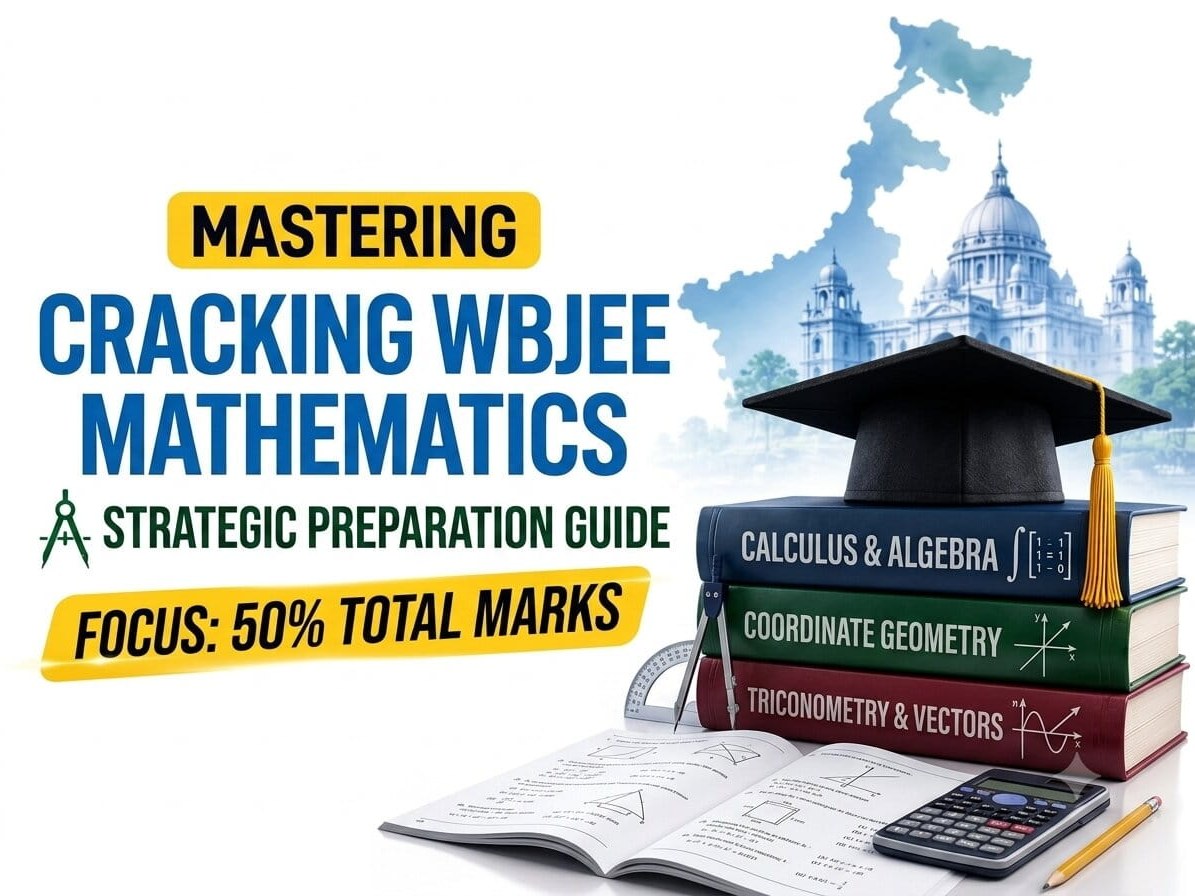
How to Crack WBJEE Mathematics: Preparing the Subject That Carries 50% of the Total Marks
Mathematics alone accounts for 100 of the 200 total marks in WBJEE, making it the single most decisive subject in the entire exam. Physics and Chemistry share the remaining 100 marks equally between them, which means a candidate's Mathematics performance carries as much weight as both other subjects combined. Any WBJEE preparation strategy that treats Mathematics as just one of three equal subjects is working against the exam's own structure rather than with it.
Why Mathematics Deserves Disproportionate Preparation Time
WBJEE's Paper 1 is dedicated entirely to Mathematics, with 75 questions spread across three difficulty categories, and this paper is widely regarded by past candidates as the most demanding section of the exam. Since Mathematics alone determines half the total score, even a modest improvement in accuracy here moves the overall rank more than a similar improvement in Physics or Chemistry would.
Mathematics is tested through 75 questions worth 100 marks, compared to 40 questions worth 50 marks each in Physics and Chemistry
Category 1 questions dominate the Mathematics paper in volume, rewarding speed and accuracy over complex reasoning, while Category 2 and Category 3 questions are fewer but carry proportionally more weight per question
Category 3 questions carry no negative marking, which makes them genuinely low-risk once a candidate has narrowed down the likely correct options, even under exam pressure
Because Mathematics is tested through a dedicated paper with its own two-hour window, fatigue management within that single paper matters more than most candidates initially realise
A candidate who scores strongly in Mathematics while performing only averagely in Physics and Chemistry will often outrank a candidate with the reverse profile, simply because of how the total marks are weighted
High-Weightage Chapters That Deserve Priority
Not all Mathematics chapters in WBJEE carry equal exam weight, and candidates preparing under time pressure should sequence their revision around the chapters that appear most consistently rather than moving through the syllabus in textbook order. Algebra, Calculus, and Coordinate Geometry together form the backbone of the paper, and a candidate who has mastered these three areas thoroughly is generally well positioned regardless of how the remaining chapters are distributed.
Calculus, spanning Limits, Continuity, Differentiation, Integration, and Differential Equations, consistently draws the largest share of questions and deserves the single largest block of preparation time
Algebra, including Complex Numbers, Quadratic Equations, Sequences and Series, and Permutations and Combinations, forms a close second priority, with several sub-topics appearing nearly every year
Coordinate Geometry, particularly Straight Lines and Conic Sections, recurs heavily and also underpins several Vectors and 3D Geometry questions, so weakness here compounds across multiple chapters
Trigonometry, Matrices and Determinants, and Vectors round out a group of moderately weighted chapters that still appear reliably enough to not be skipped
Statistics and Probability carry comparatively lower weightage but are usually straightforward once the core formulas are internalised, making them a strong candidate for last-mile scoring in the final weeks before the exam
Building Speed for a Time-Pressured Paper
With 75 questions to attempt inside a two-hour window, WBJEE Mathematics leaves very little room for a candidate to work through unfamiliar problem types from scratch during the actual exam. Speed has to be built well in advance, through repeated, timed practice rather than through untimed conceptual study alone, since conceptual clarity without speed still results in an incomplete paper.
Practice previous years' WBJEE Mathematics papers under strict timing conditions, since the exam's pacing differs meaningfully from JEE Main and candidates preparing for both should calibrate separately for each
Attempt Category 1 questions first in every practice session to build a habit of securing the high-volume, lower-risk marks before spending time on the fewer, heavier Category 2 and Category 3 questions
Track average time per question across practice sets and treat any chapter consistently taking longer than the paper's average as a priority for further drilling
Solve mixed-chapter problem sets regularly rather than only chapter-isolated practice, since WBJEE frequently blends Coordinate Geometry into Calculus questions and Algebra into Vectors problems
Revisit Class 11 foundations in Trigonometry, Straight Lines, and Sequences and Series periodically, since these chapters quietly determine performance in several Class 12 topics, a dependency that plays out similarly in how Class 11 and Class 12 weightage interact in JEE Main preparation
Using the Category System Strategically
WBJEE's three-tier marking structure rewards a deliberate, category-aware approach rather than attempting every question in the order it appears on the paper. Understanding how negative marking varies by category changes which questions are worth attempting under time pressure and which are worth skipping entirely.
Category 1 questions carry a quarter-mark penalty for wrong answers, so these should only be attempted with reasonable confidence rather than through elimination-based guessing
Category 2 questions carry a steeper half-mark penalty, making them the riskiest category to attempt without strong conceptual clarity, and candidates should be more selective here than in Category 1
Category 3 questions, which allow more than one correct option and carry no negative marking, should never be left unattempted, since even a partially reasoned answer carries no downside
A practical exam-day sequence many toppers follow is to secure Category 1 marks first, attempt Category 3 questions next given the zero-risk structure, and reserve Category 2 questions for whatever time remains
Reviewing a completed practice paper afterward specifically by category, rather than only by overall score, reveals which category is actually costing the most marks through negative marking rather than through incorrect concepts
Balancing Mathematics Against Physics and Chemistry
Prioritising Mathematics does not mean neglecting Physics and Chemistry, since both remain necessary to clear the exam's overall qualifying and competitive thresholds. The more useful framing is proportional: since Mathematics is worth as much as both other subjects combined, its weekly study allocation should reflect that weighting rather than an even three-way split.
Allocate a visibly larger share of weekly study hours to Mathematics compared to Physics or Chemistry individually, while still maintaining consistent contact with both other subjects
Use Chemistry's comparatively faster preparation curve to free up additional Mathematics practice time during the final months before the exam
Track subject-wise mock test scores separately rather than only an overall composite score, since a strong Mathematics score can mask genuine weaknesses building up elsewhere
Candidates also targeting JEE Main alongside WBJEE should note that JEE Main weights all three subjects equally, unlike WBJEE, so the same subject priority does not automatically transfer between the two exams, a distinction worth understanding fully through a detailed comparison of WBJEE and JEE Main difficulty, pattern, and marking scheme
The Bottom Line
WBJEE Mathematics is not simply one of three subjects to prepare evenly; it is the single largest determinant of the final score, carrying as much weight as Physics and Chemistry combined. Prioritising Calculus, Algebra, and Coordinate Geometry, building genuine timed-practice speed, and using the category-based marking system strategically are what separate candidates who merely attempt the Mathematics paper from those who actually convert it into their strongest scoring section.
Article Stats
You Might Also Like
What Is the MS Course? A Complete Guide to Introduction, Eligibility, NEET PG Counselling and Preparation
What Is the MD Course? A Complete Guide to Introduction, Eligibility, NEET PG Counselling and Preparation

Tripura MBBS BDS Round 3 Re-Revised Schedule 2026: Choice Filling, Merit List, Allotment and Admission Dates