 All Articles
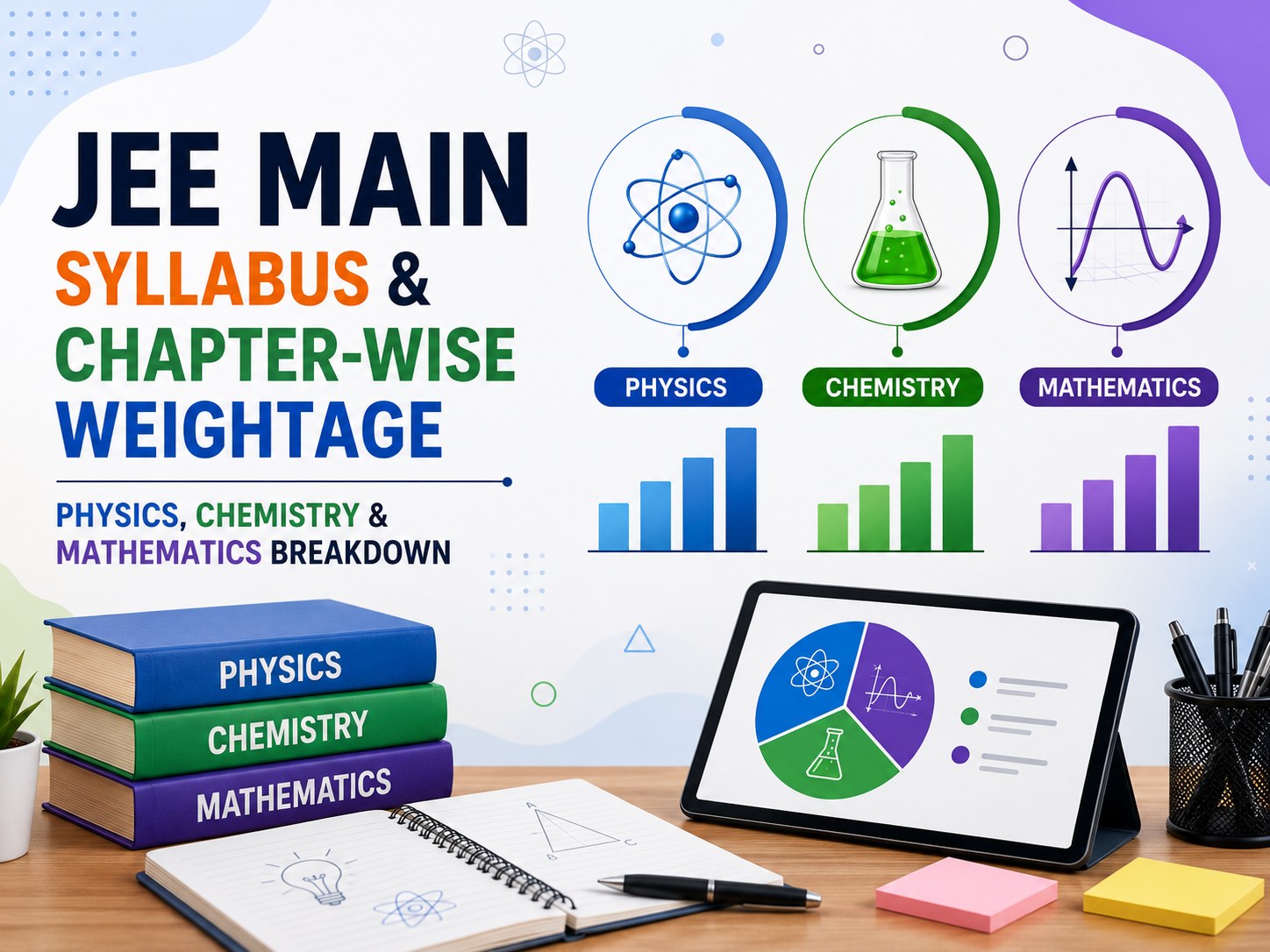
JEE Main Syllabus & Chapter- Wise Weightage: Physics, Chemistry & Mathematics Breakdown
NTA doesn't release an official chapter-wise weightage list for JEE Main - but years of question paper analysis have made the pattern fairly predictable. Here's a detailed, chapter-level breakdown of where the marks actually concentrate across all three subjects, based on trends from recent sessions.
How Weightage Analysis Works
Since JEE Main runs across multiple shifts and sessions each year, no single paper perfectly represents "the syllabus." What analysts do instead is track how often each chapter appears across several years of papers, and how many questions (out of a chapter's total scope) show up on average. Individual chapters in JEE Main typically carry anywhere from 1 to 5 questions per session, translating to a chapter-wise weightage roughly in the 3-10% range depending on the topic - and a relatively compact set of high-weightage chapters ends up accounting for 60-70% of the entire paper.
This doesn't mean the remaining chapters are safe to skip - it means your revision time delivers better returns when it's front-loaded toward the chapters below.
Physics: Chapter-Wise Weightage
Current Electricity leads the Physics section, averaging around 7.5% weightage and typically contributing 2-3 questions per session. It's considered one of the most reliably scoring chapters since it's largely formula-driven rather than conceptually tricky.
Ray Optics and Optical Instruments follows at roughly 6.5%, usually appearing as 2-3 conceptual, diagram-based questions. Electrostatics - specifically Electrostatic Potential and Capacitance - sits around 6%, generally tested through 1-2 numerical questions.
Modern Physics, covering Dual Nature of Radiation and Matter (around 4%) and Atoms and Nuclei (roughly 3-5%), shows up consistently across sessions, usually contributing 1-2 questions each. Thermodynamics and Laws of Motion, together with Current Electricity, typically add up to 15-20 marks combined. Semiconductors and Electromagnetism round out the list of chapters that appear with notable regularity.
Class 12 Physics topics carry a slightly heavier share of the paper — roughly 60% — compared to about 40% from Class 11 topics, reflecting the general pattern across the exam.
Chemistry: Chapter-Wise Weightage
Chemistry tends to be the most evenly distributed of the three subjects across Physical, Organic, and Inorganic branches, but a few chapters still stand out clearly.
Coordination Compounds carries around 7% weightage, making it one of Inorganic Chemistry's most consistently tested chapters. In Organic Chemistry, Aldehydes, Ketones, and Carboxylic Acids average around 6%, alongside strong representation from Hydrocarbons and general Organic reaction mechanisms.
On the Physical Chemistry side, Stoichiometry, Chemical Equilibrium, and Thermodynamics are consistently high-weightage, while s-Block and p-Block elements dominate the Inorganic portion alongside Periodic Table-based questions. Together, chapters like Coordination Compounds, Hydrocarbons, and Periodic Table trends contribute roughly 35-40 marks combined across a typical paper.
Chapters like Solutions, Metallurgy, and other Surface Chemistry-adjacent topics generally carry comparatively lower weightage, making them reasonable to deprioritize slightly if you're short on revision time - though not to skip entirely, since Chemistry rewards broad coverage more than the other two subjects.
Mathematics: Chapter-Wise Weightage
Mathematics shows the sharpest concentration of all three subjects. Calculus alone — spanning Limits, Continuity and Differentiability, Definite Integration, and Applications of Derivatives - accounts for roughly 28-31% of the entire Mathematics section, making it by far the single highest-weighted area in the paper. Within Calculus, Limits/Continuity/Differentiability alone averages around 5.5% (about 2 questions), Definite Integration around 5.1%, and Applications of Derivatives around 4.75%.
Coordinate Geometry is the next major cluster, with Conic Sections (Parabola, Ellipse, Hyperbola) averaging close to 9.9% on their own - among the single highest chapter-level weightages in the entire syllabus. Together, Calculus and Algebra combined typically make up 65-70% of all Mathematics questions in a session.
From the Class 11 portion, Sequence and Series and Straight Lines each average around 6.6% weightage, as do Matrices and Determinants, Integral Calculus, and Three-Dimensional Geometry. Most remaining Class 12 chapters - Sets, Relations and Functions, Complex Numbers and Quadratic Equations, and similar topics - tend to average closer to 3.3% each individually, though they still add up meaningfully in aggregate.
Class 11 vs Class 12: Where the Balance Sits
Across all three subjects, Class 12 topics generally carry a slightly larger share of the paper than Class 11 topics - roughly a 55:45 split overall, though this varies somewhat by subject. This is a useful sequencing cue for revision: if you're prioritizing by weightage rather than working strictly syllabus-order, Class 12 chapters generally deserve marginally more attention, without neglecting the Class 11 chapters listed above that individually carry high weightage of their own.
What to Do With This Breakdown
Build your first revision pass around the highest-weightage chapters identified here - Current Electricity, Ray Optics, and Electrostatics in Physics; Coordination Compounds and core Organic reaction chapters in Chemistry; Calculus and Coordinate Geometry in Mathematics - since these alone can account for a large share of your total score.
Don't stop at high-weightage chapters only. The remaining 30-40% of the paper still matters, and previous-year analysis shows lower-weightage chapters often contain comparatively easier, faster-scoring questions precisely because fewer candidates focus heavily on them.
Solve chapter-wise previous-year question sets specifically for the high-weightage chapters above, since question patterns within these chapters tend to repeat structurally across sessions even as the specific numbers change.
Treat every percentage figure here as an estimate derived from historical analysis, not an NTA-confirmed number - recheck this breakdown against the most recent 1-2 sessions' actual papers as they become available, since emphasis can shift gradually even without formal syllabus changes.
Key Things to Remember
NTA doesn't publish official chapter-wise weightage - all figures here are derived from multi-year question paper analysis.
In Physics, Current Electricity (~7.5%), Ray Optics (~6.5%), and Electrostatics (~6%) lead the weightage table.
In Chemistry, Coordination Compounds (~7%) and Organic reaction chapters like Aldehydes/Ketones/Carboxylic Acids (~6%) are consistently high-weightage.
In Mathematics, Calculus alone accounts for roughly 28-31% of the section, with Conic Sections close behind at nearly 9.9% on its own.
Class 12 content carries a marginally larger share of the paper (~55%) than Class 11 content (~45%) across subjects.
This article is based on multi-year analysis of JEE Main question papers and is not an official NTA-released weightage list. Percentages and question counts are estimates that can shift slightly each session - candidates should verify the current syllabus on the official NTA website and supplement this analysis with their own review of the most recent papers.
Article Stats
You Might Also Like
What Is the MS Course? A Complete Guide to Introduction, Eligibility, NEET PG Counselling and Preparation
What Is the MD Course? A Complete Guide to Introduction, Eligibility, NEET PG Counselling and Preparation
Tripura MBBS BDS Round 3 Re-Revised Schedule 2026: Choice Filling, Merit List, Allotment and Admission Dates