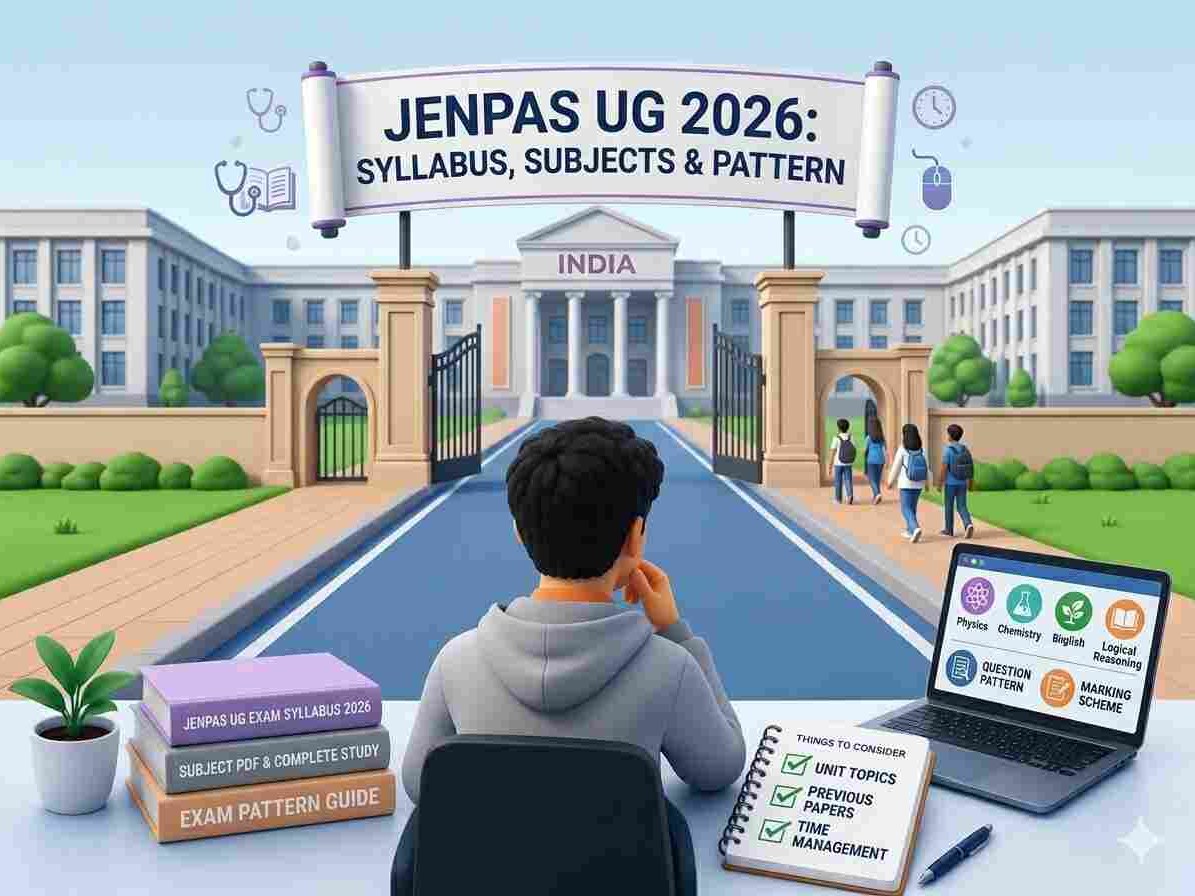
Securing a top rank in the Joint Entrance Test for Nursing, Paramedical, and Allied Sciences Undergraduate courses (JENPAS UG) is the ultimate goal for students across West Bengal aspiring to join prestigious medical institutes. Conducted by the West Bengal Joint Entrance Examinations Board (WBJEEB), this highly competitive offline entrance exam serves as the single gateway to elite programs like BSC Nursing, BPT, BMLT, BHA, and multiple specialized paramedical tracks.
To beat the rising competition and clear this state-level hurdle, having a random preparation plan is not enough. You need absolute conceptual clarity mapped precisely to the official, newly structured curriculum. This comprehensive guide breaks down the complete jenpas ug syllabus for the 2026 academic calendar, uncovers the dual-category exam patterns, explains the shifting marking weights, and gives you actionable strategies to optimize your study tracker.
JENPAS UG Exam Pattern 2026: The Core Architecture
Before diving deep into individual chapters, you must thoroughly understand the evaluation format. The WBJEEB organizes the entrance test into two distinct papers targeted at completely different career paths:
Paper I Architecture: This paper is compulsory for all major undergraduate healthcare paths, including Nursing, Bachelor of Physiotherapy (BPT), Bachelor of Medical Laboratory Science (BMLS), and multiple allied health tracks like Operation Theatre Technology or Optometry.
Paper II Architecture: This test is exclusively required if you are applying for the Bachelor of Hospital Administration (BHA) program.
A crucial structural insight for aspirants is that if your target is purely Nursing or standard paramedical courses, you strictly only need to appear for Paper I. You do not need to take Paper II unless a seat in Hospital Administration is your explicit goal. During the online application window, students have the flexibility to register for Paper I, Paper II, or both, depending on their academic career goals.
Each standalone paper runs for a duration of 90 minutes (1.5 hours) and presents a total of 100 Multiple Choice Questions (MCQs) aggregating to a total value of 115 marks. The exam is administered via an offline, pen-and-paper OMR sheet format. Except for the language-specific components (English, Reasoning, and General Knowledge), the entire questionnaire is printed bilingually in English and Bengali, making it accessible to students across different medium backgrounds in West Bengal.
Detailed Marks Distribution: The Two-Category Blueprint
Both Paper I and Paper II use a unique question splitting system divided into Category 1 and Category 2 formats. Failing to understand how these two categories interact on your OMR sheet can instantly ruin your final score due to unexpected point deductions or missed scoring opportunities.
Decoding the Tricky 2026 Marking Scheme
The marking dynamic of the jenpas ug syllabus requires careful execution because a single wrong bubble on the OMR sheet can alter your state merit percentile.
Category 1 Structural Rules: In this section, questions carry 1 mark each. Every correct choice adds +1 mark to your tally. However, there is a strict negative marking penalty of -0.25 marks for every single incorrect choice. If you mistakenly mark multiple bubbles for a single question, it is treated as a wrong answer and penalized accordingly. Unattempted questions receive zero marks.
Category 2 Structural Rules: This section features advanced objective questions carrying 2 marks each. There is absolutely no negative marking for incorrect choices or multiple selections here. However, these questions contain one or more correct options. To secure the full +2 marks, you must mark all the correct options and none of the wrong ones.
If you mark a combination containing some correct options but zero incorrect options, you receive partial credit. The partial marks are calculated using a specific mathematical formula:
Marks Awarded=Total Number of Actually Correct Options2×(Number of Correct Options Marked)
If even a single incorrect option is bubbled on your OMR layout for a Category 2 question, the entire score for that question drops to zero.
Subject Weightage Blueprint for Paper I
Paper I features 100 questions distributed across five core areas to evaluate science and professional healthcare aptitude:
Biological Sciences: 15 questions in Category 1, 5 questions in Category 2 (Total 20 questions, 25 marks)
Physics: 15 questions in Category 1, 5 questions in Category 2 (Total 20 questions, 25 marks)
Chemistry: 15 questions in Category 1, 5 questions in Category 2 (Total 20 questions, 25 marks)
Basic English: 20 questions strictly in Category 1 (Total 20 questions, 20 marks)
0 questions strictly in Category 1 (Total 20 questions, 20 marks)
Subject Weightage Blueprint for Paper II
Paper II evaluates candidates for administrative roles, modifying the science modules into basic foundational competencies:
Physical Science: 25 questions in Category 1, 5 questions in Category 2 (Total 30 questions, 35 marks)
Mathematics: 10 questions in Category 1, 5 questions in Category 2 (Total 15 questions, 20 marks)
General Knowledge: 10 questions in Category 1, 5 questions in Category 2 (Total 15 questions, 20 marks)Basic English: 20 questions strictly in Category 1 (Total 20 questions, 20 marks)
Logical Reasoning: 20 questions strictly in Category 1 (Total 20 questions, 20 marks)
Subject-Wise Syllabus Breakdown for Paper I
The syllabus for Paper I core sciences maps closely to the standard XI and XII curricula approved by the West Bengal Council of Higher Secondary Education (WBCHSE) along with national councils like CBSE and ICSE.
1. Biological Sciences (High Weightage Core)
Biology serves as the highest-scoring foundation of Paper I. Questions frequently mix direct theoretical concepts with comparative animal and plant cycles.
Diversity & Structural Organization: Diversity in the Living World, Five Kingdom classification, structural organization in plants and animals, morphology and anatomy of angiosperms, cell structure, function, biomolecules, and cell division mechanisms.
Plant & Human Physiology: Transport in plants, mineral nutrition, photosynthesis, respiration, plant growth hormones, digestion and absorption, breathing, human body circulation, excretory mechanisms, locomotion, and neural and chemical coordination controls.
Genetics & Advanced Biology: Principles of inheritance and variation, Mendelian traits, molecular basis of inheritance, DNA replication, transcription, translation, evolution theories, human health and diseases, immunology, and microbes in human welfare.
Ecology & Biotech: Principles and processes of biotechnology, genetic engineering applications in medicine and agriculture, organisms and environment populations, biodiversity preservation, ecosystems, and environmental pollution control strategies.
2. Core Physics
Physics questions test a balance of basic concepts and numerical problems. Focus on formula derivations and unit conversions.
Mechanics & Matter: Physical world and measurement dimensions, kinematics, vectors, laws of motion, work, energy, power, system of particles and rigid body rotation, gravitation laws, and the properties of bulk matter.
Thermodynamics & Waves: Kinetic theory of gases, laws of thermodynamics, thermal properties of matter, oscillations, and wave optics.
Electricity & Magnetism: Electrostatics, electric fields, current electricity networks, magnetic effects of current, permanent magnetism, electromagnetic induction, and alternating currents.
Modern Physics: Electromagnetic waves, dual nature of radiation and matter, atoms, nuclei structure, semiconductor electronic devices, and basic digital communication systems.
3. Core Chemistry
Chemistry is divided into organic reactions, physical formulas, and inorganic properties.
Physical Chemistry: Basic concepts, atomic structure, states of matter, chemical thermodynamics, chemical equilibrium, ionic equilibrium, redox reactions, solid state lattices, liquid solutions, electrochemistry equations, chemical kinetics, and surface chemistry.
Inorganic Chemistry: Classification of elements and periodicity in properties, chemical bonding structures, molecular geometry, hydrogen properties, s-block and p-block elements, d-block and f-block transition elements, extraction of elements metallurgy, and coordination compounds.
Organic & Applied Chemistry: Organic chemistry basic principles, purification techniques, hydrocarbons, haloalkanes, haloarenes, alcohols, phenols, ethers, aldehydes, ketones, carboxylic acids, nitrogen organic compounds, amines, biomolecules, polymers, and chemistry in everyday life applications.
4. Basic English
This section tests your baseline understanding of language grammar, vocabulary, and structural clarity. All questions are multiple-choice options carrying 1 mark each with negative penalties.
Grammar Foundations: Articles, prepositions, tenses, subject-verb agreement, parts of speech rules, voice change transformations, and direct/indirect narrative speech.
Vocabulary Mastery: Synonyms, antonyms, idioms and phrases, one-word substitutions, spelling mistake detections, and cloze test applications.
Sentence Structural Skills: Error spotting in sentences, sentence improvement, ordering of sentences, and paragraph completion.
5. Health Aptitude
As a key evaluation component for nursing and paramedical tracking, Health Aptitude replaced the general reasoning portion to filter for healthcare domain affinity.
Human Body Concepts: Fundamental human anatomy overview, major organ systems, functions, and elementary lifestyle adjustments.
Nutrition & Hygiene: Balanced diets, vitamins, minerals, malnutrition deficiency diseases, personal hygiene routines, sanitation, and clean water processing.
Public Health Frameworks: Common communicable and non-communicable diseases, symptoms, viral transmission controls, national health vaccination programs, first-aid basics, and active public health awareness campaigns driven by the government.
Subject-Wise Syllabus Breakdown for Paper II (BHA)
For Paper II, the level for Physical Science and Mathematics drops to the Class 10 standard of the West Bengal Board of Secondary Education (WBBSE), while the auxiliary subjects match the Class 12 standard.
1. Physical Science (Class 10 Foundation)
This section blends elementary physics and chemistry concepts to evaluate core secondary school scientific literacy.
Physics Core: Common environment concerns, behavior of gases, thermal phenomena, light reflection and refraction through lenses, current electricity basics, electromotive force, and atomic nuclei radioactivity.
Chemistry Core: Periodic table properties, ionic and covalent chemical bonding, electricity chemical reactions, laboratory preparation of inorganic gases, metallurgy principles, and basic organic chemistry naming and chains.
2. Mathematics (Class 10 Foundation)
Mathematics questions demand quick calculation speed and accuracy across standard secondary arithmetic, algebra, and geometry concepts.
Arithmetic & Algebra: Real numbers, simple and compound interest calculations, partnership business accounts, quadratic equations with one variable, ratio and proportion properties, and variation rules.
Geometry & Mensuration: Theorems related to circles, tangents, cyclic quadrilaterals, right circular cylinders, spheres, cones, rectangular parallelopipeds, and coordinate geometry basics.
Trigonometry & Statistics: Trigonometric ratios, identities, complementary angles, heights and distances problems, mean, median, ogive, mode calculations, and basic probability concepts.
3. General Knowledge (Class 12 Level)
This module evaluates your worldly awareness, tracking standard historical milestones, geographic frameworks, and current dynamic events.
Static GK Roots: Highlights of Indian history, the Indian national freedom movement, physical and economic geography of India, basics of the Indian Constitution, polity, and fundamental economic concepts.
Dynamic Current Events: National and international news events, prominent sports awards, recent scientific advancements, summit locations, and key administrative appointments across India.
4. Logical Reasoning
Logical reasoning screens for analytical speed and mental agility through diverse verbal and non-verbal puzzle layouts.
Verbal Reasoning: Analogies, classification groupings, series completion, coding-decoding, blood relation trees, direction sense tests, and logical deduction statements.
Non-Verbal Reasoning: Pattern completion exercises, figure matrix tracking, mirror and water reflections, and embedded figure extractions.
Strategic Action Plan to Master the 2026 Examination
To translate this syllabus knowledge into an elite merit rank, your daily preparation schedule must follow a strict execution strategy.
1. Build an Active Error Log for Category 1 Elimination
Because Category 1 carries a punishing 25 percent negative marking rate, guessing blindly on your OMR sheet can drop your ranking by thousands of positions. Maintain an active diary where you catalog every error you make during chapter practice. Group these errors into conceptual misunderstandings, calculation slips, or misread questions. Reviewing this log daily trains your brain to skip unconfirmed questions during the real 90-minute rush.
2. Master Multiple Correct Elimination for Category 2
Category 2 questions are won or lost based on complete verification. Do not stop reading alternative choices the moment you find one option that looks right. Since multiple options can be correct, read all four choices carefully. If you are uncertain about a third option, it is often safer to leave it unselected; as long as you do not select a wrong option, you will still collect valuable partial marks using the board’s tracking formula.
3. Practice Strict Time-Boxed OMR Bubbling
Many candidates fail the JENPAS UG exam not because they lacked knowledge, but because they ran out of time. Solving 100 questions in 90 minutes gives you less than one minute per question, with zero time left over for the manual tracking of physical OMR bubbles.
During your weekly practice, use printed mock OMR sheets and set a strict countdown clock for 80 minutes. This builds the muscle memory needed to bubble answers quickly and cleanly without damaging the sheet.
4. Utilize Government Syllabus PDFs for Final Revisions
When your study timeline enters its final phase, stop reading bulky reference textbooks. Re-examine the precise syllabus guidelines listed by the WBJEEB. Focus your energy on revising short formula lists for Physics, running through chemical naming mechanisms for Organic Chemistry, and reviewing human physiology summaries. Ensuring your preparation aligns with these official checkpoints is the ultimate secret to clearing the exam with confidence.
Article Stats
You Might Also Like

What Is the MS Course? A Complete Guide to Introduction, Eligibility, NEET PG Counselling and Preparation
What Is the MD Course? A Complete Guide to Introduction, Eligibility, NEET PG Counselling and Preparation
Tripura MBBS BDS Round 3 Re-Revised Schedule 2026: Choice Filling, Merit List, Allotment and Admission Dates