Overview
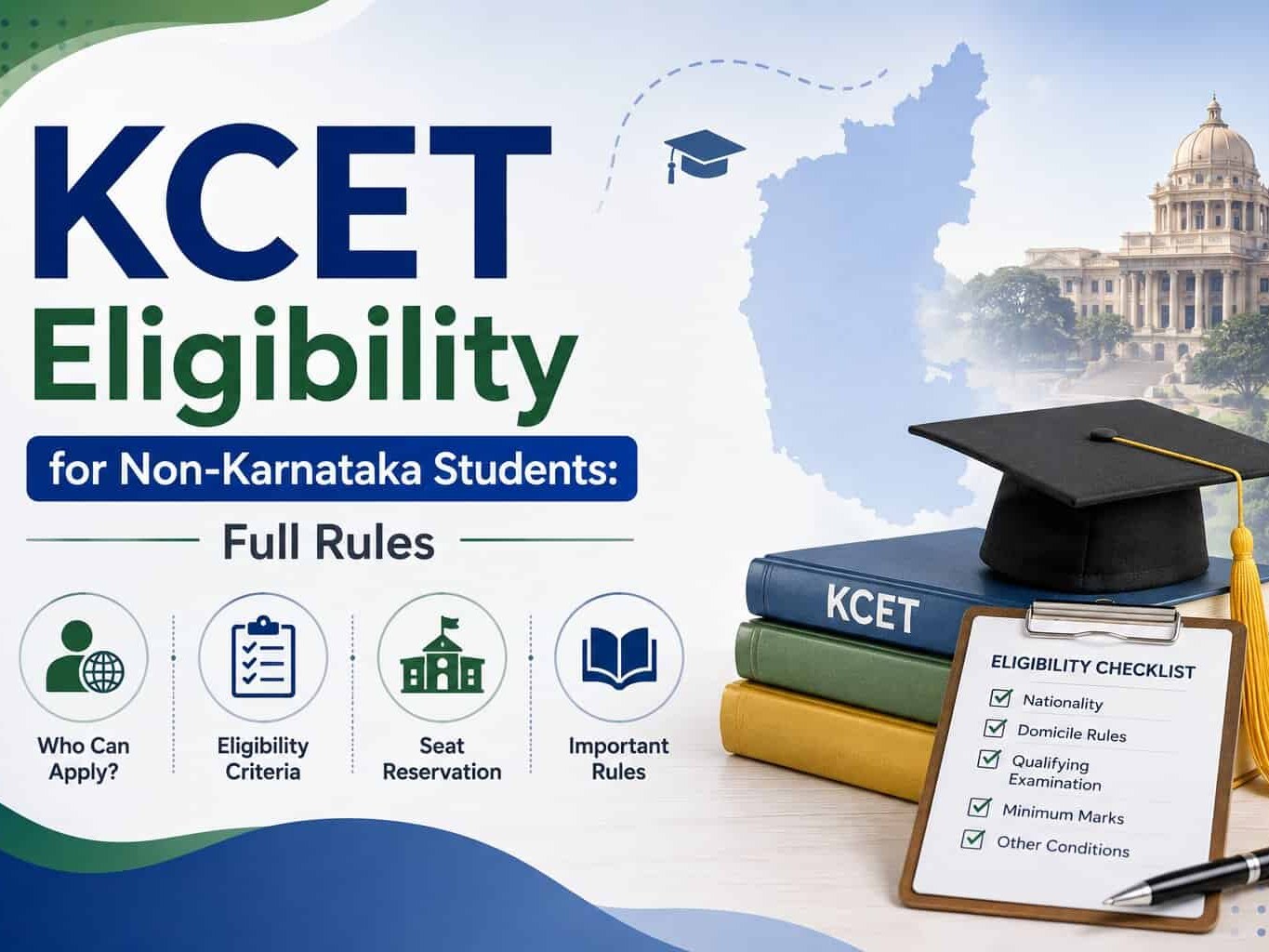
KCET (Karnataka Common Entrance Test) is primarily designed for candidates domiciled in Karnataka, and Karnataka domicile status is the single biggest factor determining what a candidate can actually access through this exam. Non-Karnataka candidates can register and appear for KCET, but they generally cannot claim Karnataka's domicile-based reservation benefits or compete for government quota seats - they're typically restricted to general merit consideration for a limited number of seats, usually at higher fees, unless they qualify under one of several specific domicile exemption clauses.
The Karnataka Examinations Authority (KEA) defines a detailed set of domicile eligibility clauses, labelled A through O, and candidates satisfying any one of these clauses are treated as domicile-eligible for KCET purposes, even if they don't fit the most obvious "grew up in Karnataka" scenario.
Type
This is a state-level engineering, medical, and professional course entrance exam eligibility framework.
It is governed by domicile-based clauses defined by the Karnataka Examinations Authority (KEA).
It distinguishes between full domicile eligibility (government quota access) and limited, non-domicile participation (general merit only, restricted seats).
State / Authority
KCET domicile eligibility rules apply specifically within the State of Karnataka.
The rules are set and enforced by the Karnataka Examinations Authority (KEA).
Eligibility is verified not just at registration, but again during the actual counselling process — a mismatch discovered later can still cause delays or disqualification.
Provider
KEA is responsible for publishing the domicile clauses, verifying documents, and administering both KCET registration and counselling.
KEA also issues the course-wise and category-wise eligibility criteria annually through its official notification.
Document verification for domicile claims happens through KEA's designated process during counselling.
Key Details: How Non-Karnataka Candidates Can Still Qualify
A candidate who has studied in Karnataka for a minimum of seven consecutive years — typically from 1st Standard through 2nd PUC/Class 12 — in a government or government-recognized institution can generally qualify under Karnataka domicile rules, even without being born there.
A candidate whose parent(s) are employed by the Karnataka state government, the Central Government posted within Karnataka, or All India Services and posted in Karnataka, can often qualify under a specific domicile clause, even if the candidate's own schooling happened outside Karnataka.
A candidate whose parent is serving or retired from the Central Armed Police Force (CAPF), and who had declared Karnataka as their hometown at the time of joining service, can qualify under a distinct domicile clause, provided proof is obtained from the parent's service record office.
"Horanadu" and "Gadinadu" Kannadiga candidates — those who studied a full ten academic years in Kannada medium outside Karnataka — are exempt from the Language Test requirement under a specific provision, reflecting their cultural/linguistic connection to the state.
Candidates who do not meet any domicile clause can still register and appear for KCET, but are typically restricted to a limited number of seats under general merit, with no access to government quota, and often at higher fee structures.
Key Eligibility & Documentation
Candidates must be Indian citizens, and generally must have passed their qualifying exam with the minimum required marks (commonly 50-60%) from a university recognized under VTU (Visvesvaraya Technological University) for engineering courses.
Qualifications from Karnataka State Open University, or from boards/universities not recognized under VTU, are typically not accepted for KCET eligibility.
Candidates from outside India or non-standard boards must obtain an Equivalence Certificate — from the Association of Indian Universities or KEA itself — confirming their qualification is equivalent to Indian Class 12/PUC level.
Domicile claims must be backed by the specific documentation each clause requires — study certificates, parent's employment/service records, or caste/income certificates issued by the appropriate Tehsildar for reserved categories.
Candidates currently appearing for their 2nd PUC/Class 12 exams are eligible to apply, provided they submit their results through KEA's designated window once declared.
What to Do Now
Check the specific domicile clause (A through O) that might apply to your situation — many families assume they don't qualify simply because they weren't born in Karnataka, when a parent's service record or seven years of schooling could still make them eligible.
Gather the exact supporting documents required for your specific domicile clause well in advance, since KEA verifies eligibility again during counselling, not just at registration.
If you genuinely don't meet any domicile clause and are specifically targeting private engineering colleges in Karnataka, consider COMEDK UGET as the standard alternative route, since it doesn't carry the same domicile restrictions as KCET's government quota.
If you're appearing under general merit as a non-domicile candidate, plan your finances around potentially higher fees and a more limited seat pool compared to domicile-eligible candidates.
Before finalizing your decision on which exam route to pursue, comparing recent KCET and COMEDK cutoff trends for your target colleges can help you plan more realistically.
Key Things to Remember
Non-Karnataka candidates can register and appear for KCET, but generally cannot access government quota or reservation benefits unless they meet a specific domicile exemption clause.
Seven years of schooling in Karnataka, or a parent's government/CAPF service connection to the state, are among the most common ways non-native candidates qualify for domicile status.
Candidates who don't meet any domicile clause are typically limited to general merit consideration with fewer seats and higher fees.
COMEDK UGET is the commonly recommended alternative for non-domicile candidates specifically targeting private engineering colleges in Karnataka.
This article is based on commonly reported KCET domicile eligibility rules set by the Karnataka Examinations Authority. Candidates should verify the exact, current-year domicile clauses and required documents directly through the official KEA notification before applying.
Article Stats