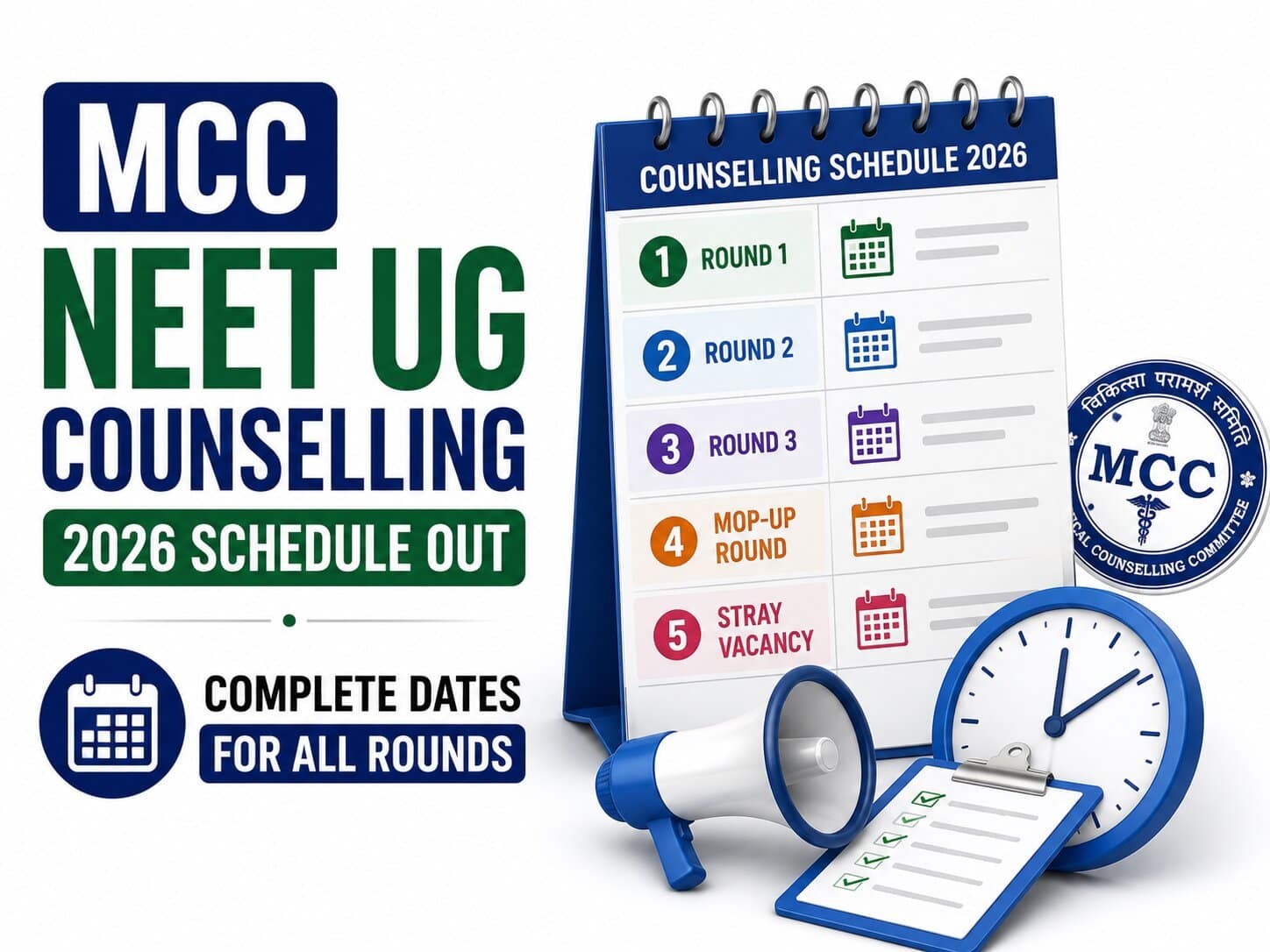
The Medical Counselling Committee (MCC) is the central body responsible for conducting counselling for medical admissions across India's top institutions. For students who have qualified for NEET UG 2026, the MCC application marks the first critical step toward securing a seat in a government medical college. Understanding the process, its timelines, fee structure, rounds, and documentation requirements is essential before the registration window opens.
What Is MCC Counselling and Who Is It For?
MCC counselling governs admissions to the 15% All India Quota (AIQ) seats available in government medical and dental colleges across the country. In addition to AIQ seats, MCC also manages admissions to centrally funded institutions, including AIIMS campuses, JIPMER, Banaras Hindu University (BHU), and Aligarh Muslim University (AMU), as well as deemed universities.
It is important to note that MCC counselling covers only the AIQ share of seats. The remaining 85% of seats in government colleges fall under state-level counselling, which is conducted separately by each state authority. A candidate can and often should register for both MCC and their respective state counselling simultaneously, since participation in one does not bar entry into the other.
Only those who have qualified for NEET UG 2026 are eligible to apply. No candidate without a valid NEET scorecard can register on the MCC portal.
When Does the MCC Application Open?
The MCC counselling calendar is directly tied to the announcement of NEET UG 2026 results, which are expected in June 2026. Once results are declared, the MCC typically takes a few weeks to release its official schedule.
Registration for Round 1 of MCC counselling is expected to begin around July 2026
The counselling process then continues across multiple rounds over several months
Exact dates will be published on the official MCC website once confirmed by the committee
Candidates are advised to monitor the MCC website regularly after NEET results are declared, as registration windows are time-bound and missing them can mean losing access to the round entirely.
The Step-by-Step MCC Application Process
The MCC application process follows a structured sequence. Each step must be completed in order, and no step can be skipped.
Step 1: Online Registration
The process begins with registering on the official MCC counselling portal. Candidates will need to provide:
NEET UG 2026 Roll Number and Application Number
Personal details, including name, date of birth, and category
A valid email ID and mobile number for communication
Registration is the gateway to all subsequent steps. Without completing this, a candidate cannot proceed to fee payment, choice filling, or seat allotment.
Step 2: Payment of Fees
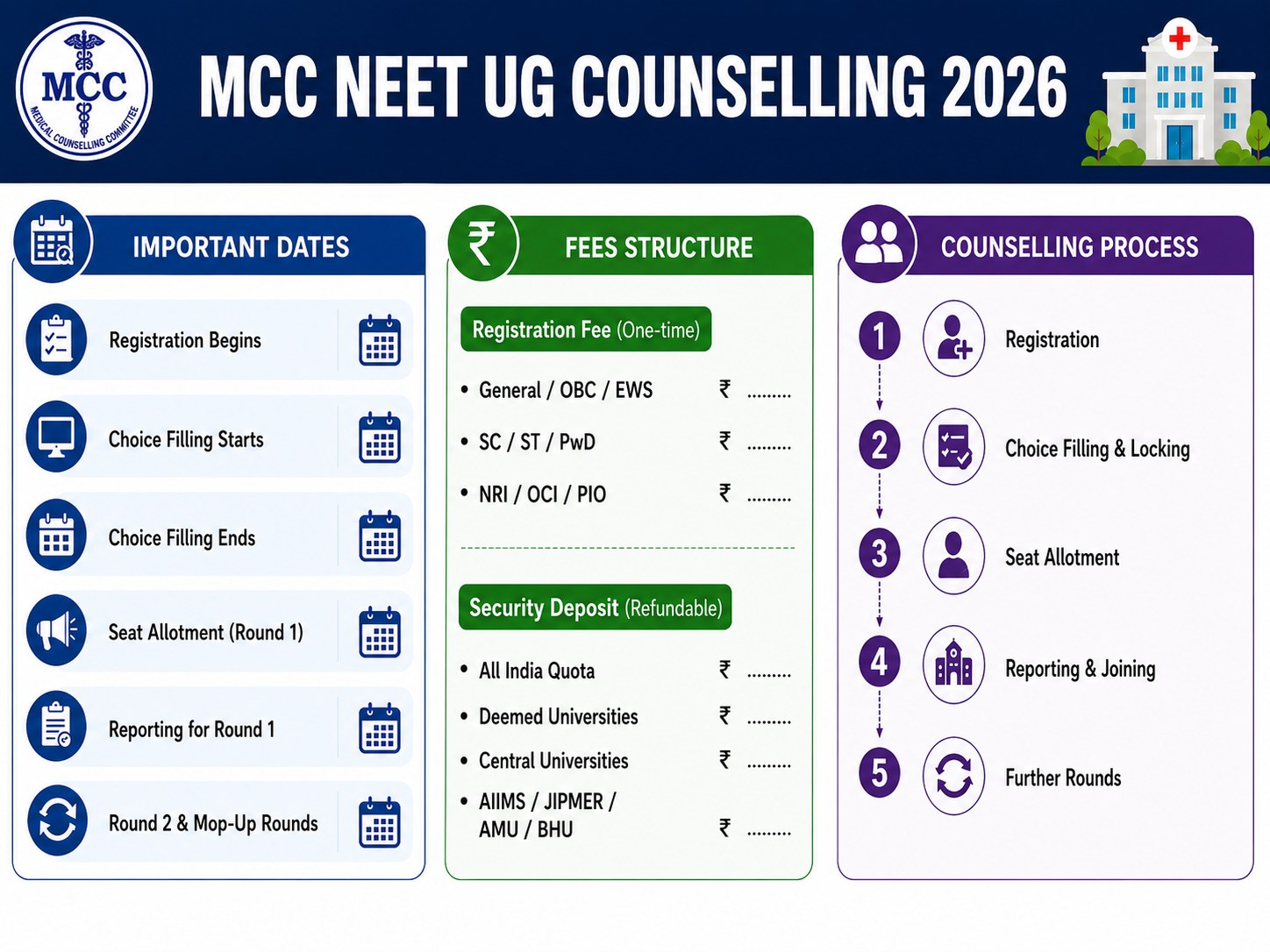
After registration, candidates must pay two separate fees, a registration fee (non-refundable) and a security deposit (refundable upon completion of the process or withdrawal under applicable conditions). The fee structure varies by category and by the type of counselling being pursued.
Fee Structure at a Glance:
Registration Fee:
General / EWS (AIQ) - ₹1,000
SC / ST / OBC / PwD (AIQ) - ₹500
Deemed Universities - ₹5,000
Security Deposit:
General / EWS (AIQ) - ₹10,000
SC / ST / OBC / PwD (AIQ) - ₹5,000
Deemed Universities - ₹2,00,000
The security deposit for deemed universities is substantially higher, reflecting the private nature of these institutions. Candidates applying only to AIQ seats in government colleges will find the deposit amount considerably lower.
Step 3: Choice Filling
Once fees are paid, candidates can fill in their preferred colleges and courses. This is arguably the most consequential step in the entire counselling process.
Candidates can select from hundreds of government medical and dental colleges participating under the AIQ
Preferences must be listed in a clear order of priority, first choice, second choice, and so on
A well-researched and strategically arranged choice list significantly increases the chances of getting a preferred seat
Candidates are encouraged to fill as many choices as possible rather than limiting themselves to a few top colleges, since seat allotment is based on rank, availability, and preferences collectively.
Step 4: Choice Locking
After filling in preferences, candidates must lock their choices before the deadline set by MCC. This is a mandatory step.
If choices are not locked before the deadline, the system will not consider them for allotment
Once locked, choices cannot be altered
Some rounds allow auto-locking if a candidate fails to lock manually, but this is not a feature to rely upon
Locking choices is a small but critical action that many candidates overlook under the assumption that filling choices is enough. It is not.
Step 5: Seat Allotment
Seat allotment is carried out by MCC based on three factors:
The candidate's NEET UG rank
The preferences filled and locked by the candidate
Availability of seats in the respective colleges and categories
Results are published on the MCC portal. Candidates can log in to view whether a seat has been allotted and to which college and course.
Step 6: Reporting to the Allotted College
Upon receiving an allotment, candidates must:
Download the seat allotment letter from the portal
Report to the allotted college within the stipulated reporting window
Complete document verification and pay the admission fee at the institution
Failure to report within the deadline results in automatic cancellation of the allotted seat, and the candidate loses the security deposit in most cases.
The Rounds of MCC Counselling
MCC counselling does not happen in a single round. It is spread across multiple rounds, each with its own registration window, choice-filling period, and reporting deadline.
Round 1
The first round is open to all eligible candidates. Seats are allotted based on rank and preferences. Candidates who receive a seat in Round 1 but choose not to accept it can exit freely without financial penalty, making it a relatively low-risk round to participate in.
Round 2
Round 2 is held after Round 1 reporting is complete. Seats that remain vacant, either due to non-reporting or free exits, are pooled back and re-allocated. In some conditions, withdrawing from a Round 2 seat may carry a financial penalty.
Mop-Up Round
After Rounds 1 and 2, seats that are still unfilled across participating colleges enter the Mop-Up Round. This round is particularly important for candidates who did not receive a seat or received one they were not satisfied with in earlier rounds.
Stray Vacancy Round
This is the final stage of counselling. Stray vacancies, seats that remain empty even after the Mop-Up Round, are filled at the institutional level. This round is conducted directly at participating colleges and is limited in scope.
Candidates should plan to participate actively in all relevant rounds, since seats from earlier rounds continuously open up as candidates withdraw or fail to report.
Documents Required for the Application and Reporting
While documents are primarily verified at the time of college reporting, candidates should keep them prepared well before registration begins to avoid last-minute difficulties.
Documents typically required include:
NEET UG 2026 Admit Card
NEET UG 2026 Scorecard
Class 10 Certificate (as proof of date of birth)
Class 12 Marksheet and Certificate
Government-issued photo ID (Aadhaar Card or Passport)
Category Certificate, where applicable (SC/ST/OBC/EWS/PwD)
Seat Allotment Letter (downloaded from the MCC portal after allotment)
Passport-size photographs
Candidates belonging to reserved categories must ensure that their certificates are valid, current, and issued by a competent authority, as expired or improperly issued certificates can lead to disqualification at the reporting stage.
Key Points Every Candidate Must Keep in Mind
Given the complexity and the volume of students participating in NEET UG counselling each year, a few important reminders can make the difference between securing admission and losing a seat over a procedural error.
Register early: The MCC portal may experience heavy traffic during the initial days of registration. Completing registration well before the deadline avoids technical difficulties.
Be thorough with choice filling: More preferences mean a higher chance of allotment. Do not limit choices to only the top-ranked colleges.
Always lock choices: Filling preferences without locking them is as good as not filling them at all.
Track deadlines across all rounds: MCC sets separate deadlines for registration, fee payment, choice filling, locking, and reporting for each round. Missing any single deadline can forfeit participation in that round.
Report on time: Once a seat is allotted, reporting within the window is non-negotiable. Late reporting means seat cancellation and possible forfeiture of the security deposit.
State counselling runs separately: Participating in MCC does not replace the need to register for state counselling. Candidates should monitor both simultaneously.
The MCC application for NEET UG Counselling 2026 is a process that demands attention, preparation, and timely action. From registration and fee payment to choice filling, locking, and finally reporting to the allotted college, every step carries weight. A missed deadline or an unlocked preference list can undo months of hard work.
With NEET UG 2026 results expected in June 2026 and Round 1 counselling likely to begin in July, candidates now have a window to familiarise themselves with the process, gather their documents, and prepare their college preference lists in advance. The official MCC website remains the only authoritative source for confirmed dates, notifications, and updates, and checking it regularly once results are declared is strongly advised.
Article Stats