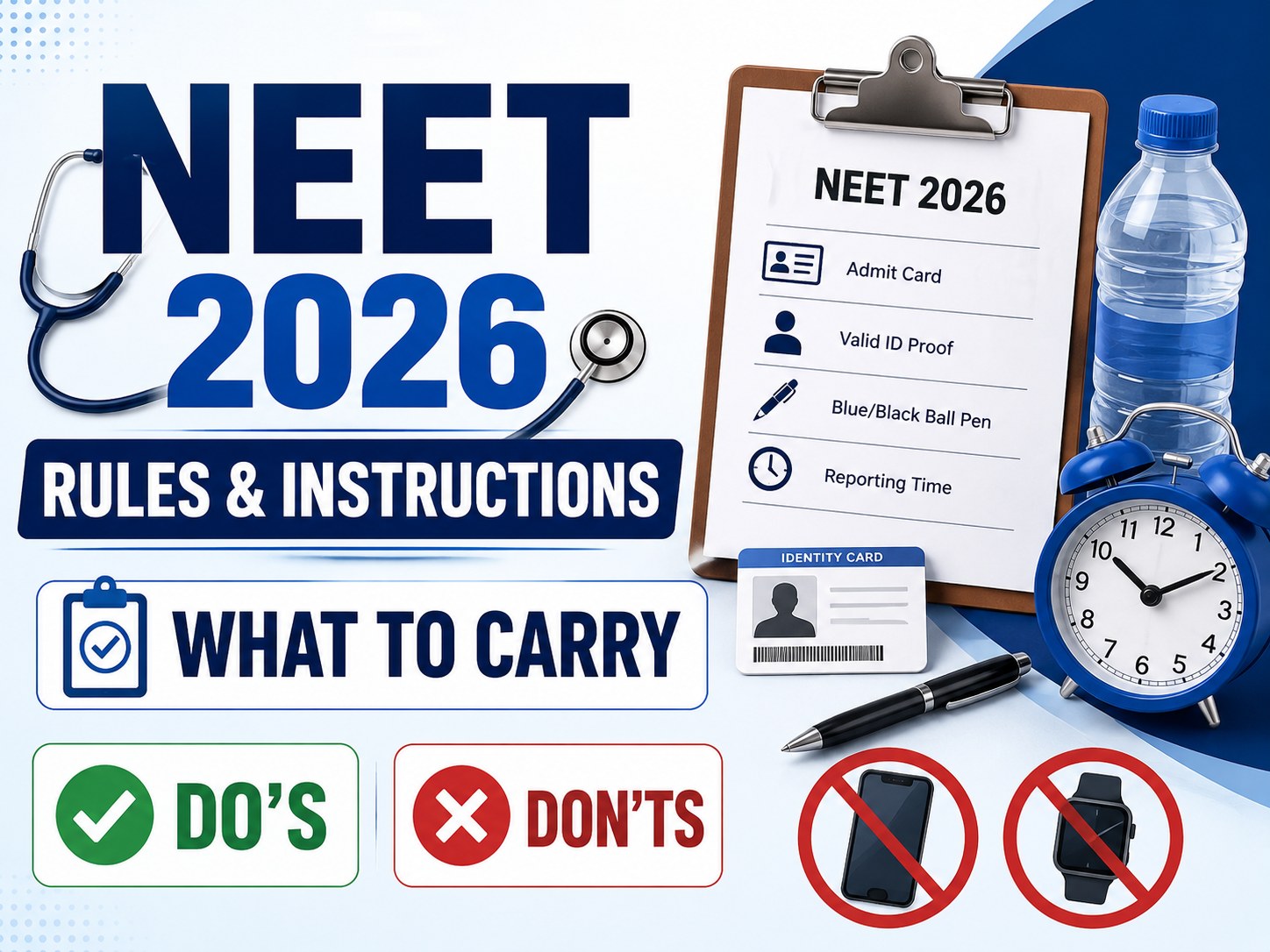
The National Testing Agency (NTA) has issued its official exam-day advisory for NEET UG 2026, laying out a comprehensive set of rules that all candidates must strictly follow on the day of the test. The guidelines cover everything from what to wear to which documents are mandatory at the gate, and officials have made it clear that violations, even unintentional ones, can result in a candidate being turned away from the exam hall entirely.
NEET UG remains the sole gateway to undergraduate medical admissions across India, with well over two million students registering for the exam each year against a comparatively small number of available seats in government and private medical colleges. Given the scale and the stakes involved, the NTA says these rules are essential to ensure a fair, transparent, and tamper-proof examination process. The 2026 advisory comes in the backdrop of controversies in recent years involving paper leaks and the suspected use of electronic communication devices during the exam, and the agency appears to have tightened several of its existing protocols in direct response.
Understanding these rules in advance is not optional. Arriving at an exam center underprepared, whether that means wearing the wrong clothes, carrying a prohibited item, or forgetting a document, can end months of hard work in a matter of minutes.
Dress Code: Simple, Light, and Sleeve-Free
The dress code for NEET UG 2026 has been framed with one clear objective: to make the security frisking process at entry points as smooth and transparent as possible. The NTA wants candidates in clothing that leaves no room, literally, for concealment.
For the upper body, candidates are required to wear light-colored, half-sleeve shirts, T-shirts, or kurtas. Full sleeves and long sleeves are not permitted under any circumstances. The restriction exists because full-sleeve garments have previously been flagged as potential hiding spots for cheat slips or miniature electronic devices. Clothing with heavy embroidery, large decorative buttons, zippers across multiple panels, or thick layering is also not allowed, as these features slow down the inspection process and require additional scrutiny from security personnel.
For the lower body, simple trousers, salwar, or regular pants are acceptable. Candidates should avoid jeans with thick metal rivets or heavy belt buckles, as metal hardware will trigger detectors during the frisking stage.
On footwear, the rules are among the strictest in the advisory. Shoes, boots, sneakers, and all forms of closed footwear are completely prohibited. Candidates must wear slippers or flat, open sandals. This rule is not new, but it is firmly in place for 2026, following documented cases in previous years where small electronic devices were found concealed within the soles or interiors of closed shoes.
Students who wear religious or customary attire, including turbans, hijabs, or similar garments, are fully permitted to appear in their traditional dress. However, the NTA has specifically asked such candidates to report to the exam center well ahead of the standard gate-opening time. This is to allow sufficient time for a respectful and thorough security check conducted by appropriately designated staff. Candidates in this category should factor in this additional time when planning their travel and departure from home.
Watches Banned Across the Board
One of the more prominent additions to the 2026 advisory is the blanket ban on all types of watches. This includes analog watches, digital watches, smartwatches, and fitness bands or activity trackers with display screens. The ban is absolute, with no category of watch exempt from the rule.
The concern is straightforward. Smartwatches and connected devices can receive and transmit data, making them a security risk in a high-stakes examination environment. Rather than attempting to distinguish between different types of watches at the gate, the NTA has chosen to prohibit all of them without exception.
Candidates who rely on a watch to manage their time during the exam need not worry. Every exam hall will have a clearly visible wall clock, and invigilators will also provide time updates at regular intervals during the paper.
Complete List of Banned Items
Beyond watches, the NTA has released a detailed list of items that are entirely prohibited from the exam premises. Candidates are advised to go through this list the evening before the exam and ensure that none of these items are in their pockets, bags, or on their person when they leave for the center.
Electronic devices of any kind are banned. This covers mobile phones, Bluetooth headsets, earphones, microphones, cameras, pen drives, and calculators. Even a phone that is switched off is not permitted inside the premises. Candidates should leave phones at home, or if they must carry one for travel, lock it securely in their vehicle before entering the exam center compound.
Stationery and writing materials should not be brought from home. This includes pens, pencils, erasers, rulers, geometry boxes, and writing pads. All stationery needed for the exam will be provided inside the hall. This is one fewer thing to worry about on the morning of the exam.
Personal accessories such as wallets, handbags, belts, sunglasses, and caps are also on the banned list. Since the majority of exam centers do not provide any storage or cloakroom facility, items left outside are entirely at the candidate's own risk. The most practical approach is to simply not bring them at all.
Jewelry and metallic accessories must be left at home without exception. This means rings, earrings, nose pins, necklaces, chains, bangles, bracelets, and metallic hair clips or pins. Even small metallic pieces will activate the sensitive detectors used during entry frisking, causing delays for the candidate and disruption to the entry queue behind them. Candidates are strongly advised to remove all such items the night before and not wear them on exam day.
Food and drink items, unless specifically required for medical reasons with prior approval from the NTA, are generally not permitted inside the hall. Candidates with medical conditions that require food or medication during the exam should check the official advisory for the process to seek prior permission.
What Happens at the Gate: Frisking, Biometrics, and CCTV
Entry into a NEET UG 2026 exam center is a structured, multi-step process, and candidates should be mentally prepared for it to take some time, especially if they arrive close to the deadline.
At the first checkpoint, every candidate will undergo mandatory physical frisking using handheld metal detectors calibrated to detect even very small metallic objects. This is precisely why the dress code and the jewelry ban are enforced so firmly. Any metallic item on a candidate's person will halt the process and require additional verification.
After frisking, candidates proceed to a biometric verification stage. Here, fingerprints are scanned and a live digital photograph is captured to confirm that the person appearing for the exam matches the registered details in the NTA's system. This step has been put in place specifically to prevent impersonation, a problem that has surfaced in competitive examinations in India in the past.
Inside the exam hall, CCTV cameras are installed throughout and will remain operational for the entire duration of the exam. The NTA has indicated that sessions may be recorded and that footage can be reviewed in the event of any complaint or reported irregularity. Candidates following all the rules have nothing to be concerned about regarding this.
The Three Documents You Must Carry
While almost everything is on the banned list, there are three items that are not just allowed but absolutely mandatory. Without all three, a candidate will not be permitted to enter the exam hall.
The first is the NEET UG 2026 Admit Card. This must be a clearly printed copy, not a blurry photocopy. A passport-size photograph must be pasted in the designated box on the admit card before arriving at the center. Candidates should prepare this the night before and double-check it in the morning.
The second is a valid, original government-issued photo ID. Acceptable documents include an Aadhaar Card, Passport, Voter ID Card, or PAN Card. Digital versions stored on a phone or tablet are not accepted. It must be the original physical document. Photocopies will be turned away at the gate.
The third requirement is extra passport-size photographs, identical to the one used in the NEET 2026 application. One photograph will need to be pasted on the attendance sheet inside the exam hall. Candidates are advised to carry at least two to three additional copies to account for any unforeseen requirements.
Late Entry: No Exceptions, No Negotiations
The NTA has stated unambiguously that once the exam center gates close, no candidate will be permitted entry, regardless of the circumstances. A flat tyre, a traffic jam, a delayed train, or arriving two minutes past the cutoff, none of these will be considered valid grounds for entry after the gates shut. This rule has no exceptions.
The official advisory strongly recommends that candidates arrive at least two hours before the reporting time mentioned on their admit card. Reaching early allows time to locate the correct exam room and seat, complete the security and biometric formalities without being rushed, and settle in calmly before the exam begins. Candidates who arrive in a hurry, stressed and out of breath, are at a psychological disadvantage before they have even picked up a pen.
Official Source Is the Only Reliable Source
In the weeks leading up to the exam, social media platforms and messaging apps tend to circulate unverified claims about last-minute rule changes, revised reporting times, or new document requirements. The NTA has issued a clear advisory asking candidates to disregard all such information. The only reliable source for rules, updates, and official notices is the NTA's official website. Candidates should bookmark it and check it directly rather than relying on forwards or screenshots shared in group chats.
Preparation for NEET UG 2026 does not end with Biology, Physics, and Chemistry. Knowing the rules of the day is just as important as knowing the answers on the paper.
Article Stats
You Might Also Like
What Is the MS Course? A Complete Guide to Introduction, Eligibility, NEET PG Counselling and Preparation
What Is the MD Course? A Complete Guide to Introduction, Eligibility, NEET PG Counselling and Preparation
Tripura MBBS BDS Round 3 Re-Revised Schedule 2026: Choice Filling, Merit List, Allotment and Admission Dates