NEET counselling is a deciding stage for every medical aspirant, and AIQ Round 2 plays a very important role in shaping your future. The All-India Quota (AIQ) allows students to compete for government medical seats across India, not just in their home state. While Round 1 is the beginning of the process, many students do not get their preferred college on their first attempt. This is where Round 2 becomes a second and often better opportunity.
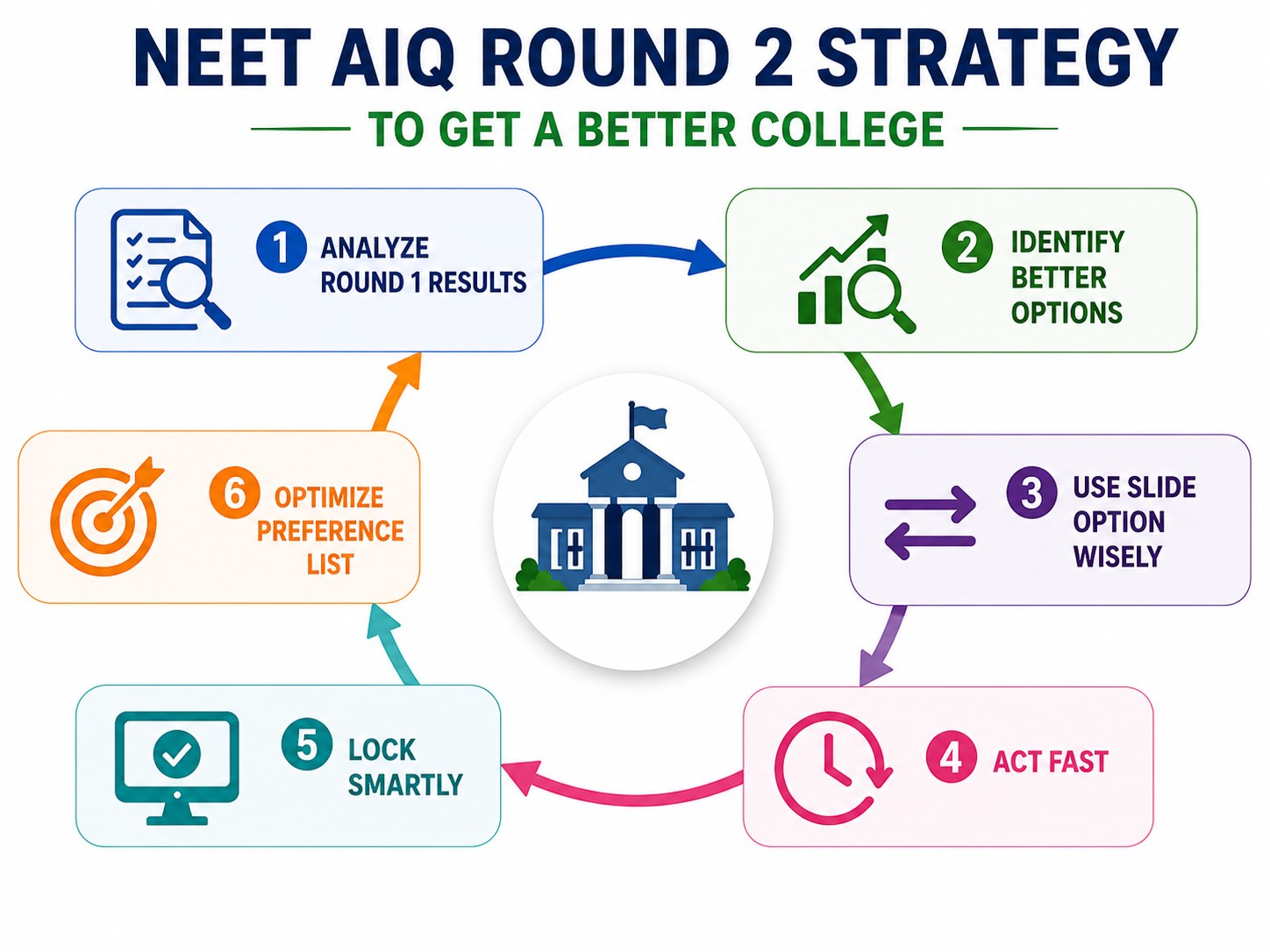
One of the biggest advantages of AIQ Round 2 is the seat upgrade option. Students who joined a college in Round 1 can get a better college in Round 2 if they arrange their choices wisely. Many top colleges become available again when some students move to state quota seats or do not report after Round 1, creating new vacancies.
What is the All India Quota (AIQ) and Its Rounds?
First, let’s understand the basics.
All India Quota (AIQ): These are 15% of seats in government medical colleges across India (except in Jammu & Kashmir). They are filled by a central counselling done by the Medical Counselling Committee (MCC). If you want to study in a good college in another state, AIQ is your path.
Counselling Rounds: AIQ counselling happens in multiple rounds.
Round 1: The first seat allotment. You get a seat based on your rank and choices.
Round 2: The most important upgrade round. Many new seats (from students who left Round 1 seats, fresh seats) are added. This is your chance to jump to a better college.
Further Rounds: There are more rounds (Mop-Up, Stray Vacancy), but Round 2 is the main one for most students.
Difference Between AIQ Round 1 and Round 2
AIQ Round 1 is the first chance to enter the medical counselling system, while Round 2 is a revision round where many new opportunities appear. In Round 1, most students choose colleges based on rank guesses and past trends. In Round 2, students have better clarity after seeing actual cut-offs and seat allotment results.
One major difference is that vacant seats appear in Round 2. Some students do not join their colleges in Round 1, some shift to state quota counselling, and others withdraw. All these seats become available again in Round 2.
Round 2 also allows students who accepted a seat in Round 1 to go for a seat upgrade. You can change your preference list based on your results and aim for a better college.
Another change is that competition shifts. Many high-rankers leave AIQ in Round 2, which can slightly reduce cut-offs in certain colleges. This makes Round 2 very useful for mid-rank students.
Overall, Round 2 is not weaker than Round 1 — in fact, it is smarter. Planning, analysing trends, and making careful choices in Round 2 can help you get a better seat than you expected.
What is Seat Upgrade in AIQ Counselling?
A seat upgrade means getting a better medical college in the next counselling round without losing your current seat. If you accepted a seat in Round 1, you still have the chance to move to a better option in Round 2 based on your preference order and rank.
When Round 2 choice filling begins, you can modify your preference list. If you place better colleges above your current one and your rank qualifies, your seat will be automatically upgraded. Your previous seat is cancelled only after the new seat is confirmed.
Seat upgrade works on three main factors: your NEET rank, vacant seats, and preference order. If higher-ranked colleges have vacancies and your rank meets the cut-off, the system will upgrade your seat.
The biggest benefit of seat upgrade is that there is no risk of downgrade — you either move up or stay where you are. However, if you do not report after Round 2, you may lose your chance to continue.
Smart use of seat upgrades can turn an average college into a top-ranked one. That is why Round 2 is so important.
Sliding Rules Explained
Sliding rules explain how your seat changes from one round to another. Sliding allows you to move to a better seat automatically based on your preference list and rank.
If you have already accepted a seat in Round 1, you do not need to leave it to participate in Round 2. You can simply change your preferences. If a better seat becomes available and your rank allows, the system slides you into the new seat.
Sliding does not allow:
Holding two seats at once
Moving to a lower-ranked college
Skipping reporting deadlines
Once upgraded, the old seat is cancelled automatically.
If no better seat is available, you remain in your original seat. Your position does not worsen.
Sliding ends after the final AIQ round.
Many students misunderstand sliding and think it might remove their seat. In reality, sliding protects your current seat while giving you a chance to improve.
Understanding sliding rules prevents panic and helps you make bold but safe choices.
How to Decide the Correct Preference Order
Preference order determines your final college more than your rank does. It is the list where you arrange colleges from most wanted to least wanted.
Always place your dream colleges at the top, even if you think rank is insufficient. The system checks from the top and gives the highest possible seat.
A smart method:
First, fill the best colleges
Then the medium ones
Finally, safer options
Never place low colleges at the top “just to be safe” — that blocks upgrades.
Do research:
College reputation
Location
Patient flow
Fees
Hostel facilities
Rearrange your list for Round 2 based on cut-offs and available seats.
Preference order is your strategy weapon. Use it wisely.
The Golden Chance: Seat Upgrade in Round 2
What is a seat upgrade?
It means in Round 2, you are offered a new seat that is better than the seat you got in Round 1 (or a seat at all if you didn’t get one). “Better” can mean:
A college with a higher reputation.
A college closer to your home.
A college in a city you prefer.
How does the upgrade happen?
When you get a seat in Round 1, you have two options:
Freeze: You are happy with the seat and do NOT want any upgrade. You will keep this seat.
Slide (or Float): You want a better seat. If a better seat (as per your choice list) becomes available in Round 2, you will “slide” to that new seat.
Important: If you choose Freeze in Round 1, you will NOT be considered for Round 2. So, to get an upgrade, you must have chosen Slide in Round 1.
Understanding the “Sliding Rules” (It’s Simple!)
The word “sliding” might sound tricky, but it’s simple logic. Let’s break down the rules:
Rule 1: You Always Slide UP, Never DOWN.
The new seat in Round 2 must be higher on your own preference list than your Round 1 seat. The computer checks your list from the top. The first seat you are eligible for (based on rank and availability) is yours.
Rule 2: Your Rank is Your Ticket.
A higher rank student will get a seat before a lower rank student, if they have both chosen it. So, even if you really want College A, if someone with a better rank also wants it and it’s the only seat, they will get it.
Rule 3: Vacancy is the Door.
You can only slide into a seat that is vacant (empty) in Round 2. These vacancies come from:
Students who left their Round 1 AIQ seat to take a state quota seat.
Students who did not report to their Round 1 college.
New seats added from some institutions.
The BIGGEST Counselling Mistakes to AVOID
Many smart students lose good seats because of these errors. Please don’t make them!
Wrong Preference Order:
This is the most important step. The order in which you list colleges decides everything.
Mistake: Putting a college you like less at a higher number just because someone said it’s “good.”
Smart Move: List colleges in the order YOU truly want them. Your #1 should be your dream college. #2 should be your next favourite. The computer will give you the highest possible one on your list. If you put a safe choice at #1, you will get it, even if a seat in your dream college was available later!
Not Choosing “Slide” in Round 1:
If you want any chance of an upgrade, you must choose the Slide (Float) option when you get your Round 1 seat. Choosing “Freeze” ends your AIQ journey.
Not Participating in Round 2 Because You Have a Seat:
Even if you have a seat from Round 1, you MUST fill choices again in Round 2 if you chose “Slide.” Some students think they will automatically get an upgrade. No! You have to log in and submit your choices again for Round 2.
Following the Crowd:
Just because everyone is choosing a college in City X doesn’t mean you should. Think about location, fees, language, distance from home, and your own comfort.
Ignoring the Rules:
Always read the official instructions on the MCC website (mcc.nic.in). It is the final truth. Don’t rely only on rumors or what friends say.
Conclusion
The All India Quota (AIQ) gives medical students a valuable opportunity to compete for colleges across the country, not just in their home state. AIQ Round 2 is essential because it opens doors for improvement, whether it is getting a better college, a better location, or even a different course. Many students upgrade their seats in this round simply by understanding the process and making informed choices.
The most important factor is your preference order. Placing colleges in the right order allows the system to allot you the best possible seat according to your rank. At the same time, understanding the seat upgrade and sliding rules helps you take safe chances without fear of losing your current seat.
Avoid common counselling mistakes such as wrong choice filling, missing deadlines, not locking preferences, and ignoring official notices. These small errors can cost you a good college.
Planning smartly, staying updated, and making informed decisions can completely change your counselling result. Remember, Round 2 is not just another round — it is a second chance to build a better future. Use it wisely.
Article Stats