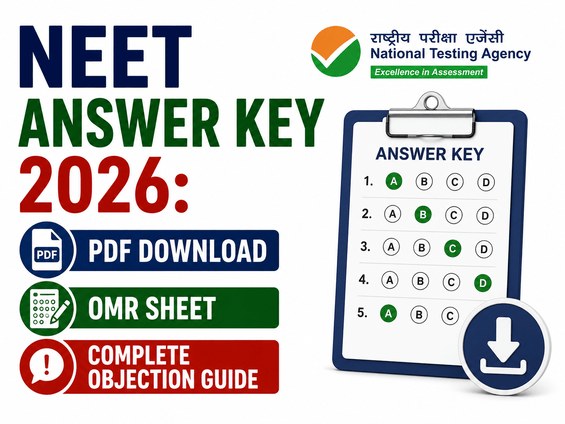
NEET Answer Key 2026: PDF Download, OMR Sheet and Complete Objection Guide
The Re-NEET 2026 provisional answer key is out. NTA released it on June 25, 2026, — and the objection window is open only until June 28, 2026 at 11:50 PM. If you appeared for the re-examination on June 21, you have a narrow window right now to download your answer key, check your OMR response sheet, calculate your expected score, and raise any objections you believe are valid.
This article covers everything you need to do in the next three days: where to find the answer key PDF, how to read your OMR sheet correctly, how to calculate your score accurately, and how to file a challenge if you think NTA got something wrong.
NEET 2026 Answer Key: Current Status at a Glance
The Re-NEET UG 2026 re-examination was held on June 21, 2026, in offline pen-and-paper mode from 2:00 PM to 5:15 PM IST. Over 22.79 lakh candidates appeared across 5,440 exam centres in 551 cities within India and 14 cities abroad. NTA released the provisional answer key for all four paper codes — Code 50, Code 60, Code 70, and Code 80 — on June 25, 2026 at approximately 7:30 PM IST, alongside the candidate OMR response sheets.
Key dates that apply right now:
Re-NEET 2026 exam date: June 21, 2026
Provisional answer key released: June 25, 2026
Objection window open: June 25 to June 28, 2026 (11:50 PM)
Final answer key: After objection review (date to be announced)
Expected result: By July 15, 2026 (tentative)
The objection window closes on June 28. After that, no challenges are accepted under any circumstance.
How to Download the NEET 2026 Answer Key PDF
The answer key is available only through the official NTA NEET portal. No third-party website, coaching institute portal, or educational app can give you your personalised recorded responses — those are only on neet.nta.nic.in.
Steps to download the provisional answer key and OMR sheet:
Go to neet.nta.nic.in and look for the notification titled "NEET UG 2026 Provisional Answer Key / OMR Response Sheet" on the homepage. NTA places this as a live highlighted link during the active window.
Click on the link and log in using your Application Number along with your Password or Date of Birth, plus the Security PIN displayed on screen.
Once logged in, your scanned OMR response sheet and the provisional answer key for your assigned paper code will be displayed.
Download both documents. Save them in at least two locations — your phone, cloud storage, and a printed hard copy. These are documents you will need again at various stages through counselling.
Your paper code — 50, 60, 70, or 80 — is printed on your admit card and on the top of your OMR sheet. Make absolutely certain you are comparing your responses with the answer key for your specific code. The same question number can have a different correct answer across codes. Using the wrong answer key is the most common self-evaluation error at this stage.
If the portal is slow or unresponsive — which happens during peak download hours — try accessing it from a browser rather than an app, or access it during non-peak hours (early morning or late night). Do not wait until June 28 to attempt this. Server load increases significantly near the deadline.
Understanding Your OMR Sheet: What It Shows and What It Doesn't
The OMR response sheet and the answer key are two separate documents that need to be read together. Many students confuse the two or assume one is sufficient for score calculation. It is not.
Your OMR sheet shows what NTA's machine recorded as your marked response for each question. Your answer key shows what the correct answer is. The gap between these two — what you marked versus what was correct — is your actual performance data. Without both documents open simultaneously, any score calculation is guesswork.
The scanned OMR sheet contains several important details:
Your application number and registration number for identity verification
Your assigned paper code confirming which answer key to use
The question-by-question record of your marked responses, displayed as the darkened bubble option (A, B, C, or D) for each question number
Any questions left unattempted, which appear as blank responses
There is one specific situation that warrants particular attention: if the response recorded on your OMR sheet differs from what you physically marked during the exam, this is an OMR discrepancy — and it can be challenged separately from an answer key challenge. Both types of challenges go through the same portal and carry the same ₹200 fee per question, but they are treated as distinct categories. An OMR challenge says the machine misread your response. An answer key challenge says the answer NTA marked as correct is wrong. Review your OMR sheet carefully against your memory of the exam before assuming any score loss is due to wrong answers on your part.
How to Calculate Your Expected NEET 2026 Score
NTA's marking scheme for NEET UG 2026 is unchanged from previous years:
Correct answer: +4 marks
Incorrect answer: −1 mark
Unattempted question: 0 marks (no penalty)
The formula is:
Expected Score = (Number of Correct Answers × 4) − (Number of Incorrect Answers × 1)
The maximum score is 720. Total questions are 180 — Physics: 45, Chemistry: 45, Biology: 90.
A practical example: a candidate who answered 155 questions correctly and left 25 unattempted with no incorrect responses scores 620. A candidate who answered 155 correctly but also attempted 15 incorrectly scores (155 × 4) − (15 × 1) = 620 − 15 = 605. The difference between these two hypothetical students is 15 marks — which at the competitive mid-range of the distribution can represent a rank gap of several thousand positions.
Two things to keep in mind while calculating. First, use your OMR recorded responses for the count of correct and incorrect answers — not your memory of the exam. Memory is unreliable under stress, and the machine's record is what NTA uses for result computation. Second, treat your calculated score as a range, not a precise figure. NTA may accept objections that change answers in the final key, which would revise scores upward or downward. Think in terms of a band — if your calculation shows 590, plan for 585–595 — rather than anchoring to a single number.
Also note: the Re-NEET 2026 is conducted in a single shift with no inter-shift normalisation. Scores are calculated directly from the marking scheme against the final answer key, without any percentile normalisation adjustment between batches.
The Objection Process: How to Challenge the Provisional Answer Key
NTA's objection mechanism exists because exam papers — even those prepared by subject experts under controlled conditions — occasionally contain errors. Answers can be ambiguous, questions can have two defensible correct responses, or syllabus coverage can be disputed. The provisional key is the working document. The final key, published after all objections are reviewed, is what determines results.
The objection window for Re-NEET 2026 is open from June 25 to June 28, 2026 at 11:50 PM. There is no extension. There is no offline alternative. Everything happens on the official website.
Step-by-step challenge process:
Step 1 — Log in to the challenge portal. Visit the official website and click on the "Challenge Answer Key / OMR Response Sheet" link. Log in using your Application Number and Password or Date of Birth.
Step 2 — Review your OMR sheet first. Before challenging any answer key entry, confirm that your OMR sheet accurately reflects what you marked. If there is an OMR discrepancy, raise that challenge separately and first — because your OMR response is the baseline from which the answer key comparison is made.
Step 3 — Identify the question to challenge. Navigate to the specific question number. Your paper code is pre-assigned and visible on your admit card and OMR. Select the option you believe is the correct answer.
Step 4 — Upload supporting evidence. This step is mandatory. Objections submitted without supporting evidence are rejected outright, regardless of whether the underlying claim is correct. NTA accepts the following as valid evidence:
Scanned pages from NCERT Class 11 or Class 12 textbooks supporting the answer you are claiming
Pages from other standard reference books used in NEET preparation
Published research or peer-reviewed material where applicable for Biology questions
Any additional supporting documentation relevant to the specific question
Compile all evidence into a single PDF file before uploading. Keep the file size within the portal's specified limit.
Step 5 — Pay the challenge fee. The objection fee is ₹200 per question challenged. Payment is made online through debit card, credit card, or net banking. This fee is non-refundable under any circumstance — even if your objection is accepted and the answer is revised in the final key. Do not challenge frivolously, but do not avoid challenging genuine errors because of the fee.
Step 6 — Save the confirmation receipt. After submission, download and print the challenge confirmation receipt. This is your proof of submission. Keep it until results are declared.
There is no official cap on the number of questions you can challenge. You can raise objections against as many questions as you wish, provided each has valid supporting evidence and the ₹200 fee is paid separately for each.
What Happens After You File an Objection
All submitted objections are reviewed by a panel of subject-matter experts appointed by NTA. The panel evaluates each challenge independently, cross-referencing the claimed answer against standard textbooks and accepted scientific or medical knowledge.
If a challenge is found valid, the question may be handled in one of two ways. If a definitive correct answer exists and it differs from what NTA initially published, the final key is updated accordingly. If the question is found to be genuinely ambiguous or flawed — with no single defensible correct answer — the question is dropped entirely. When a question is dropped, every candidate who attempted it receives full marks (+4) regardless of what they marked. Candidates who left it blank receive no marks.
This is an important nuance: if another candidate successfully challenges a question and it gets dropped or corrected, the revised final key applies to all candidates uniformly. You do not need to have filed an objection yourself to benefit from a valid change. NTA has already confirmed at least one dropped question in the Re-NEET 2026 provisional key — meaning everyone who attempted that question will receive +4 regardless of their response. Monitor the final key when it is published, even if you did not file any challenges.
Unofficial vs Official Answer Key: Which One to Trust
In the hours after the June 21 examination, coaching institutes including Allen, Aakash, Motion, Physics Wallah, Vedantu, and others released unofficial answer keys for Codes 50, 60, 70, and 80. These unofficial keys serve a purpose: they give candidates an early score estimate while NTA's official key is being finalised.
However, unofficial keys can and do contain errors. Different institutes sometimes disagree on individual answers, particularly for ambiguous Biology questions or Physics problems where multiple approaches yield different results. Treat unofficial keys as directional — a rough score range, not a precise figure.
The official NTA provisional answer key, now released, is the authoritative working document. Even this may change based on accepted objections. The final answer key — published after the objection window closes and reviews are complete — is what determines your score and rank. Make your counselling plans around a score range that accounts for possible changes in both directions, not around a single number calculated from any one source.
What to Do After Checking Your Score
The hours between checking the answer key and the result declaration are not dead time. For candidates who have calculated their expected score, this period is the most strategically useful window in the entire admissions cycle.
At whatever score range your calculation shows, the natural next question is: what does this mean for my rank, and what does that rank mean for my college options? These are not questions to answer in the three days between result and counselling registration. They are questions to work through now, carefully, while there is time to research properly.
Students who use this window to map their expected rank against previous-year counselling closing ranks — understanding which colleges are realistic under AIQ at their rank and which are accessible through state quota — enter result day with a plan rather than a reaction. Those who start from scratch after results are declared consistently make worse counselling decisions, not because they are less capable, but because they are under time pressure with compressed information.
For West Bengal students specifically, understanding how both WBMCC state quota counselling and MCC AIQ rounds work — and how the two processes overlap in timeline — is essential context before either window opens. Students exploring top medical colleges in West Bengal should be cross-referencing those options against both their AIQ rank and their state quota rank simultaneously. And for students who have seen their score and are unsure whether to plan around government MBBS or consider private options, the mop-up and stray vacancy round dynamics are worth understanding before Round 1 choice-filling begins.
The result is expected by July 15, 2026. MCC AIQ counselling is expected to begin in the last week of August. That interval — from result to counselling registration — is shorter in 2026 than in most previous years given the Re-NEET timeline compression. Starting the planning process now, with a calculated score range rather than waiting for an official number, is the practical approach.
Key Things to Remember Before the Objection Deadline
The objection window closes June 28, 2026 at 11:50 PM. Everything after that point is fixed. Before that deadline:
Download both the provisional answer key and your OMR response sheet from the official website using your login credentials
Use your OMR recorded responses — not memory — to calculate your expected score
Check your paper code carefully (50, 60, 70, or 80) and use only the matching answer key section
If you notice an OMR recording discrepancy, raise it as a separate challenge from any answer key challenge
For any answer you genuinely believe is wrong, compile your NCERT or textbook evidence before uploading — unsupported objections are automatically rejected
Pay ₹200 per challenged question; this fee is non-refundable regardless of outcome
Save the challenge confirmation receipt after submission
Monitor the final answer key after the objection window closes — accepted revisions apply to all candidates, including those who did not file challenges
Beyond the immediate deadline, use your score range to begin researching your college options. For students who want to understand how their expected score translates into rank and which specific colleges fall within that range across categories and quotas, a free counselling session is the fastest way to get a personalised map of options before the result window opens. The answer key phase is the setup. The decision that actually shapes the next five years happens in counselling.
All dates and processes in this article are based on NTA's official release at neet.nta.nic.in dated June 25, 2026. Dates marked as tentative — including the result date of July 15 — are based on expert analysis of previous-year NTA timelines and are subject to change. Always verify active deadlines directly at neet.nta.nic.in before taking any action.
Article Stats
You Might Also Like
What Is the MS Course? A Complete Guide to Introduction, Eligibility, NEET PG Counselling and Preparation

What Is the MD Course? A Complete Guide to Introduction, Eligibility, NEET PG Counselling and Preparation
Tripura MBBS BDS Round 3 Re-Revised Schedule 2026: Choice Filling, Merit List, Allotment and Admission Dates