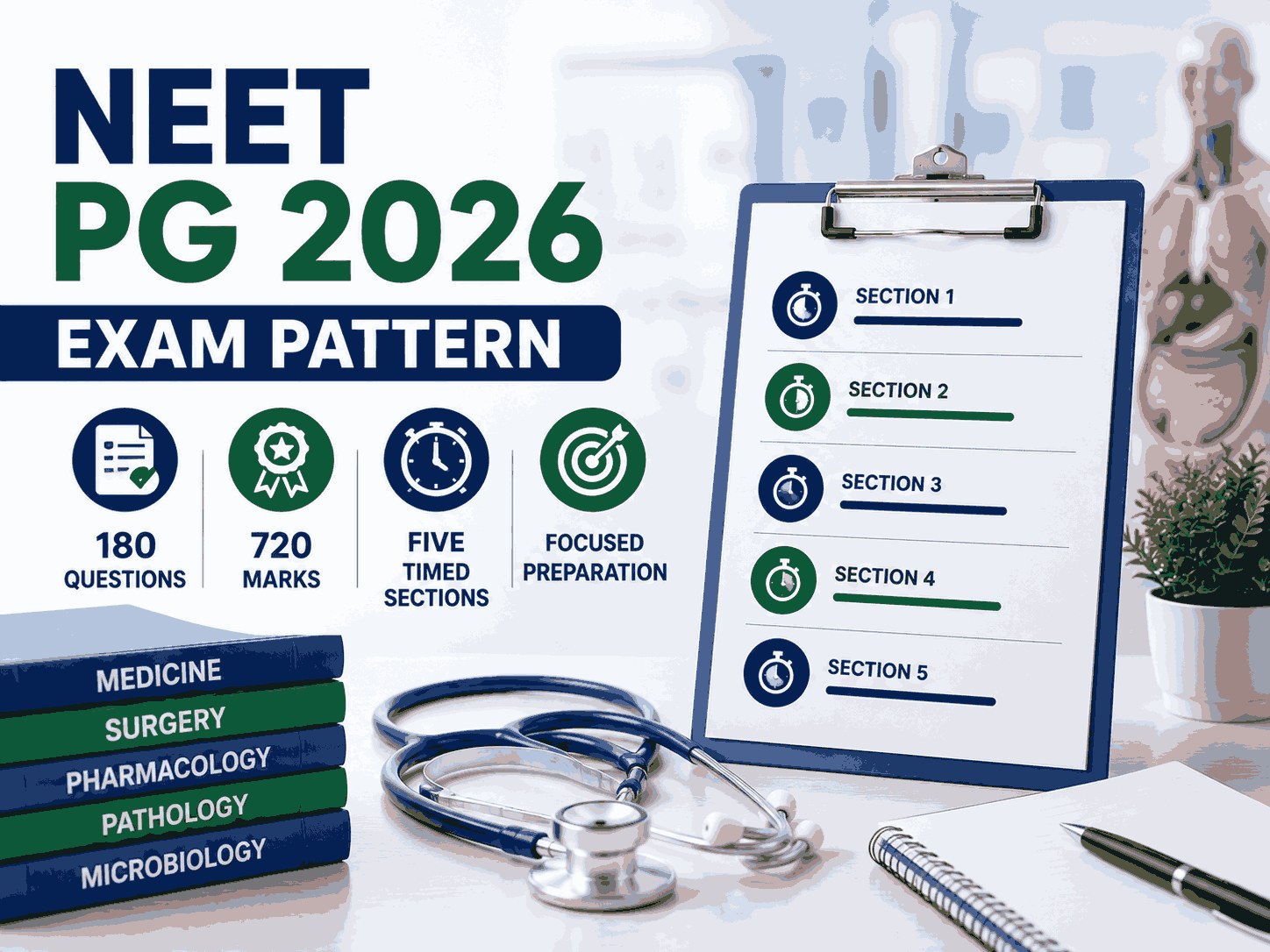
NEET PG 2026 comes with a genuinely revised exam pattern this year - not a minor tweak, but a structural change to question count, total marks, and how the exam is timed internally. If you're preparing for this cycle, here's exactly what's changed and what's stayed the same.
The Big Change: 180 Questions, Down from 200
NEET PG 2026 will consist of 180 multiple-choice questions, reduced from 200 in previous years. As a direct result, the maximum score has also dropped - from 800 marks to 720 marks - since the marking scheme itself (4 marks per correct answer) hasn't changed.
The exam remains a single-shift, Computer-Based Test (CBT), conducted in English only, with no regional language option. NEET PG 2026 is scheduled for 30th August 2026, from 9:00 AM to 12:30 PM.
Five Time-Bound Sections: How the Paper Is Structured
The paper is divided into five compulsory, time-bound sections - Groups A through E - with 36 questions in each section, down from 40 questions per section under the earlier format. Every candidate gets exactly 42 minutes to complete each section.
This sectional structure is strict: once your 42 minutes for a section are up, the system automatically locks that section and moves you to the next one. There's no going back to review or change answers in a section once its time has expired, regardless of how many questions you managed to attempt within it.
Total Duration Stays the Same - But You Get More Time Per Question
Despite the reduction in question count, the overall exam duration remains unchanged at 3 hours 30 minutes (210 minutes). This means the same total time is now spread across fewer questions, working out to roughly 70 seconds per question, up from around 63 seconds under the previous 200-question format.
That extra time per question isn't a huge shift in isolation, but it does suggest NBEMS may be leaving room for questions that are somewhat longer, more clinically detailed, or require more careful reading - rather than simply making the exam easier by asking fewer questions in the same window.
Marking Scheme: Unchanged
The marking scheme itself hasn't been touched. Each correct answer earns +4 marks, each incorrect answer costs -1 mark, and unattempted questions score zero. With 180 questions now worth 4 marks each, the new maximum works out to exactly 720 marks.
Syllabus Coverage Remains the Same
The subject coverage hasn't changed either - NEET PG 2026 continues to test across all 19 MBBS subjects, spanning Pre-Clinical subjects (Anatomy, Physiology, Biochemistry), Para-Clinical subjects (Pathology, Pharmacology, Microbiology, Forensic Medicine, Community Medicine), and Clinical subjects (Medicine, Surgery, Obstetrics & Gynaecology, Paediatrics, and others).
Why This Change Matters for Your Preparation
If you've been practicing with mock tests or question banks built on the old 200-question, 800-mark format, they no longer reflect the actual exam you'll be sitting for. The sectional structure (36 questions per 42-minute block instead of 40) changes your pacing calculations, and the total marks ceiling has shifted, which affects how you should interpret your mock scores relative to expected cutoffs.
The no-back-navigation rule across sections also deserves specific attention in your preparation - a strategy that relies on returning to skipped or flagged questions later in the exam simply won't work here, since each 42-minute block is sealed off the moment its time runs out.
What to Do Now
Update or replace any mock test material still built on the 200-question, 800-mark format, and specifically look for practice tests calibrated to the new 180-question, five-section, 42-minutes-per-section structure.
Practice under strict sectional time limits rather than treating the exam as one continuous 210-minute block - since each 36-question group locks independently, your pacing needs to work within each 42-minute segment, not just across the full exam.
Get comfortable with the idea that a section, once timed out, is genuinely closed - build the habit of making a final decision on flagged or uncertain questions before time runs out in each group, rather than planning to return to them later.
Recalculate your target score and expected cutoff benchmarks using the new 720-mark ceiling, rather than referencing older cutoff data based on the 800-mark scale without adjusting for the change.
Key Things to Remember
NEET PG 2026 has 180 questions for 720 marks, down from 200 questions and 800 marks in previous years.
The paper is split into five time-bound sections (Groups A-E) of 36 questions each, with a strict 42-minute limit per section and no back-navigation once time expires.
Total exam duration remains 210 minutes (3 hours 30 minutes), giving candidates roughly 70 seconds per question — slightly more than before.
The marking scheme (+4 correct, -1 incorrect, 0 unattempted) and full syllabus coverage across all 19 MBBS subjects remain unchanged.
This article is based on the NEET PG 2026 exam pattern as officially released in the NBEMS Information Bulletin. Candidates should verify all details, including exam timing and any further updates, on the official NBEMS website before finalizing their preparation strategy.
Article Stats
You Might Also Like
What Is the MS Course? A Complete Guide to Introduction, Eligibility, NEET PG Counselling and Preparation

What Is the MD Course? A Complete Guide to Introduction, Eligibility, NEET PG Counselling and Preparation
Tripura MBBS BDS Round 3 Re-Revised Schedule 2026: Choice Filling, Merit List, Allotment and Admission Dates