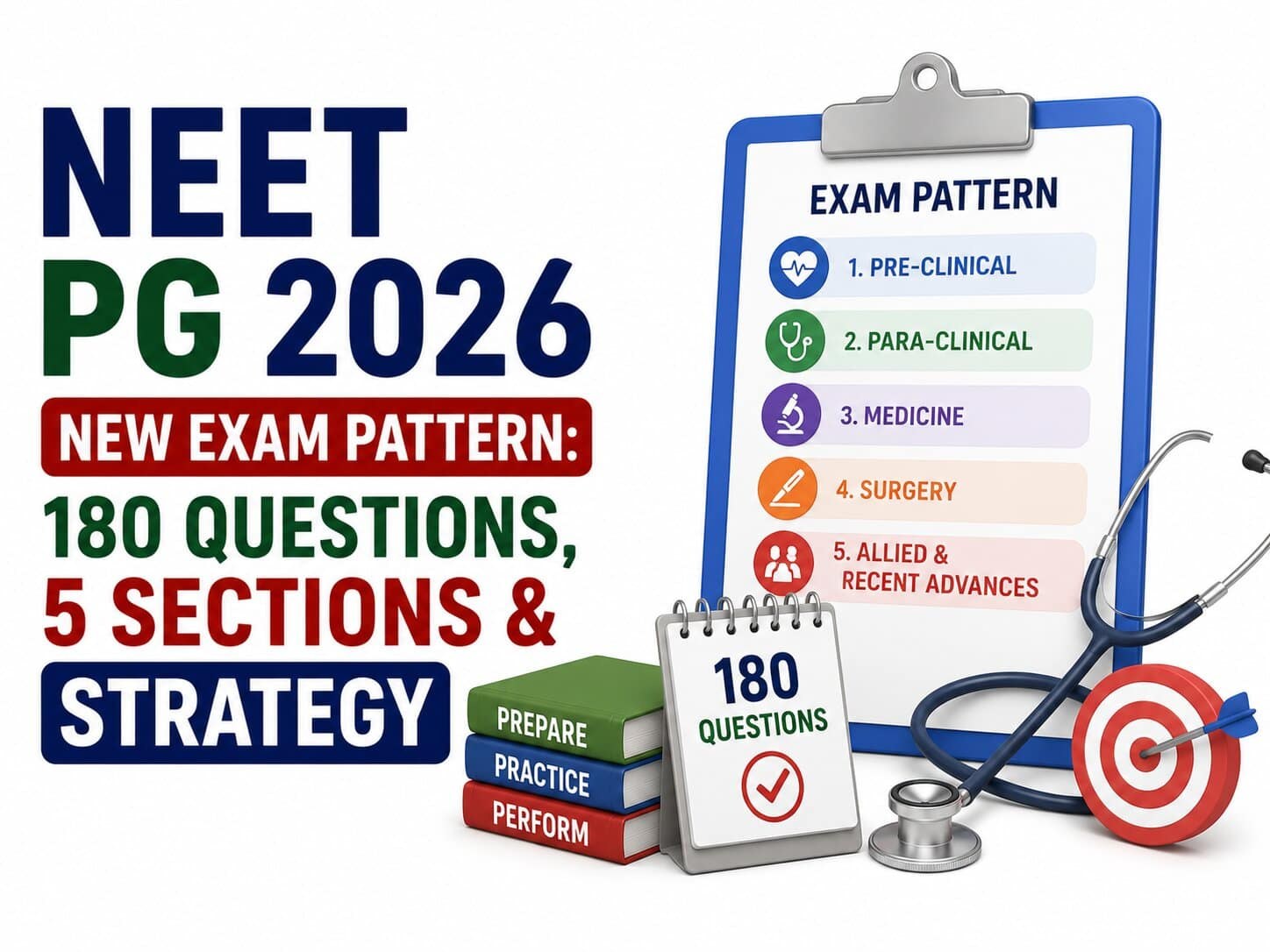
NBEMS dropped the official information bulletin for NEET PG 2026 on July 1, 2026 — and it brought the biggest structural change to the exam in recent years. The question count has been reduced from 200 to 180. The five-section, time-locked format stays, but each section now has 36 questions instead of 40. The total duration remains 3 hours 30 minutes. The marking scheme is unchanged.
If you were preparing based on the old 200-question format, your strategy needs an update. Not a complete overhaul — but a meaningful recalibration. This article covers exactly what changed, what it means for how the paper will be set, and how to reorient your preparation before August 30.
What Changed: The Full Pattern Breakdown
The NEET PG 2026 paper, as officially confirmed in the NBEMS information bulletin, works as follows.
The examination consists of 180 multiple-choice questions, each with four response options in English only. The paper is divided into five time-bound sections — Groups A, B, C, D, and E — with 36 questions in each section. Every candidate gets exactly 42 minutes per section. When the 42 minutes for a section ends, the system automatically moves to the next one. There is no going back. Questions marked for review within an active section are still evaluated normally under the marking scheme — the review flag does not suspend or protect an answer.
The marking scheme is unchanged: +4 for every correct answer, −1 for every incorrect answer, 0 for un-attempted questions. Maximum marks are now 720 (down from 800 under the old 200-question format), since 180 questions × 4 marks = 720.
The exam will be conducted on August 30, 2026, in a single shift from 9:00 AM to 12:30 PM. Entry to the centre closes at 8:30 AM — candidates who arrive after the reporting counter closes are denied entry with no exceptions. The exam is computer-based and conducted entirely in English. There is no Hindi or vernacular option.
Two additional changes in the 2026 bulletin that go beyond the pattern itself: candidates must now select three preferred test states rather than specific test cities, with the first preference mandatorily being the state of their correspondence address. And in compliance with a Supreme Court directive, NBEMS will publish the answer key alongside each candidate's marked responses after the exam, with a two-day challenge window for objections.
What the Reduction From 200 to 180 Questions Actually Means
The headline change — 20 fewer questions — sounds like a relief. In practice, it is not a gift. It is a signal about the direction the paper is heading.
When NBEMS reduces the question count while keeping the same duration, time per question increases. Under the old format, 200 questions in 210 minutes gave candidates 63 seconds per question on average — already tight for complex clinical scenarios. Under the new format, 180 questions in 210 minutes gives 70 seconds per question. That 7-second difference might seem marginal. What it actually signals is that the examiner has room to ask harder, longer, more clinically detailed questions without the paper becoming unsolvable on time.
This is exactly the shift the transcript describes, and it is accurate. The trajectory of NEET PG over the past several cycles has been a deliberate move away from one-line factual recall questions — "what is the drug of choice for X" — toward integrated, case-based clinical reasoning questions that require applying knowledge to a patient presentation. Fewer questions with more time per question accelerates this shift. The exam is not testing what you know. It is testing whether you can use what you know under time pressure, in a locked-section format where you cannot revisit or adjust.
The syllabus has not changed. Every subject from the MBBS curriculum remains in scope — clinical subjects (Medicine, Surgery, Obstetrics and Gynaecology, Paediatrics, Ophthalmology, ENT, Orthopaedics, Psychiatry, Anaesthesia, Radiology, Dermatology), pre-clinical subjects (Anatomy, Physiology, Biochemistry), and para-clinical subjects (Pathology, Microbiology, Pharmacology, Forensic Medicine, Community Medicine). What changes is the form in which that knowledge is tested.
The 42-Minute Section: Why It Is the Most Important Feature of the Format
The five-section, time-locked structure has been part of NEET PG since 2021, but it deserves fresh attention in the context of 2026 preparation because it fundamentally changes how the paper must be approached.
In a traditional free-navigation exam, a candidate can skim through all 180 questions, answer the easy ones first, and return to difficult ones with the remaining time. This is efficient — it maximises the use of every minute. The NEET PG format eliminates this entirely. You have 42 minutes for 36 questions. When those 42 minutes are up, the section closes automatically. Whatever you have not answered in that section is gone. You move to the next group with zero carryover of time or attention.
The practical consequence is that time management has to happen at the section level, not the paper level. You cannot borrow time from a section where you finished early and apply it to a section where you are running behind. Every 42-minute block is its own self-contained exam. A candidate who spends 8 minutes on a single difficult question in Group A and then rushes the remaining 35 questions in 34 minutes has made a section-level error that cannot be corrected by the time Group B opens.
This format rewards candidates who have built the habit of sectional pacing — who know, through practice, how long a comfortable clinical case-based question takes them to read and process, and who have calibrated their decision speed to the 42-minute window through repeated timed mock sections. The candidates who struggle are those who prepare in free-time conditions and discover only in the exam hall that sectional locking feels radically different.
For MBBS graduates who are also preparing for counselling support after NEET PG — understanding how postgraduate seat allocation works, how college selection at the PG level differs from undergraduate counselling, and what factors matter most in choosing a PG seat — the college admission counselling framework that covers undergraduate admissions has structural parallels worth understanding in advance.
How to Restructure Your Preparation for the New Format
The content of NEET PG 2026 preparation has not changed. The method needs to.
The single most important adjustment is making the 42-minute section the fundamental unit of your mock practice — not the full paper, not a subject-wise test, but a 36-question timed section that locks after 42 minutes. Every mock test you sit from this point should be structured this way. Five groups, 36 questions each, 42 minutes per group, no return between groups. If you cannot find a mock platform that replicates this exactly, simulate it manually: set a 42-minute timer, answer 36 questions, stop completely when the timer goes off, then start the next group. This builds the sectional pacing reflex that the exam format demands.
The second adjustment is the shift from factual recall to clinical application in your daily practice. One-line recall questions — the kind that can be answered in under 30 seconds by a candidate with good memory — will become increasingly rare in the new format. What the paper is moving toward are questions that present a patient scenario, give you two or three sentences of clinical information, and ask for the most appropriate next step, the most likely diagnosis given a specific detail in the history, or the mechanism of action most relevant to the clinical outcome described. These questions cannot be answered by memory alone. They require that you know the fact and understand how it applies in a clinical context.
Specifically, this means:
Practise integrated case-based MCQs daily — questions where the clinical scenario is the question, not just a wrapper for a factual answer
Prioritise subjects with high clinical case weighting: Medicine, Surgery, Pathology, Obstetrics and Gynaecology, and Community Medicine together represent a significant portion of the paper's clinical application questions
Work image-based questions into your routine — ECGs, X-rays, CT scans, histopathology slides, fundoscopy images. These are inherently application-based and cannot be answered through text recall alone
When reviewing a factual topic, always ask the follow-up question: how does this appear in a patient? What would the clinical scenario look like if this were the diagnosis?
The third adjustment is negative marking discipline. At +4/−1, every four incorrect answers cost you one correct answer's worth of marks. In a 180-question paper with maximum marks of 720, aggressive guessing on questions you genuinely do not know can meaningfully drag your score. Within each 42-minute section, your triage strategy matters: answer what you are confident about, mark uncertain questions for review within the section, and return to them with remaining time before the section closes. Do not leave any question completely unattempted if you have a reasonable basis for eliminating one or two options — a 50–50 chance between two options has a positive expected value under the marking scheme.
Registration: Dates, Fees, and What Cannot Be Changed
NEET PG 2026 registrations opened on July 1, 2026. The last date to apply is July 21, 2026, at 11:55 PM. Applications are submitted online through nbe.edu.in and natboard.edu.in only. The application fee is ₹3,500 for General, OBC, and EWS category candidates and ₹2,500 for SC, ST, and PwBD categories. Fees are non-refundable and non-transferable under any circumstance.
The edit window opens July 25–28, 2026. Within this window, candidates can correct fields including category, PwBD status, and uploaded documents. However, some details cannot be changed even during the edit window — including name, date of birth, and exam state preference. Category changes to a higher fee bracket require paying the balance fee before the window closes, or the application will be treated as incomplete.
Eligibility criteria for NEET PG 2026 require candidates to hold an MBBS degree or provisional pass certificate recognised under the NMC Act 2019, hold permanent or provisional registration with the NMC or a State Medical Council, and have completed one year of compulsory rotating internship on or before September 30, 2026. Applications from candidates whose internship completes after September 30 will be rejected with no scope for representation.
For the exam centre, candidates must select three preferred test states — not cities — with the first preference mandatorily corresponding to the correspondence address in the application. Second and third preferences must be neighbouring states. Centre allotment is not on a first-come, first-served basis.
What NEET PG 2026 Means for MBBS Graduates Completing in 2026
For MBBS students currently in their final year or completing internship, the August 30 exam date creates a tight but workable window. The internship completion deadline of September 30, 2026 means that candidates completing internship by late September are eligible, provided the completion is confirmed by that date. Provisional pass certificate holders who have not yet received their final degree are eligible to apply.
The intersection of MBBS completion and NEET PG preparation is particularly relevant in 2026 given the Re-NEET UG timeline compression. Students who completed their MBBS in institutions where the academic session was affected by earlier NEET UG disruptions may find their internship timelines shifted accordingly. Confirming internship completion dates against the September 30 cut-off is a practical step to take before registration closes on July 21.
For students who are still in the NEET UG counselling process — waiting on the Re-NEET 2026 result expected by July 20 and preparing for WBMCC state quota counselling or MCC AIQ rounds — the NEET PG 2026 changes are forward-looking information: the postgraduate entrance you will be preparing for five and a half years from now is already moving in the clinical application direction. The MBBS curriculum you are about to begin is the syllabus for NEET PG. How you engage with clinical postings, case-based learning, and integrated medicine during your undergraduate years will be reflected in how naturally the new NEET PG format comes to you when you reach that stage.
The Strategic Shift: From Memorisation to Application
The pattern change in NEET PG 2026 formalises a shift that has been underway for several cycles. Factual one-liners are becoming a minority of the paper. The exam is moving toward testing clinical reasoning — the ability to read a patient presentation, apply scientific knowledge to that specific context, and arrive at the most appropriate answer within a constrained time window.
This is also a more honest test of the competency that matters in medical practice. A doctor who has memorised every drug of choice but cannot apply that knowledge to an atypical presentation has memorised medicine without understanding it. NEET PG 2026's new format is, in that sense, a better examination of what MBBS training is supposed to produce.
For candidates sitting the exam on August 30, the preparation implication is clear. Start treating your mock practice as training for a specific athletic event — 36 questions, 42 minutes, section locked, no return. Do this repeatedly. Track your sectional accuracy and your sectional time separately. Identify which subject areas or question types consistently push you past the comfortable pace and address those specifically. The candidates who perform well in this format are not necessarily those with the most knowledge. They are those who have the most practice under conditions that replicate the actual exam.
Understanding what comes after NEET PG — how seat allotment works, which colleges offer which specialities, and how PG college selection differs from UG — is a secondary but real consideration for candidates approaching their preparation seriously. The marks-to-rank relationship that governs UG admissions has a direct parallel in how NEET PG scores translate into MD and MS speciality access, and thinking about the downstream counselling process is not premature at this stage of preparation.
Key Dates: NEET PG 2026 at a Glance
Registration opens: July 1, 2026
Registration closes: July 21, 2026 (11:55 PM)
Edit window: July 25–28, 2026
Exam date: August 30, 2026
Exam timing: 9:00 AM to 12:30 PM (single shift)
Entry closes: 8:30 AM on exam day
Internship deadline: September 30, 2026
Answer key release: Post-exam (per Supreme Court directive)
Objection window: 2 calendar days from exam date
Registering: Do It Now, Not on July 21
The registration deadline is July 21. The edit window after that is narrow — July 25–28 — and several fields cannot be corrected even within it. The practical advice is to complete registration this week, not in the final days. Server loads on deadline dates for national examinations are consistently high, payment gateway timeouts are common, and document upload errors discovered at 11:30 PM on the last day have no recourse.
For MBBS graduates navigating both NEET PG 2026 registration and NEET UG counselling support for a sibling or family member in the same household — the WBJEE 2026 counselling and NEET UG mop-up round processes run in parallel windows this August and September, creating a genuinely complex administrative calendar for families with students at multiple stages. Keeping both timelines on a single tracker from now is the practical approach.
The new exam pattern is official. August 30 is fixed. The preparation window between today and that date is exactly what it is — use it in a format that replicates what the exam will actually ask of you.
All information in this article is sourced from the NBEMS NEET PG 2026 official information bulletin released July 1, 2026, available at nbe.edu.in and natboard.edu.in. Registration deadlines, fees, and exam pattern details are accurate as of July 4, 2026. Candidates should verify all active deadlines directly from the official bulletin before taking any action.
Article Stats