Once the exam is over and the results are declared, the counselling process begins. This is where a candidate's NEET rank is converted into an actual seat at a medical college. Here is how the process works.
The NEET UG 2026 examination is scheduled for May 3. Once results are declared — expected in June 2026 — the next phase begins: counselling. This is the official admission process through which students are allotted seats in medical colleges across India. A good score in the examination is only the first step. How a candidate navigates the counselling process determines which college they ultimately attend, and in many cases, whether they get a seat at all.
Counselling for NEET UG is not a single process. It runs in parallel across two systems — one national and one at the state level — and involves multiple rounds spread over several weeks. Understanding how each system works, what the timelines look like, and what mistakes to avoid can make a significant difference to the final outcome.
What Counselling Is and Why It Matters
NEET counselling is the formal mechanism through which seats in government and private medical colleges are filled after the examination results are published. Admission is not automatic. A candidate cannot simply present their scorecard to a college and expect a seat. Instead, they must register for counselling, fill in their college and course preferences, and wait for a seat to be allotted to them based on their rank, their category, and the availability of seats.
The process is designed to be merit-based and transparent. Every seat is filled in order of rank, within the applicable category. A General category candidate with a higher All India Rank will be considered before one with a lower rank. Within reserved categories — OBC, SC, ST, EWS, and PwD — the same principle applies. No seat is filled outside this system. Private negotiations between candidates and colleges for NEET seats are not permitted under the rules.
The counselling process covers admission to MBBS, BDS, BSc Nursing, and BVSc programmes. It applies to government colleges, private colleges, deemed universities, and central institutions, including AIIMS and JIPMER.
Two Systems: AIQ and State Quota
The most important thing a candidate must understand before counselling begins is that there are two separate systems, and most students will need to engage with both.
The All India Quota, or AIQ, covers 15 per cent of the total seats available in government medical colleges across the country. It also covers all seats in deemed universities and central institutions such as AIIMS New Delhi, JIPMER Puducherry, and other AIIMS campuses. The AIQ counselling process is conducted by the Medical Counselling Committee, commonly referred to as the MCC. Any candidate who has qualified NEET — regardless of which state they are from — can apply for AIQ seats. There is no domicile requirement. A student from West Bengal can apply for a government MBBS seat in Maharashtra through the AIQ, and vice versa.
The State Quota covers the remaining 85 per cent of government college seats, as well as seats in private medical colleges within each state. Each state runs its own counselling process through its own designated authority. The rules, timelines, and procedures vary from state to state. Most states require candidates to meet domicile or residency conditions to be eligible for state quota seats. A candidate who studied in Tamil Nadu, for example, would typically need to apply through the Tamil Nadu state counselling authority for state quota seats in that state.
In practice, most candidates register for and participate in both AIQ counselling and their home state's counselling simultaneously. Managing both processes at the same time — with different portals, different deadlines, and different document requirements — is one of the more demanding aspects of the post-result period.
Expected Timeline for 2026
The NTA has not yet published the official counselling schedule for NEET UG 2026. Based on the examination date of May 3 and the expected result date in June, the broad timeline is expected to follow this pattern:
NEET UG Result: June 2026. Once results are published, candidates can check their All India Rank and category rank on the NTA portal.
AIQ Counselling Registration: Expected to begin in late June or early July 2026, shortly after results are declared.
Round 1 of AIQ Counselling: Expected in July 2026. This is when the first set of seat allotments will be made.
Round 2 of AIQ Counselling: Expected in July to August 2026.
State Counselling: Most states are expected to begin their counselling processes in July 2026, running alongside or slightly after the AIQ rounds.
Mop-Up Round: Expected in August to September 2026. This round is held after the main rounds are complete, to fill seats that remain vacant.
Stray Vacancy Round: Held after the mop-up round, if seats still remain unfilled.
Candidates are advised to monitor the MCC website and their respective state counselling authority's website closely once results are declared, as dates can shift and registration windows are typically short.
How the Counselling Process Works: Step by Step
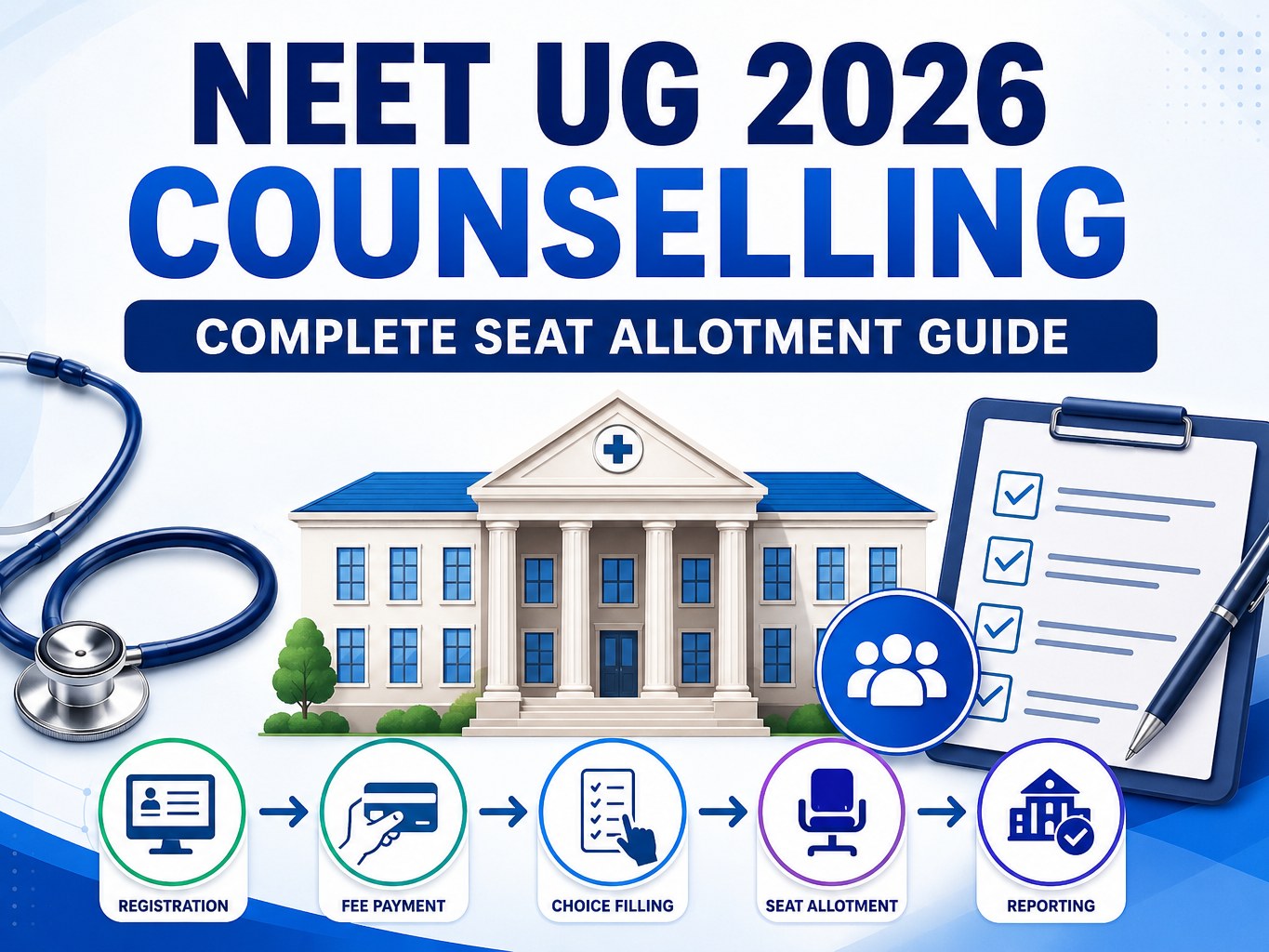
The counselling process, whether AIQ or state, follows a broadly similar sequence of steps. Understanding each step in advance helps candidates avoid errors that can cost them a seat.
Step 1 — Registration: Candidates register on the relevant counselling portal — the MCC website for AIQ, or the state authority's portal for state quota. Registration involves filling in basic personal and academic details and paying a registration fee. The registration fee varies by system and by category.
Step 2 — Choice Filling: This is the most consequential step in the entire counselling process. Candidates log into the portal and select their preferred colleges and courses, ranking them in order of preference. The portal allows candidates to add multiple options. A candidate can list government colleges, private colleges, and deemed universities in a single preference list, in whatever order they choose.
Step 3 — Choice Locking: Once a candidate is satisfied with their list of preferences, they lock their choices. After locking, no further changes are permitted. The locked preference list is what the system uses when running the seat allotment algorithm. Candidates who forget to lock their choices before the deadline may find that their selections are not registered at all.
Step 4 — Seat Allotment: The counselling authority runs an algorithm that matches candidates to seats based on their NEET rank, their category, their locked preferences, and the availability of seats. Results are published on the portal. A candidate is allotted the best seat available to them — meaning the highest-ranked option on their preference list for which a seat is available given their rank.
Step 5 — Document Verification: Candidates who receive a seat allotment must upload and verify their documents through the portal, or report in person to a designated verification centre, depending on the process followed by the relevant authority.
Step 6 — Reporting to the Allotted College: After document verification, the candidate must report to the allotted college within the stipulated deadline to confirm admission. Failure to report within the deadline results in the seat being forfeited.
Documents Required for Counselling
Candidates must have the following documents ready before the counselling process begins. Delays in arranging documents have caused students to miss deadlines in previous years.
NEET UG 2026 Admit Card
NEET UG 2026 Scorecard and Rank Letter
Class 10 mark sheet and certificate
Class 12 mark sheet and certificate
Valid photo identity proof — Aadhaar card or passport
Category certificate, if applying under OBC, SC, ST, EWS, or PwD quota
Domicile or residency certificate, for state quota counselling
Passport-size photographs
All documents should be in order and self-attested before counselling registration opens. Original documents are typically required at the time of college reporting.
How Seats Are Allotted: What Determines the Outcome
Seat allotment is determined by four factors working together: a candidate's All India Rank, their declared category, the preferences they have filled, and the availability of seats at the time the algorithm runs.
Government medical colleges have significantly higher score cutoffs than private colleges. A candidate who qualifies for a government MBBS seat will typically have a stronger rank than one who receives a private college seat. Private college seats are more accessible in terms of rank, but carry substantially higher fee structures — in some cases, fees at private medical colleges can run to several lakh rupees per year, compared to government college fees that are a fraction of that amount.
Deemed universities and central institutions like AIIMS operate differently. AIIMS, in particular, has historically been extremely competitive. The cutoff ranks for AIIMS New Delhi are among the highest in the country.
Candidates are advised to study the previous year's opening and closing ranks for colleges they are considering, as this gives a realistic picture of where their rank is likely to place them.
Number of Rounds and What They Mean
NEET counselling typically runs across four to five rounds. Each round gives candidates who did not receive a seat — or who received a seat they do not wish to accept — another opportunity.
Round 1 and Round 2 are the main rounds, in which the largest number of seats are filled. A candidate who receives a seat in Round 1 has the option of upgrading in Round 2 if a better option becomes available. The Mop-Up Round is held for seats that remain vacant after the main rounds. The Stray Vacancy Round follows, for any seats still unfilled after the mop-up. In some years, a Special Stray Vacancy Round has also been held. Participating in later rounds increases a candidate's chances if they did not receive a satisfactory allotment in the earlier rounds.
Common Mistakes to Avoid
Every counselling cycle sees students lose seats due to avoidable errors. The most frequent mistakes are as follows:
Filling college preferences in the wrong order is among the most damaging — candidates sometimes list less preferred colleges above more preferred ones, and the algorithm allots them accordingly.
Applying only to highly competitive colleges and ignoring realistic options leaves many candidates without a seat when cutoffs do not fall in their favour.
Not studying previous years' cutoff trends leads to poor choice filling.
Failing to prepare documents in advance causes candidates to miss tight verification deadlines.
Missing the choice-locking deadline results in preferences not being registered at all.
Key Points to Remember
NEET counselling is the stage at which the examination result is converted into an actual admission.
A strong NEET score improves options but does not guarantee the best outcome; how a candidate manages the counselling process matters equally.
Both AIQ and state quota counselling must be tracked and participated in simultaneously.
The choice-filling step is the most important decision a candidate will make in this process.
Documents must be prepared in advance.
Deadlines are firm, and the system does not offer exceptions.
Official updates for NEET UG 2026 counselling will be published on the MCC website at mcc.nic.in and on respective state counselling authority portals. Candidates are advised to rely only on these official sources for dates, procedures, and any changes to the schedule.
Article Stats