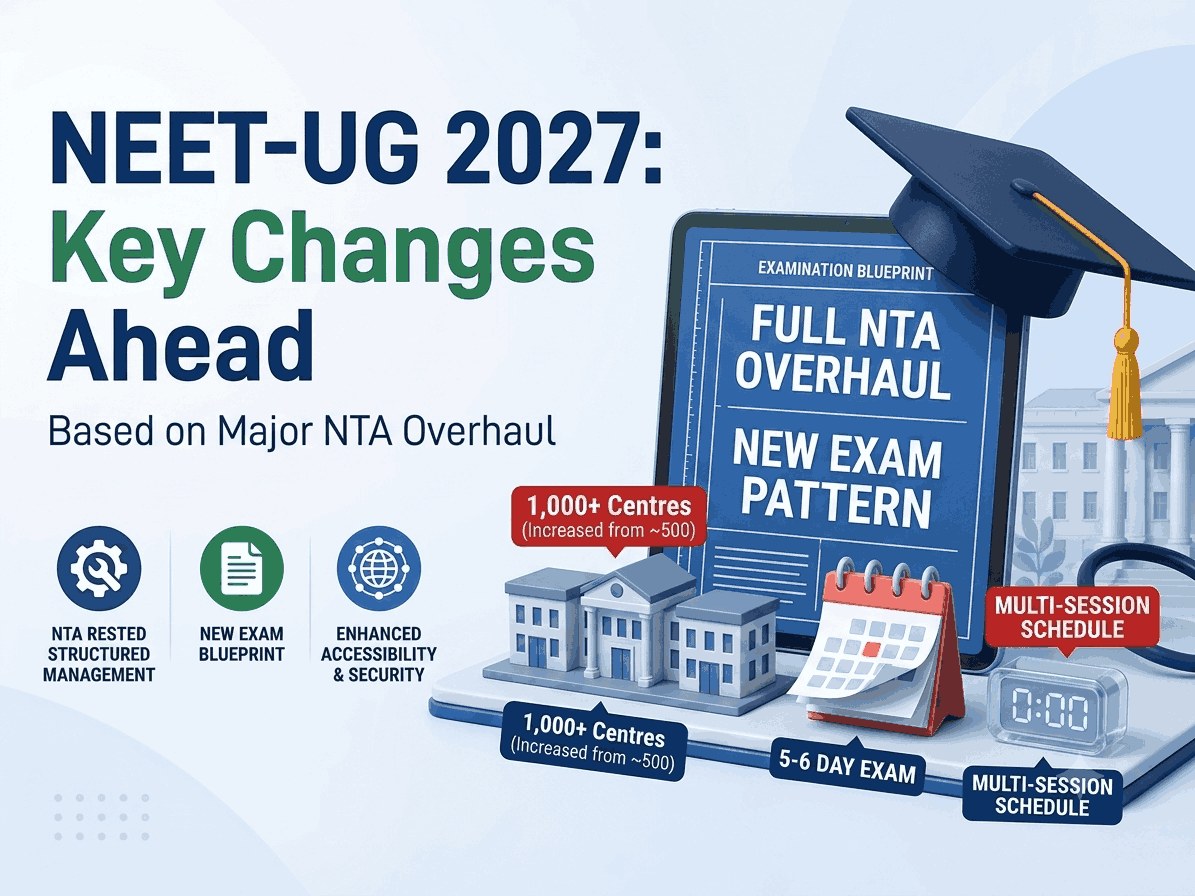
NEET-UG is about to change more in one year than it has in the last decade. Starting in 2027, the exam will move from pen-and-paper to computer-based mode, run across 5-6 days at roughly 1,000 centres nationwide, and sit inside a "top to bottom" overhaul of the National Testing Agency itself. If you're appearing in 2027, this is not a minor format tweak - it changes how you prepare, how the exam is scheduled, and how your score gets calculated.
This article breaks down what has actually been confirmed, what is still provisional, and what you should start doing right now, more than a year out from the exam.
NEET-UG 2027: Current Status at a Glance
The decision was announced by Union Education Minister Dharmendra Pradhan on May 15, 2026, following the cancellation and re-conduct of NEET-UG 2026 after a paper leak. NTA has since told the Supreme Court, through an affidavit, that it is preparing to conduct NEET-UG in computer-based test (CBT) mode from 2027.
Key facts confirmed so far:
Exam mode: Shifting from OMR pen-and-paper to computer-based test (CBT)
Duration: Spread across 5-6 days, instead of a single-day exam
Centres: Around 1,000 centres nationwide, mainly government institutions such as Kendriya Vidyalayas and Navodaya Vidyalayas, with some reputed private institutions also likely to be used
Daily capacity: Roughly 500 candidates per centre per day, totalling around 5 lakh candidates daily
NTA overhaul: A "top to bottom" restructuring of the agency's organisation, infrastructure, technology, and processes, expected to be completed before October 2026
Syllabus: Unchanged — still NCERT Class 11 and 12 Physics, Chemistry, and Biology
Marking scheme: Expected to remain +4 for correct, −1 for incorrect, 0 for unattempted, across 180 questions for 720 marks
A detailed NTA notification on shift timings, test cities, and the full exam calendar is still awaited and will follow once the agency revamp is completed.
Why This Is Happening: The Real Trigger
NEET-UG 2026 was cancelled and re-conducted on June 21, 2026 after allegations that question papers had leaked and circulated as "guess papers" before the exam. Briefing reporters, Pradhan named the root cause directly: the OMR-based, pen-and-paper format itself, which depends on physically transporting papers to thousands of centres — creating multiple points where a leak can happen.
This isn't a new idea. The recommendation to move NEET-UG to CBT mode was first made by the Radhakrishnan Committee, a seven-member panel headed by former ISRO chairman K. Radhakrishnan, constituted in 2024 after an earlier paper leak. The committee had also called for encrypted, digitally transmitted question papers printed on-site shortly before the exam, biometric identity verification, multiple exam shifts, and a "Red Team/Blue Team" cybersecurity model to continuously test the system for weaknesses. Most of these recommendations were not implemented in time for 2026 — which is part of why the government has now committed to the full switch for 2027.
What Changes for You: OMR vs CBT
The most important shift to understand isn't the number of centres — it's the exam interface itself.
How you answer: On OMR, you darken a bubble with a pen, permanently. On CBT, you simply click an option on screen.
Changing an answer: OMR makes this difficult and risks smudging your response. CBT lets you change it instantly, with no penalty.
Marking for review: Not possible on OMR sheets. CBT allows you to flag a question and come back to it later, just like in JEE Main and CUET.
Question paper delivery: OMR papers are physically transported to centres, creating multiple points of vulnerability. CBT papers are encrypted and delivered digitally, decrypted only minutes before the exam starts.
Number of shifts: The 2026 re-exam ran in a single shift. CBT is expected to run across multiple sessions over the 5-6 exam days.
NEET-UG was the last major national entrance exam still conducted on paper — JEE Main and CUET have run in CBT mode for years. If you've never taken a full-length computer-based exam before, this is the biggest adjustment ahead of you, independent of how well you know Physics, Chemistry, or Biology.
Multiple Shifts Means Normalisation Is Coming
Running the exam across 5-6 days and roughly 1,000 centres means NEET-UG will almost certainly move to a multi-shift format — something the single-shift 2026 re-exam did not use. When different candidates take different question papers across different days, raw scores aren't directly comparable, because paper difficulty can vary slightly between shifts.
To correct for this, NTA is expected to apply a percentile-based normalisation process — adjusting scores so that a candidate's relative performance within their shift is what carries forward, not just their raw marks. This is standard practice in other multi-shift NTA exams. The detailed formula and methodology have not yet been released, and this is one of the specifics to watch for once the official Information Bulletin is published.
If normalisation does apply, resist the temptation to compare your raw score directly against a friend who sat a different shift — your position within your own shift's distribution matters more than the raw number.
What Hasn't Changed (Yet)
Amid a genuinely large structural shift, a few things are confirmed to be staying the same:
Syllabus: No changes announced. It remains NCERT Class 11 and 12 content across Physics, Chemistry, and Biology, per NMC and NTA guidelines.
Marking scheme: +4 for correct, −1 for incorrect, 0 for unattempted is expected to continue.
Exam duration and question count: 180 compulsory MCQs, 720 total marks, over 3 hours — though this is subject to confirmation in the final bulletin.
Eligibility criteria: No changes have been announced regarding age or attempt limits.
Don't let format-change anxiety bleed into your actual subject preparation — the content you're studying stays the same.
Not Everyone Is Convinced This Fixes the Problem
It's worth knowing that the CBT shift is not without criticism, since this affects how much you should treat it as a guaranteed fix versus one part of a larger process.
The Federation of All India Medical Association (FAIMA) has pointed out that paper leaks and irregularities have occurred in CBT-format exams elsewhere too, including cases involving private institutes. The organisation has also filed a plea arguing that NTA never fully implemented the Radhakrishnan Committee's original recommendations — including encrypted digital transmission, biometric verification, and multi-shift testing — and that the 2026 leak was a predictable result of that gap, not an isolated failure.
Separately, a parliamentary standing committee had earlier supported retaining the pen-and-paper model, pointing to the track record of exams like UPSC and CBSE. The government has since moved forward with the CBT recommendation regardless.
None of this changes what you need to do to prepare — but it explains why the rollout is being watched closely, and why further adjustments to the plan between now and 2027 are a real possibility.
What NTA Has and Hasn't Officially Confirmed
It's easy to conflate "recommended," "announced," and "confirmed" in coverage of this topic — and the gap between them matters for how much weight to put on any single detail right now.
Officially confirmed: The shift to CBT mode from 2027, announced by the Education Minister and submitted to the Supreme Court by NTA in an affidavit.
Reported by sources, not yet in an official notification: The 1,000-centre count, the 5-6 day duration, the 5-lakh-candidates-per-day figure, and the "top to bottom" NTA restructuring timeline.
Still to be officially defined: Shift timings, test city list, exact number of sessions, the normalisation methodology, and the full exam calendar.
Treat the confirmed CBT shift as fact for your planning purposes. Treat the centre count and day count as the most credible current reporting — sourced from within the Ministry and NTA — but not yet a locked, notified figure. The gap between "sources said" and "official notification" is exactly where changes tend to happen before a final bulletin is released.
What to Do Now, More Than a Year Out
A year-plus runway before a major format change is unusually generous by NEET standards — and it's easy to waste that runway waiting for the official bulletin instead of using the time productively.
Start integrating computer-based mock tests into your routine now, even before the detailed NTA guidelines are out. The core skill gap isn't subject knowledge — it's screen-based exam mechanics: navigating between sections with a mouse or trackpad instead of flipping pages, using a "Mark for Review" flag, and managing a 3-hour exam without the tactile pacing cues a paper test gives you. Candidates who build this comfort early won't be adjusting to a new interface for the first time on exam day.
Keep watching for the detailed NTA Information Bulletin, expected once the agency's internal revamp is completed before October 2026. That bulletin — not the initial ministerial announcement — is what will lock in shift timings, city-wise centre allocation, and the exact normalisation approach.
Key Things to Remember
NEET-UG 2027 will be computer-based, spread over 5-6 days, at roughly 1,000 centres — officially confirmed for CBT mode, with centre and day figures currently sourced but not yet formally notified
The shift was triggered by the 2026 paper leak and re-exam, and follows recommendations first made by the Radhakrishnan Committee in 2024
Syllabus, marking scheme, and exam duration are expected to remain unchanged — only the mode of answering and scheduling structure is shifting
A multi-shift format likely means percentile-based normalisation will apply to your score
Some medical bodies have raised concerns that CBT alone won't fully solve exam security issues — worth tracking as the rollout continues
The detailed official Information Bulletin, with shift timings and city allocation, is still awaited
Start CBT-format mock practice now rather than waiting for the final notification — the interface adjustment is the one part of this change you can start preparing for immediately
This article is based on statements by Union Education Minister Dharmendra Pradhan (May 15, 2026), NTA's submission to the Supreme Court, and reporting on the Radhakrishnan Committee's recommendations. Figures on centre count, exam duration, and daily capacity are based on source reporting and are subject to change pending NTA's official notification. Always verify final details at neet.nta.nic.in once released.
Article Stats
You Might Also Like

What Is the MS Course? A Complete Guide to Introduction, Eligibility, NEET PG Counselling and Preparation

What Is the MD Course? A Complete Guide to Introduction, Eligibility, NEET PG Counselling and Preparation
Tripura MBBS BDS Round 3 Re-Revised Schedule 2026: Choice Filling, Merit List, Allotment and Admission Dates