 All Articles
NEET UG 2027 Computer Based Test: 1,000 Centres, 6 Days, 500 Cities — Full NTA Overhaul Explained
India's largest undergraduate medical entrance examination is about to change more fundamentally than it has in its entire history. Starting from the 2027 academic cycle, NEET UG will no longer be a pen-and-paper test. The central government has confirmed the transition to a Computer Based Test format — and the blueprint that is emerging is ambitious in scale, radical in structure, and long overdue given what the 2026 cycle put over 22 lakh students through.
Here is everything that is confirmed, what is still being finalised, why the NEET UG 2027 computer based test shift is happening now, and what it means for every student currently in Class 11 who will sit this exam next year.
What Is Confirmed: The NEET UG 2027 Computer Based Test Format
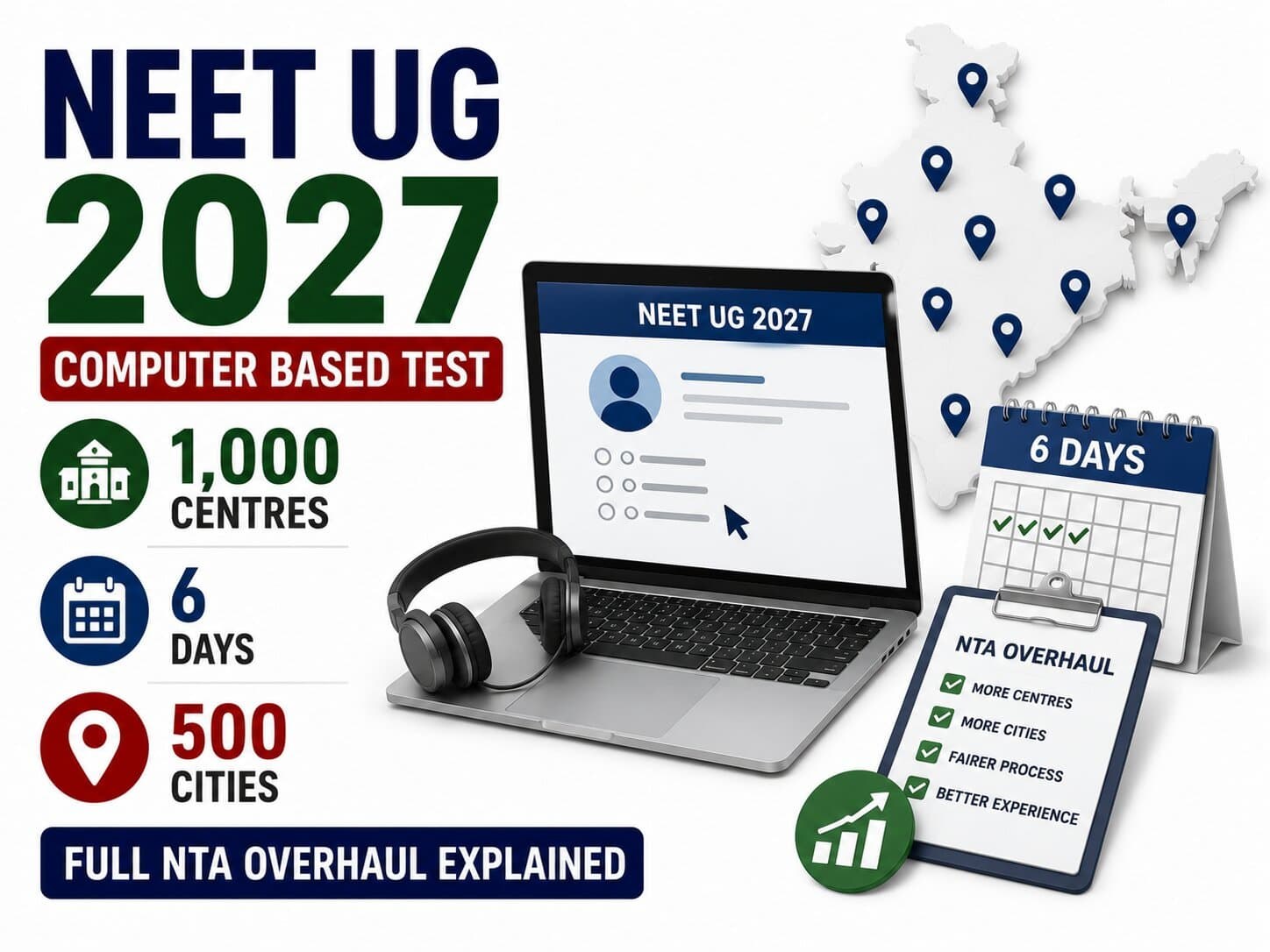
According to a report by The Indian Express — the publication that first broke the detailed blueprint — the NEET UG 2027 computer based test will be conducted over five to six days across approximately 1,000 examination centres in about 500 cities nationwide. This is the most significant structural change in the examination's history.
The key numbers at a glance:
Exam mode: Computer Based Test (CBT) — fully online, no pen-and-paper
Duration of exam window: 5 to 6 days (exact schedule to be released post-NTA restructuring)
Number of exam centres: Approximately 1,000
Cities covered: Around 500 cities across India
Daily candidate capacity: Approximately 5 lakh candidates per day
Candidates per centre per day: Approximately 500
Primary centre type: Government institutions — Kendriya Vidyalayas (KV) and Navodaya Vidyalayas (NV)
Additional centres: Select reputed private institutions with verified infrastructure
Education Minister Dharmendra Pradhan publicly confirmed the CBT transition on May 15, 2026, while announcing the Re-NEET UG re-examination. The confirmation came in line with the recommendations of the seven-member high-level committee constituted by the Ministry of Education in 2024, chaired by Dr. K. Radhakrishnan, former Chairman of ISRO.
The transition from pen-and-paper to NEET UG computer based test mode follows the model already established by JEE Main — India's largest engineering entrance examination — which has been conducted as a CBT across multiple days and sessions since 2019.
Why the NEET UG 2027 Computer Based Test Is Happening Now
The 2026 NEET UG cycle was a turning point. The original examination conducted on May 3, 2026, was cancelled after a paper leak controversy that triggered nationwide protests, a CBI investigation, and the cancellation of results for over 22 lakh candidates. A re-examination was conducted on June 21, 2026 — and the result of that re-examination is expected by July 20.
The paper leak was not an isolated incident. A Parliamentary Standing Committee on Education, which recently reviewed NTA's functioning, reported that over the past two decades, question paper leaks occurred in 45 major entrance examinations — each taken by at least one lakh candidates — but criminal convictions were secured in only two cases. That record is the institutional context behind the urgency of the current reform.
The Rajasthan Police SOG investigation found a "guess paper" containing over 100 questions similar to those that appeared in the May 3 NEET UG Biology and Chemistry sections. The series reportedly contained around 410 questions, of which approximately 120 are alleged to have appeared in the actual exam. That scale of breach in a single-day, single-shift, pen-and-paper exam reveals the fundamental vulnerability of the format — a vulnerability that a multi-day, multi-shift computer based test eliminates by making it structurally impossible to circulate the same paper.
For students who gave the Re-NEET on June 21 and are now waiting on the July 20 result, understanding how the current NEET UG 2026 answer key and score calculation works is the immediate priority — while the 2027 CBT format is forward-looking context for the next generation of aspirants.
The NTA Restructuring: What Changes Inside the Agency
Alongside the NEET UG 2027 computer based test format change, the central government is planning a complete structural overhaul of the National Testing Agency itself. Sources describe this as a "top to bottom" revamp — not a cosmetic adjustment but a fundamental rebuilding of the organisation that administers NEET UG, JEE Main, CUET, and dozens of other national examinations.
The restructuring covers five distinct dimensions:
Organisational structure: NTA currently operates with approximately 150 sanctioned posts — a remarkably lean headcount for an agency managing examinations taken by crores of candidates annually. The revamp is expected to expand staffing significantly across technical, administrative, and security functions.
Technology infrastructure: The shift to CBT requires a technology backbone capable of simultaneously hosting thousands of candidate sessions across 1,000 centres in real-time. This includes server infrastructure, secure content delivery systems, candidate interface software, and real-time monitoring dashboards.
Security protocols: AI-powered surveillance systems, biometric verification at centres, encrypted question delivery, and randomised question assignment across candidates in the same room — all designed to make the paper leak model of examination fraud structurally obsolete.
Exam execution systems: Multi-shift, multi-day exam logistics require coordination systems that pen-and-paper examinations do not — shift assignment randomisation, carry-forward prevention between shifts, and normalisation protocols for scoring across different test windows.
Administrative systems: Transparency in centre selection, auditable chain of custody for examination materials, and publicly verifiable centre credibility assessments.
The NTA restructuring is expected to be completed by October 2026. Once the restructuring is finalised, a detailed notification will be issued covering shift timings, the complete list of test cities, centre selection criteria, and other operational specifics for the NEET UG 2027 computer based test. No specific exam date for 2027 has been announced yet.
This restructuring timeline is relevant for Class 11 students beginning their NEET 2027 preparation now. The official notification — which will confirm the exact number of days, the shift pattern, the city list, and whether normalisation will be applied across shifts — will likely arrive between November 2026 and January 2027. Preparation in the interim should focus on subject knowledge and CBT interface familiarity rather than waiting for format specifics.
How the NEET UG Computer Based Test Format Changes Preparation
The content of NEET UG preparation does not change with the switch to CBT. The NCERT-based Biology, Physics, and Chemistry syllabus remains the same. What changes is the interface, the pacing discipline, and some strategic elements of exam-day execution.
Students who have grown up taking school and board examinations on paper may find the initial adjustment to a computer-based interface uncomfortable — but this is a short-term friction, not a structural disadvantage. JEE aspirants have navigated the CBT format for years, and the consensus from that population is that adaptation through mock practice on a CBT interface eliminates most of the unfamiliarity within a few weeks of consistent practice.
The specific changes in exam-day execution that students need to prepare for:
Navigation over scanning: In a pen-and-paper exam, a candidate can flip through the entire paper in 60 seconds and identify easy questions to answer first. In a CBT, navigation is sequential by default — candidates move through questions on screen and use the question palette to jump between numbers. The discipline of using the question palette efficiently, marking questions for review, and managing sectional time without the physical reference of a paper booklet is a learned skill.
On-screen calculations: Physics and Chemistry questions involving numerical calculations require either mental arithmetic, the on-screen calculator provided, or rough work on the physical rough sheet provided at the centre. Practising numerical problems without relying on writing intermediate steps on the question paper — as most pen-and-paper students do — is an adjustment that needs to be built into mock test practice.
Shift-based scheduling: With 5 to 6 days and multiple shifts per day, candidates will be assigned a specific date and shift. The NEET UG 2027 computer based test is expected to apply normalisation across shifts to account for variation in question difficulty — similar to JEE Main's approach. Understanding how normalisation works and what it means for your score versus your rank is preparation knowledge that will become important once the official format notification is released.
Mock CBT practice: NTA typically releases mock CBT interfaces for registered candidates before the actual examination. Treating these mocks as genuine timed practice sessions — rather than exploratory tool familiarisation — is the preparation habit that consistently produces better CBT performance.
For students currently in Class 10 considering medical careers, understanding the broader landscape of MBBS admissions and what an MBBS graduate can expect in the coming years is useful context alongside the format change.
The Dr. K. Radhakrishnan Committee: What It Recommended
The seven-member high-level committee chaired by Dr. K. Radhakrishnan — former Chairman of the Indian Space Research Organisation — was constituted by the Ministry of Education in 2024 following an earlier NEET paper leak. Its mandate was to review examination security systems and recommend structural reforms for national entrance examinations.
The committee formally recommended transitioning NEET UG from pen-and-paper to computer based test mode. This recommendation was not made lightly — the committee's deliberations involved consultation with exam experts, technology infrastructure providers, educational institutions, and student representative groups. The recommendation was accepted in full by the government, with Education Minister Dharmendra Pradhan confirming the CBT transition publicly on May 15, 2026.
The committee's broader recommendations also covered the multi-phase examination model — conducting the exam over multiple days rather than a single day — which the Parliamentary Standing Committee on Education subsequently endorsed as well. The Standing Committee specifically suggested that conducting NEET UG over multiple phases would reduce the logistical pressure of administering India's largest entrance examination in a single day and make large-scale paper leaks structurally far more difficult to execute.
The 2026 experience — where a single question paper circulated before the May 3 exam compromised the entire national examination — is the most direct possible argument for the multi-day, multi-shift CBT format. When the paper changes between shifts and between days, the model of obtaining and distributing a question paper in advance simply does not work.
What NEET UG 2027 CBT Means for Students Appearing in 2026 Counselling
For students who gave the Re-NEET 2026 and are waiting for results by July 20, the 2027 format change is background information — important for context but not immediately actionable. The 2026 counselling cycle will proceed on the existing pen-and-paper result. MCC AIQ counselling is expected to begin in the last week of August 2026, with WBMCC state quota counselling running in parallel.
The immediate priorities for 2026 Re-NEET candidates are result tracking, rank prediction, college research, and document preparation — not format changes for an exam they have already taken. Understanding what NEET UG score converts to at various rank levels and which colleges become accessible at those ranks is the preparation work that matters most right now.
For students who will attempt NEET UG 2027 — currently in Class 11, or Class 12 students who want to improve their 2026 result — the CBT transition is immediately relevant. These students have approximately 10 to 12 months before NEET 2027, and the best use of that time is subject-matter preparation that runs alongside gradual CBT interface familiarisation through available online mock platforms.
Financial planning matters too for families evaluating MBBS pathways. Top scholarships available for medical students after Class 12 are worth researching now — many scholarship applications have Class 12 result deadlines and annual application windows that open well before NEET results are declared.
The Investigation: Paper Leak Accountability and What Has Happened So Far
The criminal investigation into the NEET UG 2026 paper leak is ongoing. The CBI is handling the central probe. Rajasthan Police SOG conducted the initial investigation that uncovered the "guess paper" containing questions that appeared in the May 3 examination.
Public criticism has focused on the fact that arrests to date have primarily been of paper setters, translators, and distributors in the lower rungs of the leak chain — while those alleged to have masterminded and financially profited from the leak have not yet faced charges. Government sources, responding to this criticism, have stated categorically that investigations are ongoing and "no one will be spared if they have committed the crime."
The NTA and Ministry of Education officials briefed a Parliamentary Standing Committee on Education about the steps being taken to strengthen exam security. The briefing covered both the immediate measures taken for the Re-NEET on June 21 and the structural reforms planned for NEET UG 2027.
The record cited in that briefing — 45 major examination paper leaks over 20 years with only 2 convictions — reflects a systemic enforcement failure that the government has acknowledged. The combination of CBT format, NTA restructuring, and strengthened security protocols is the structural response to that record, but legal accountability for past leaks remains an open question that student groups and medical associations are actively monitoring.
The Bigger Picture: NEET UG 2027 Computer Based Test in the Context of Indian Medical Education
The NEET UG 2027 computer based test transition places India's medical entrance examination on the same footing as most major national examinations worldwide. The United States Medical Licensing Examination (USMLE), the UK's Medical Licensing Assessment (MLA), and equivalent examinations in Australia, Canada, and most EU countries are all administered in computer-based format. The move is not just an administrative reform — it is an alignment of India's medical entry examination with global standards.
For the approximately 25 lakh students who are expected to take NEET annually by 2027, the CBT format also addresses a basic fairness concern. In a pen-and-paper examination conducted on a single day at 5,400+ centres across the country, the variation in physical examination conditions — hall lighting, room temperature, paper print quality, invigilator consistency — introduces environmental factors that are outside a candidate's control. A standardised CBT environment at credibility-verified centres reduces this variation.
The choice of Kendriya Vidyalayas and Navodaya Vidyalayas as primary examination centres is also significant. These are government-run institutions with established infrastructure, accountable administration, and existing CCTV and security systems. Selecting centres with proven institutional accountability — rather than ad-hoc centres in coaching institute buildings or private venues without established security infrastructure — is one of the most important lessons the leak controversy generated.
Students exploring government medical college options in West Bengal and beyond as they prepare for either 2026 counselling or 2027 examination should review top medical colleges in West Bengal alongside the national landscape to understand their realistic options at various NEET rank levels.
What Happens Next: The Timeline to Watch
The NEET UG 2027 computer based test is confirmed in principle. The details are still being finalised. Here is the sequence of announcements to track:
By July 20, 2026: Re-NEET UG 2026 result declared on neet.nta.nic.in
Late July – August 2026: MCC releases 2026 AIQ counselling schedule; WBMCC releases state quota schedule
By October 2026: NTA restructuring expected to be completed
Post-October 2026: Detailed NEET UG 2027 CBT notification released — covering shift timings, city list, centre selection criteria, normalisation methodology, and registration process
Early 2027: NEET UG 2027 registration expected to open
2027 (date TBD): First NEET UG computer based test conducted
For students currently in Class 11, October 2026 is the horizon after which concrete planning for the new format becomes possible. Until then, NCERT subject preparation remains the highest-leverage activity — because the syllabus does not change even as the delivery format does.
For 2026 Re-NEET candidates in the middle of their counselling cycle, the complete counselling journey from rank to seat confirmation is the immediate focus — understanding which colleges are accessible at your predicted rank, how to build a choice list that covers both AIQ and state quota options, and what documents need to be ready before the choice-filling window opens.
The Short Version: What Every Student Needs to Know About NEET UG 2027 CBT
The NEET UG 2027 computer based test is confirmed, not speculative. Education Minister Dharmendra Pradhan said so on May 15. The Dr. K. Radhakrishnan committee recommended it. The Parliamentary Standing Committee on Education endorsed it. The blueprint from The Indian Express — 1,000 centres, 500 cities, 5-6 days, 5 lakh candidates daily — is detailed and credible.
What is not yet confirmed: the exact exam dates, the shift structure, whether one or two shifts will run per day, the specific normalisation formula, and the complete city list. These details will come after the NTA restructuring is completed by October.
What is already clear is the direction. India's NEET UG is moving from a single-day, single-paper, nationwide pen-and-paper format to a multi-day, multi-shift, computer based test conducted at verified government-institution centres. The paper leak model of examination fraud cannot survive this transition. That is its purpose. And for 25 lakh students who will sit NEET UG every year for the foreseeable future, it is long overdue.
All information in this article is based on confirmed government announcements and reports sourced from The Indian Express, Free Press Journal, Medical Dialogues, and Outlook India as of July 8, 2026. The NEET UG 2027 computer based test notification, including shift timings, test cities, and operational details, is expected after NTA's restructuring is completed by October 2026. All candidates should verify final details from nta.ac.in and neet.nta.nic.in once the official notification is released.
Article Stats
You Might Also Like

What Is the MS Course? A Complete Guide to Introduction, Eligibility, NEET PG Counselling and Preparation

What Is the MD Course? A Complete Guide to Introduction, Eligibility, NEET PG Counselling and Preparation
Tripura MBBS BDS Round 3 Re-Revised Schedule 2026: Choice Filling, Merit List, Allotment and Admission Dates