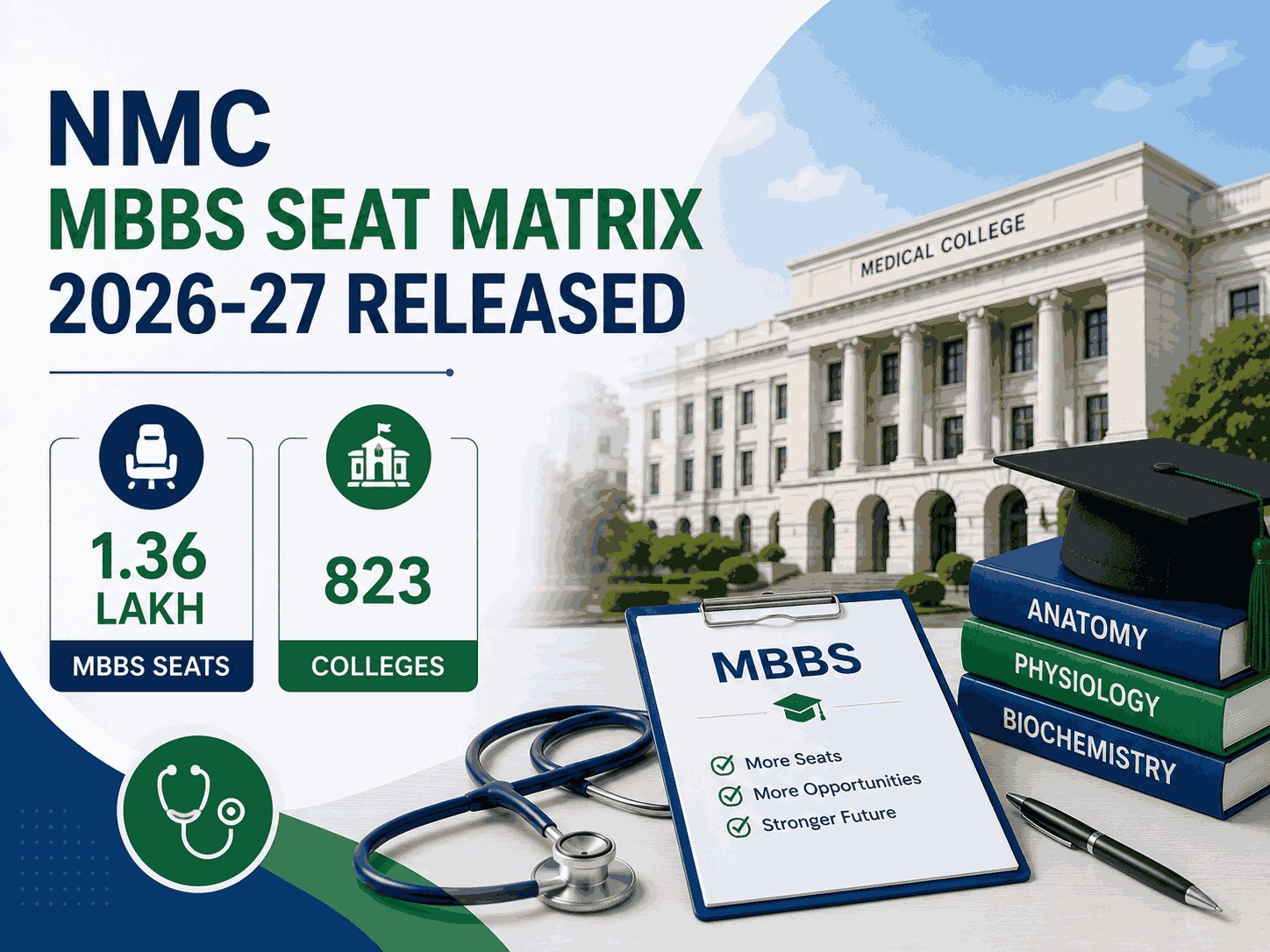
NMC has just handed out the single most important number of this counselling season: 1,36,939. That's how many MBBS seats are officially up for grabs in the 2026-27 academic session, and for the first time in years, the jump from last year is large enough to actually move cutoffs.
If you're heading into NEET UG counselling this year, the seat matrix isn't background reading — it's the document that tells you how many real shots you have, which colleges are new to the list, and which state to watch closely during choice-filling. Here's what has actually been released, what it means, and what's still pending.
MBBS Seat Matrix 2026-27: Current Status at a Glance
The Medical Assessment and Rating Board (MARB), under the National Medical Commission, released the seat matrix for the 2026-27 academic session in mid-July 2026, in an official communication issued by NMC Secretary Dr Raghav Langer. It covers colleges that had applied under the NMC's public notice dated December 22, 2025.
Key facts confirmed so far:
Total seats: 1,36,939 MBBS seats across 823 medical colleges nationwide
Coverage: Excludes Institutes of National Importance (INIs) such as AIIMS, JIPMER, and PGIMER, whose seats are managed separately through the MCC central pool
New seats added: 9,911 additional seats over last year, a 7.80% overall increase
Renewed seats: 1,27,028 seats carried forward from existing colleges
New colleges: 25 newly approved medical colleges — 7 government (400 seats) and 18 private (2,000 seats)
Basis of approval: Seats approved as of July 13, 2026
Status: Subject to revision if the Appeal Committee or any other competent authority orders changes
A detailed college-wise and state-wise breakdown is available on the official NMC website, and this is what counselling authorities will use for both All India Quota and State Quota admissions.
Why the Jump Is Larger Than Usual
Every year's seat matrix moves a little, but this one moved more than most. Government college seats grew from 61,185 across 441 colleges to 63,296 — an increase of 2,111 seats, or 3.45%. Private college seats grew from 65,843 across 382 colleges to 73,643 — an increase of 7,800 seats, or 11.85%.
Put together, private medical colleges account for roughly 78.7% of every new seat added this year. If you're relying on last year's private-college cutoff to judge your chances this time, treat that number with caution — a meaningfully larger private pool this year likely means cutoffs in that segment settle somewhat lower than 2025's.
Government seat growth, by contrast, has been steady rather than dramatic, continuing a pattern of incremental capacity addition rather than a sudden wave of new government medical colleges.
Government vs Private: What Changed and Why It Matters
The seat matrix doesn't just report one big number — it reports two very different stories underneath it.
On the government side, most of the movement comes from a modest number of brand-new colleges plus small intake increases at already-approved colleges. This is the segment most NEET aspirants aim for first, largely because of lower fees, and its growth rate this year is closer to what you'd expect in a normal admission cycle.
On the private side, the growth is sharper and driven by two things at once: 18 newly approved private colleges bringing 2,000 fresh seats, and a wider set of existing private colleges receiving intake increases. Private colleges granted new seats or new approvals also carry a compliance step attached — they're required to submit an E-Bank Guarantee to MARB within a short window to actually secure their Letter of Permission, which is one reason NMC has flagged that the matrix "remains subject to revision."
State-Level Reality Check
National totals are useful for context, but counselling happens state by state, and the increase hasn't landed evenly everywhere. Jammu & Kashmir, for instance, now has 1,675 total MBBS seats, made up of 1,525 government seats and 150 private seats — a state-specific figure that matters far more to a J&K-domicile candidate than the national 1,36,939 figure does.
The same logic applies wherever you're applying: don't anchor your expectations to the national increase alone. Pull the state-wise matrix for your own state (and any state where you hold domicile-based eligibility) before you start ranking your choices.
What Hasn't Changed
Amid the seat increase, a few structural pieces of the counselling process remain the same as previous years:
Quota split: Roughly 15% of government college seats go into the All India Quota (AIQ) run centrally by MCC, and the remaining 85% stay with State Quota counselling
AIIMS/JIPMER/PGIMER: Still counselled separately from this matrix, through the MCC central pool
Category-wise reservation: State-level reservation percentages for General/UR, OBC, SC, ST, EWS, and PwD categories continue to follow existing state policy
Round structure: Seats not accepted or vacated in earlier rounds still re-enter the pool for subsequent rounds, including the mop-up and stray vacancy rounds
Why the Matrix Still Isn't the Final Word
NMC has been explicit that this release is not necessarily the last version of the seat count for 2026-27. Two things can still move the number between now and the final rounds.
First, the Appeal Committee route: colleges that were denied seats or increases can appeal, and any resulting decision gets reflected in a revised matrix uploaded to the NMC website. Second, the compliance deadline for newly approved private colleges: those that fail to submit the required E-Bank Guarantee within the given window risk losing the newly sanctioned seats before they're even offered in counselling.
Neither of these is likely to swing the national total by much, but they can meaningfully change the picture for a specific college or state, especially in the private segment where most of this year's growth sits.
What to Do Now, Before Choice-Filling Opens
A seat matrix release is exactly the moment to move from general planning to concrete list-building, rather than waiting for counselling day.
Pull the official state-wise matrix for your domicile state and any other state you're eligible for, and note which colleges are new this year versus which ones simply had intake increases — the two carry very different risk profiles, since brand-new colleges often come with less established infrastructure and outcomes track record. Cross-check any college you're seriously considering against NMC's list of approved colleges directly on nmc.org.in rather than relying solely on aggregator sites, since this is the version that gets revised first if an appeal changes anything. And build your preference list around your realistic rank band using this year's seat count, not last year's — a 7.8% larger pool, concentrated mostly in private colleges, is enough to shift where a given rank lands.
Key Things to Remember
1,36,939 total MBBS seats across 823 colleges for 2026-27, a 7.80% increase over last year, excluding AIIMS/JIPMER/PGIMER
9,911 new seats added, with private colleges contributing 78.7% of that growth
Government seats: 63,296 (+2,111); Private seats: 73,643 (+7,800)
25 new medical colleges approved — 7 government, 18 private
The matrix is based on approvals as of July 13, 2026, and remains open to revision through the Appeal Committee process and pending private-college compliance deadlines
Always verify state-wise and college-wise figures on the official NMC website, before finalising your choice list
This article is based on NMC's official seat matrix communication issued by NMC Secretary Dr Raghav Langer and the public notice released by the Medical Assessment and Rating Board (MARB) in July 2026, along with subsequent state-wise notifications. Figures are subject to revision pending any Appeal Committee decisions or compliance outcomes for newly approved colleges. Always verify final, updated details at before counselling and choice-filling.
Article Stats
You Might Also Like
What Is the MS Course? A Complete Guide to Introduction, Eligibility, NEET PG Counselling and Preparation
What Is the MD Course? A Complete Guide to Introduction, Eligibility, NEET PG Counselling and Preparation
Tripura MBBS BDS Round 3 Re-Revised Schedule 2026: Choice Filling, Merit List, Allotment and Admission Dates