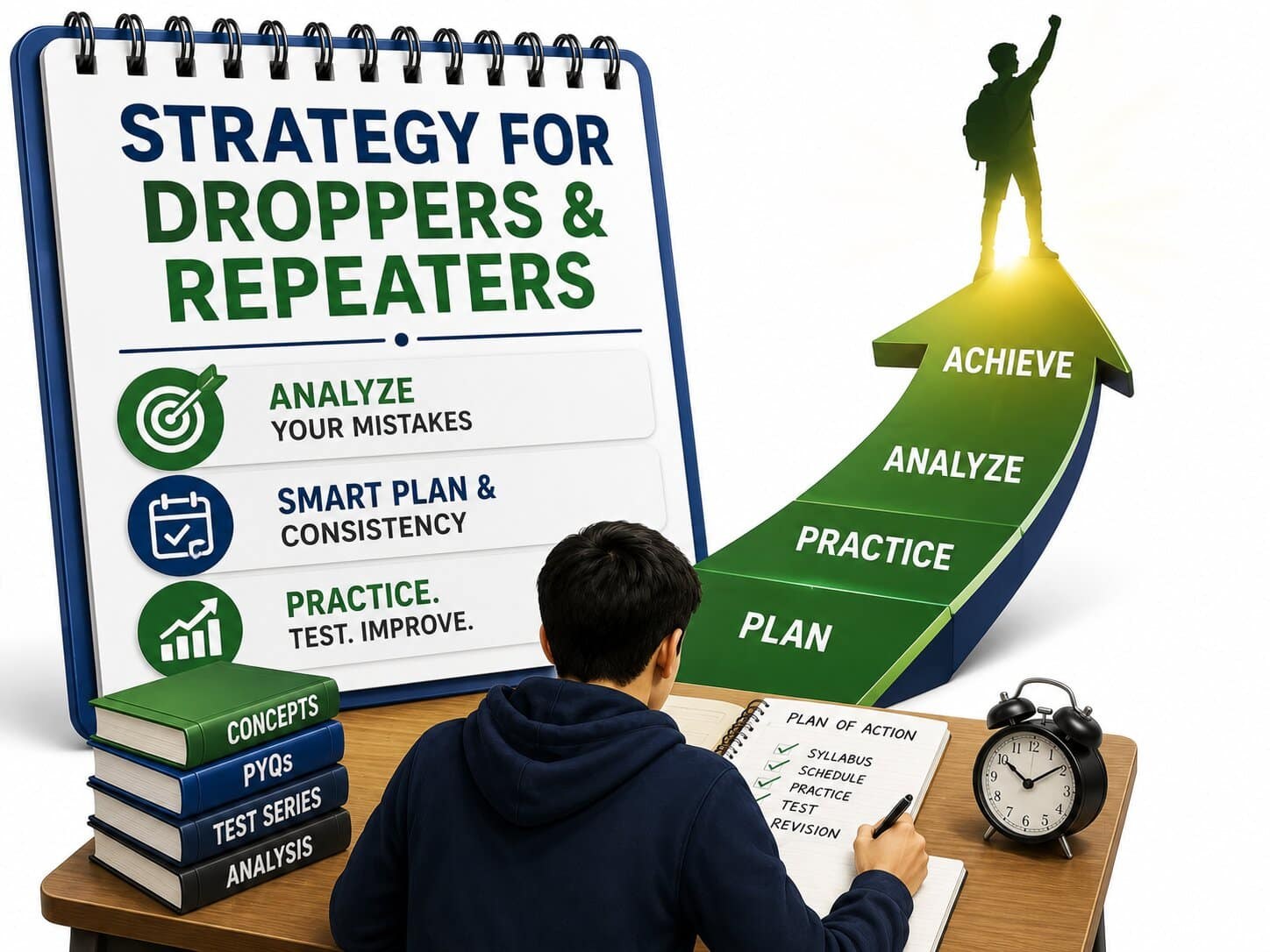
Repeating a year for JEE Main or WBJEE is a fundamentally different exercise from first-attempt preparation, yet many droppers unconsciously repeat the exact same study approach that produced their earlier result. The candidates who see genuine improvement in a repeat attempt are almost always the ones who first diagnosed specifically why the previous attempt fell short, rather than simply studying the same syllabus for a second, longer stretch of time.
Start With an Honest Diagnosis, Not a Fresh Restart
The most common mistake droppers make is treating the repeat year as a blank slate, discarding everything from the previous attempt and starting preparation from scratch. This wastes the single most valuable resource a repeater has that a first-time candidate does not: a complete, specific record of exactly where marks were lost last time.
Go through the previous year's mock tests and the actual exam's answer key analysis chapter by chapter, categorising every lost mark as a conceptual gap, a speed issue, a careless error, or an unattempted question due to time pressure
Identify whether the shortfall was concentrated in one subject or spread evenly, since these require very different fixes: a single weak subject needs targeted deep work, while an even shortfall across all three often points to time management or exam-day pressure rather than knowledge gaps
Be specific rather than general in this diagnosis; "Chemistry was weak" is far less useful than "Physical Chemistry numericals were consistently slow and Inorganic Chemistry retention faded by exam day"
Resist the urge to switch coaching materials, books, or teaching approaches entirely without first confirming that the previous materials were actually the problem, since sometimes the issue was execution rather than resources
Avoid the Trap of Re-Studying What Is Already Strong
Droppers often gravitate back toward the subjects and chapters they already feel comfortable with, since revisiting familiar material feels productive and reassuring. This instinct, left unchecked, means a second attempt can end up looking remarkably similar to the first, with strong areas getting stronger while the actual gaps that caused the shortfall remain unaddressed.
Allocate a deliberately larger share of study time to the specific weak areas identified in the diagnosis phase, even when this feels less comfortable than revisiting strong chapters
Set explicit, measurable targets for weak areas, such as reaching a specific accuracy percentage in Physical Chemistry numericals or cutting average solving time in a Mathematics chapter by a defined margin
Track progress against these targets through updated mock test results rather than judging progress purely by how much material has been read again
Where a subject was uniformly weak rather than gap-specific, consider a genuinely different approach for that subject this time, whether that means new material, a different teacher, or a structural change like daily timed practice instead of untimed reading
Managing the Psychological Weight of a Repeat Attempt
A dropper year carries a different emotional texture from a first attempt, often including pressure from family expectations, comparison with peers who have moved ahead, and the weight of having already experienced one exam-day outcome that fell short. Left unmanaged, this pressure tends to show up as either burnout from overcompensating or paralysis from fear of repeating the same result.
Set a realistic, specific target score or rank range based on genuine diagnostic data rather than an emotionally driven number meant to prove something to others
Build in scheduled rest days rather than treating every single day as one that must be maximally productive, since sustainable pace over twelve months outperforms unsustainable intensity that collapses by month eight
Avoid comparing this year's preparation timeline directly against the previous year's, since the diagnostic, gap-focused approach a repeater should follow does not map cleanly onto a first-attempt calendar
Where anxiety or motivation genuinely affects daily preparation, treat this as seriously as any academic gap, since sustained focus over a full year is itself a skill that sometimes needs deliberate attention rather than being assumed to simply happen
Structuring the Repeat Year Around Mock Test Data
Since a repeater already has a full previous attempt's worth of data, mock tests in the repeat year should be used more analytically than in a first attempt, where mock tests often simply build familiarity with the exam format. A dropper already knows the format; the mock tests this time exist to validate whether the specific gaps identified in the diagnosis phase are actually closing.
Take mock tests at a similar frequency to the middle phase of a fresh aspirant's preparation, but review them specifically against the previous year's known weak points rather than starting a new error log from zero
Track whether previously weak chapters are showing measurable improvement in both accuracy and speed across consecutive tests, since a repeater who is not seeing movement here needs to revisit their approach to that specific chapter rather than simply repeating more of the same practice
Revisit the actual previous year's exam paper itself periodically, since re-solving it under timed conditions offers a direct, concrete measure of how much genuine improvement has occurred since the last attempt
Where a repeat candidate is targeting both JEE Main and WBJEE, keep in mind that the two exams weight subjects differently, so a gap that mattered less under one exam's weighting scheme may need reprioritising under the other
Setting a Realistic, Data-Backed Target for the Repeat Attempt
One of the most grounding steps a dropper can take early in the repeat year is translating diagnostic improvement targets into a realistic score or rank goal, rather than preparing toward a vague sense of "doing better." Understanding how marks convert into rank and percentile allows a repeater to work backward from a specific, achievable target college or branch, which tends to sustain motivation far better across a long preparation year than an open-ended goal of simply improving on the previous attempt.
The Bottom Line
A repeat year succeeds or fails based on how honestly the previous attempt is diagnosed and how deliberately the resulting gaps are addressed, rather than on how many additional hours are logged in already-familiar territory. Droppers who treat their previous attempt's data as a diagnostic asset, set specific and measurable targets for identified weaknesses, and manage the psychological weight of a second attempt as seriously as the academic preparation itself are the ones who typically see a genuine, not just incremental, improvement in their final result.
Article Stats
You Might Also Like

What Is the MS Course? A Complete Guide to Introduction, Eligibility, NEET PG Counselling and Preparation

What Is the MD Course? A Complete Guide to Introduction, Eligibility, NEET PG Counselling and Preparation

Tripura MBBS BDS Round 3 Re-Revised Schedule 2026: Choice Filling, Merit List, Allotment and Admission Dates