Choosing the country for your MBBS degree is one of the vital decisions that will shape your medical profession. Indian MBBS aspirants who have done NEET will have come to a critical crossroads: they either contest a hard struggle with a very limited number of government seats, or they choose to pay a heavy sum for a seat in a private medical college in India, or they chase admission in foreign medical universities for MBBS. With the help of this comprehensive guide, you will be able to weigh the two alternatives and select the one that matches your financial situation as well as your career aspirations.
The NEET Reality: Your First Challenge
Clearing NEET is necessary for both sides. But the competition is very different. Every year, more than 2 million students in India compete for only 90,000 medical seats. It really is a very competitive situation to get into an MBBS program abroad. This major difference provides opportunities for below-average NEET scorers who, in fact, are not so lucky with Indian medical colleges.
The NEET eligibility abroad requirement was established by the National Medical Commission (NMC). Therefore, whether you wish to study domestically or overseas, passing the NEET is the only way to get into college.
Comparing prices is a huge benefit of travelling overseas:
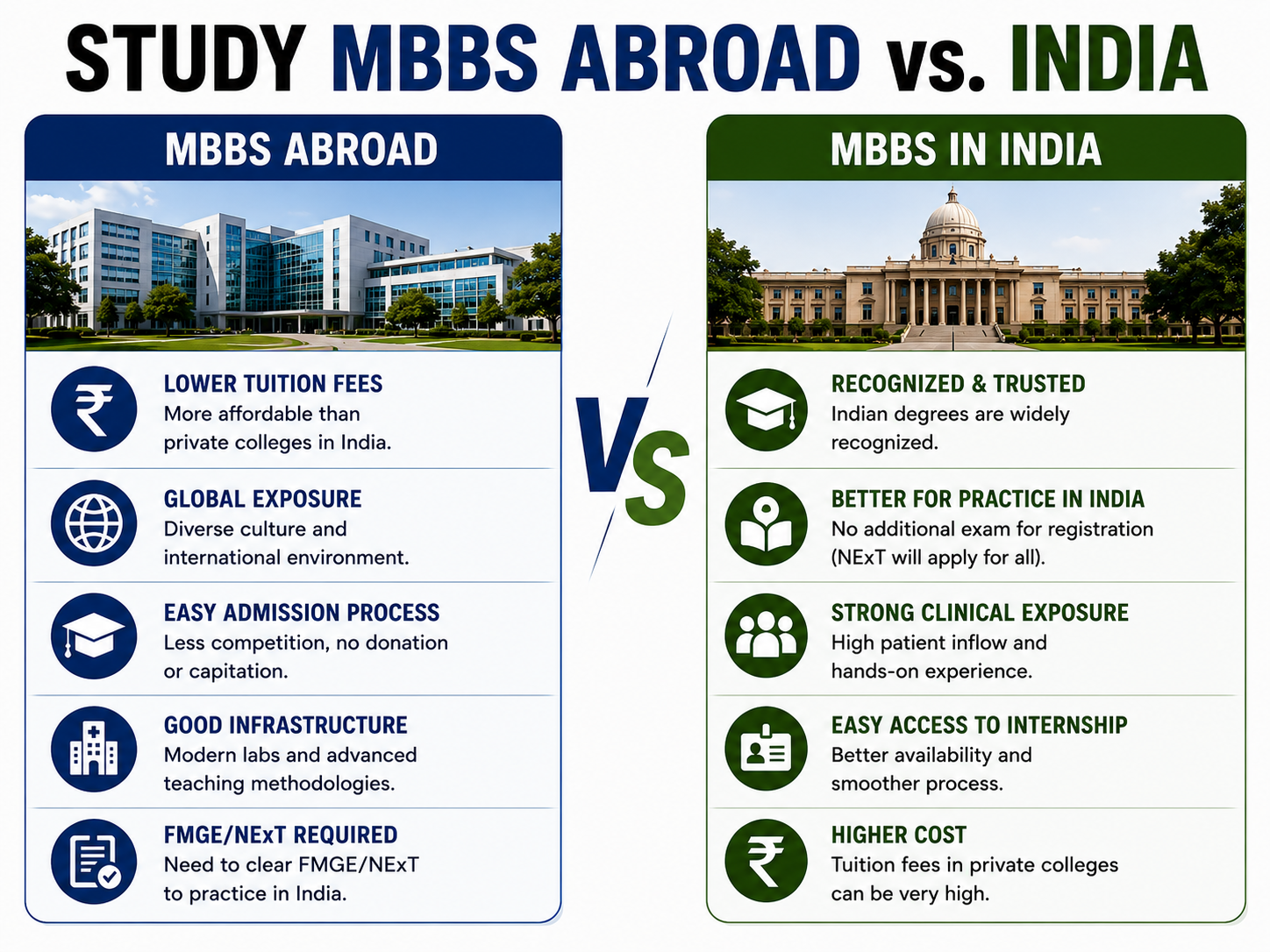
The affordability of MBBS abroad admission is among the strongest arguments in favour of this option. The breakdown of the money is as follows:
In India, the cost of a government MBBS program ranges from ₹50,000 to ₹1,00,000 annually (very competitive, very few seats).
Many families cannot afford the ₹50 to ₹1 crore cost of private MBBS in India.
The entire cost of an MBBS abroad program ranges from ₹20 to ₹45 lakhs, depending on the nation.
Compared to private colleges in India, Russia, Ukraine, Poland, Hungary, the Czech Republic, and Lithuania, which provide high-quality medical education at substantially lower prices. You can also avoid the capitation fees that are typical of private medical schools in India.
Admissions Procedure: Competitiveness vs. Simplicity
India:
A centralized approach to counselling
fiercely competitive, with seat distribution based on cutoff ranks
restricted options after results are revealed
High levels of competition-related pressure
Abroad:
Direct admissions procedure made simpler
Universities look over your credentials and NEET results
More accommodating deadlines
Reduced rivalry for seats
NMC Recognition: Making sure your degree is valid
This is important. Your degree should be verified by the NMC for you foreign medical universities to be able to practice in India. Check with the WDOMS if the foreign university you plan to apply to is listed before submitting your application. In fact, only such NMC recognition will ensure that your degree is valid for the next NEET exam or the FMGE.
Confirmation of critical actions:
To see the WDOMS listing, go to the official website.
Check for ECFMG and FAIMER approval.
Check the university's accreditation status.
Ensure the five-year MBBS course is aligned according to NMC requirements.
India's advantages in terms of the educational environment and infrastructure
High patient volume and exposure to a range of situations
Clinical infrastructure has been established in government colleges.
Make contact with the Indian healthcare system
Internship placements are easier.
The Advantages of Living Abroad:
Modern laboratories and state-of-the-art facilities
More individualized attention is possible with smaller class sizes.
English-medium instruction (though this is also offered in India)
Cultural variety and international exposure
Initial clinical training rotations
Career Prospects: India vs Abroad
Students who choose to enroll in an MBBS abroad have excellent career opportunities worldwide:
Programs for MDs and residents in the United States, the United Kingdom, Canada, and Australia
After passing the appropriate licensing exams (USMLE, PLAB, ECFMGE), direct practice abroad
exposure to various medical procedures and healthcare systems abroad
International networking with a range of medical specialists
But an MBBS in India provides:
After finishing NEXT (formerly FMGE alternative for Indian graduates), practice registration goes smoothly.
No further screening tests are necessary.
Easy access to postgraduate seats in India
Knowledge of the Indian healthcare system is highly valued.
Important Elements
To practice medicine in India after earning your MBBS overseas, you must pass the FMGE/NExT exam.
This includes:
A computer-based test consisting of 300 questions that is administered every year in June and December
A passing score of at least 50%
An NMC-recognized Indian medical college requires a 12-month internship.
Temporary registration with the State Medical Councils, followed by permanent registration
If you intend to practice in India, this extra obstacle means that your educational timeline goes beyond the five to six-year course duration.
Important Considerations for Your Decision:
Select MBBS Abroad if:
Although your NEET score qualifies you for top government positions
You're looking for reasonably priced private medical education
You want to practice medicine internationally.
You appreciate being exposed to various healthcare systems.
The affordability of private colleges in India is restricted by budgetary constraints.
Choose MBBS in India if:
You scored exceptionally high in NEET for eligibility in government seats.
You prefer seamless local practice without additional licensing exams.
You prioritise expertise in Indian healthcare systems
You want to avoid lengthy visa and immigration processes
You prefer to be close to family and the cultural environment.
The Final Statement
Both roadways lead to legitimate medical careers, but they serve different aspirations. MBBS admission abroad, through foreign medical universities by NMC recognition, comes with accessible, affordable education along with global career opportunities. Abroad, NEET eligibility requirements ensure quality standards are followed to protect students and patients alike.
A foreign medical university will promise an alternative that does not compromise on education quality for the average scorer of NEET, with expensive private college fees in India. On the other hand, if you get a competitive rank in the NEET, government medical colleges of India offer far better accessibility to the Indian health care and patient population.
Ultimately, your decision should not be different from what your career vision is, be it becoming a doctor in your own country, emigrating to practice abroad, or leaving all doors open. Whatever you choose, do your research, check with the NMC for recognition of the foreign university, and plan out your pathway to licensure post-graduation.
Article Stats