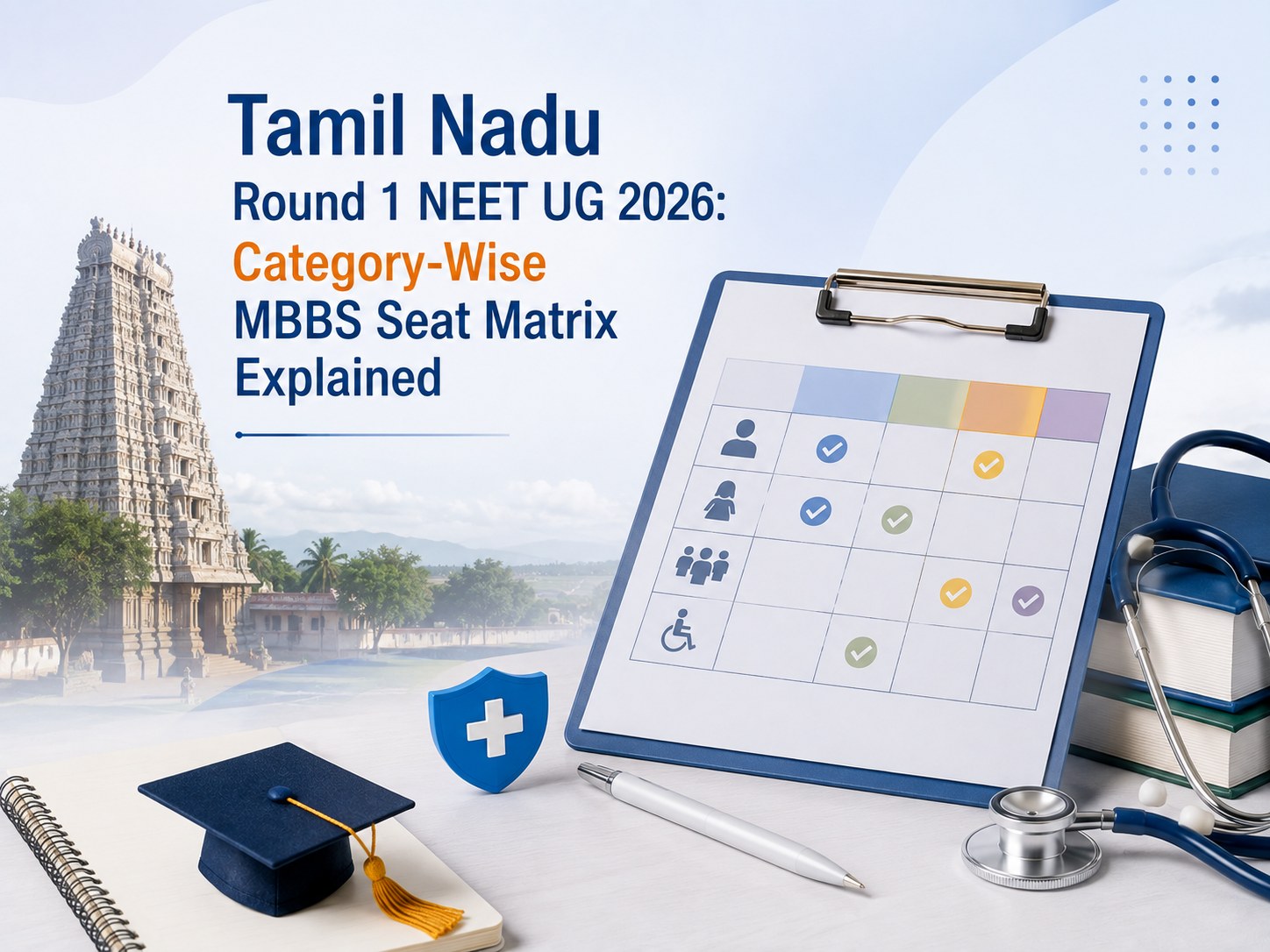
Once Tamil Nadu's Round 1 counselling opens, the single most important document for any candidate isn't the overall seat count - it's the category-wise breakdown of who's competing for what. Here's a complete look at how Tamil Nadu's MBBS seat matrix is structured and what it means for your Round 1 strategy.
Total MBBS Seats in Tamil Nadu for 2026-27
Tamil Nadu's total MBBS seat count for the 2026-27 session stands at 13,999, spread across 17 government medical colleges and 61 private medical colleges, per the official seat matrix. Of this total, 5,199 seats are in government medical colleges, with the remaining 8,800 in private and self-financing colleges. The state saw an increase of 950 MBBS seats this year, spread across 13 medical colleges - 3 government and 10 private.
Government medical college seats are further split by the standard NMC-mandated structure: 15% of these seats go to the MCC All India Quota (AIQ) pool with no domicile restriction, while the remaining 85% form Tamil Nadu's own state quota, filled through the Directorate of Medical Education's own counselling process and open only to candidates meeting Tamil Nadu domicile or nativity requirements.
How Category-Wise Reservation Works in Tamil Nadu
Tamil Nadu follows a distinctive, detailed reservation structure for its 85% state quota seats, different in both categories and percentages from many other states. The breakdown is: OC (Open Category) 31%, BC (Backward Class) 26.5% — which includes an internal BC-M (Backward Class Muslim) sub-quota of 3.5% — MBC & DNC (Most Backward Class & Denotified Communities) 20%, SC (Scheduled Caste) 18% (with an internal SCA sub-quota of 3% for specific Scheduled Caste Arunthathiyar candidates), and ST (Scheduled Tribe) 1%. A horizontal PwBD (Persons with Benchmark Disability) reservation of 5% also applies across categories.
On top of this, Tamil Nadu applies a distinctive 7.5% Government School Students horizontal quota, introduced under Tamil Nadu Act 2020, specifically reserved for candidates who studied continuously in Tamil Nadu government schools - a reservation category not found in most other states' medical counselling systems.
Why This Matters More in Round 1 Than Any Other Round
Round 1 is when the full category-wise seat matrix is applied for the first time against the merit list, meaning this is the round where category-specific competition is most transparent and predictable. Category-wise merit lists are published separately, and seats are allotted strictly according to a candidate's community rank within their category — not just their overall NEET rank - which is why understanding your specific category's seat share matters as much as your raw score.
For candidates applying under the 7.5% Government School Students quota specifically, Round 1 is also where this horizontal reservation is first applied across all applicable categories, layered on top of the standard OC/BC/MBC/SC/ST breakdown rather than replacing it.
What Recent Cutoff Trends Suggest
Government medical college cutoffs in Tamil Nadu have trended upward in recent years, reflecting intensifying demand for the 85% state quota specifically. Private colleges remain comparatively more accessible for lower-scoring candidates outside the government quota, though this varies significantly across the state quota, management quota, and NRI quota seats within private institutions. Category reservations continue to make a significant difference — a candidate's community rank within BC, MBC, SC, or ST can open up seats that would be entirely out of reach based on state rank or All India Rank alone.
What to Do Now
Locate your specific community rank - not just your NEET score or state rank - before Round 1 choice filling, since Tamil Nadu's counselling is driven heavily by category-wise merit lists rather than a single unified rank order.
Check whether you qualify for the 7.5% Government School Students horizontal quota, since this can meaningfully improve your chances if you meet the continuous-study requirement, and it applies on top of your regular category rather than instead of it.
Cross-check the official, currently released seat matrix on the Tamil Nadu Selection Committee's portal (tnmedicalselection.net) for the exact, confirmed category-wise breakdown for this specific counselling year, since seat numbers can shift slightly from year to year even when reservation percentages stay fixed.
Build your Round 1 choice list around your category-specific historical cutoff trends rather than general college reputation alone, since the closing rank for the same college can differ dramatically across OC, BC, MBC, SC, and ST categories.
Key Things to Remember
Tamil Nadu has 13,999 total MBBS seats for 2026-27 across 17 government and 61 private colleges, with government seats split 15% AIQ / 85% state quota.
Tamil Nadu's state quota reservation structure is OC 31%, BC 26.5% (incl. BC-M 3.5%), MBC & DNC 20%, SC 18% (incl. SCA 3%), and ST 1%, with a horizontal 5% PwBD and 7.5% Government School Students quota layered on top.
Round 1 is the round where category-wise merit lists and community rank matter most directly for seat allotment.
Government college cutoffs continue to trend upward, making category-specific rank tracking essential for realistic Round 1 planning.
This article is based on the officially released Tamil Nadu NEET UG 2026 MBBS seat matrix and reservation policy. Candidates should verify the exact, current seat numbers and category-wise breakdown on the official Tamil Nadu Selection Committee portal (tnmedicalselection.net) before Round 1 choice filling.
Article Stats
You Might Also Like
What Is the MS Course? A Complete Guide to Introduction, Eligibility, NEET PG Counselling and Preparation
What Is the MD Course? A Complete Guide to Introduction, Eligibility, NEET PG Counselling and Preparation
Tripura MBBS BDS Round 3 Re-Revised Schedule 2026: Choice Filling, Merit List, Allotment and Admission Dates