Clearing NEET UG 2026 was the hard part. But for thousands of medical aspirants from West Bengal, the battle for an actual college seat is only just beginning. With the exam now done and results around the corner, the spotlight is shifting to a process that will determine everything that comes next, which college, which course, which city, and which future. That process runs entirely through the West Bengal Medical Counselling Committee, and if you are a NEET qualifier from this state, understanding how it works is no longer something you can afford to delay.
The WBMCC Information Bulletin 2026, the official document governing state-level medical admissions in West Bengal, is the single most important piece of paperwork in a candidate's post-NEET life. It will tell you whether you are eligible, how to register, what documents to bring, how seats get allotted, and what happens if you miss a deadline. Miss a step here and you could lose a seat you genuinely deserved. Get it right, and a government MBBS seat in West Bengal could be yours.
What Is the WBMCC and Why Does It Hold So Much Power?
When the NTA declares NEET UG results, the National Testing Agency's job is essentially over. What kicks in immediately after is the counselling phase, the seat allotment process, and this is where an entirely different authority takes charge.
At the national level, the Medical Counselling Committee handles only a slice of available seats. The WBMCC controls the rest, specifically for West Bengal. Its jurisdiction covers:
85% state quota seats** in all government medical and dental colleges in West Bengal
100% of seats** in private medical and dental colleges within the state
Admissions to AYUSH courses — BAMS (Ayurveda), BHMS (Homoeopathy), and BUMS (Unani)
In plain terms: if you want a government MBBS seat in West Bengal through the state quota, or a private medical college seat in the state, the WBMCC is the only door you can knock on. There is no parallel route, no shortcut, and no exception.
Who Gets to Participate: The Eligibility Conditions
Not every NEET qualifier automatically gets a spot at the WBMCC counselling table. The committee has defined clear eligibility conditions, and candidates must satisfy every single one of them:
Must have qualified NEET UG 2026 with the minimum score required for their category
Must be an Indian citizen
Must have passed Class 12 with Physics, Chemistry, Biology, and English as core subjects
Must meet the West Bengal domicile requirement for state quota seats, proof of residential connection to the state is mandatory
Minimum qualifying marks differ by category, SC, ST, OBC-A, OBC-B, EWS, and PwD candidates have separate cutoff thresholds
The domicile condition trips up many candidates every year. West Bengal's 85% state quota seats are specifically reserved for students who belong to the state. Candidates from other states are not eligible for these seats. The exact definition of domicile, what documents establish it, which authority issues them, will be clearly specified in the official bulletin. Read that section with particular care.
Registration Is Fully Online, But Mistakes Are Costly
The WBMCC has moved its entire counselling process online. There are no physical registration counters, no forms to courier, and no queues at government offices. Every step happens through the official WBMCC portal.
The registration process works like this:
Step 1 — Sign up on the portal using your NEET UG 2026 roll number and basic personal details
Step 2 — Fill in your full profile, personal information, academic details, NEET scorecard data
Step 3 — Pay the counselling registration fee online, this fee is non-refundable under any circumstance
Step 4 — Upload documents in the specified format, size, and resolution
Step 5 — Complete document verification, this may be done online or may require a physical visit to a designated centre, depending on what the bulletin specifies
A word of warning that cannot be stressed enough: do not rush through registration. Every year, candidates lose their shot at a seat because of small, avoidable errors, a wrong NEET roll number, a mismatch between their name in the form and on their certificate, an expired category certificate, or a blurry document scan. Fill in each field slowly. Cross-check against your original documents. Save drafts at every stage before final submission.
The Counselling Rounds: This Is Where Seats Are Won and Lost
The WBMCC runs admissions across multiple rounds. Each round has its own purpose, its own window, and its own set of rules. Missing the timeline in any one of them can set a candidate back significantly.
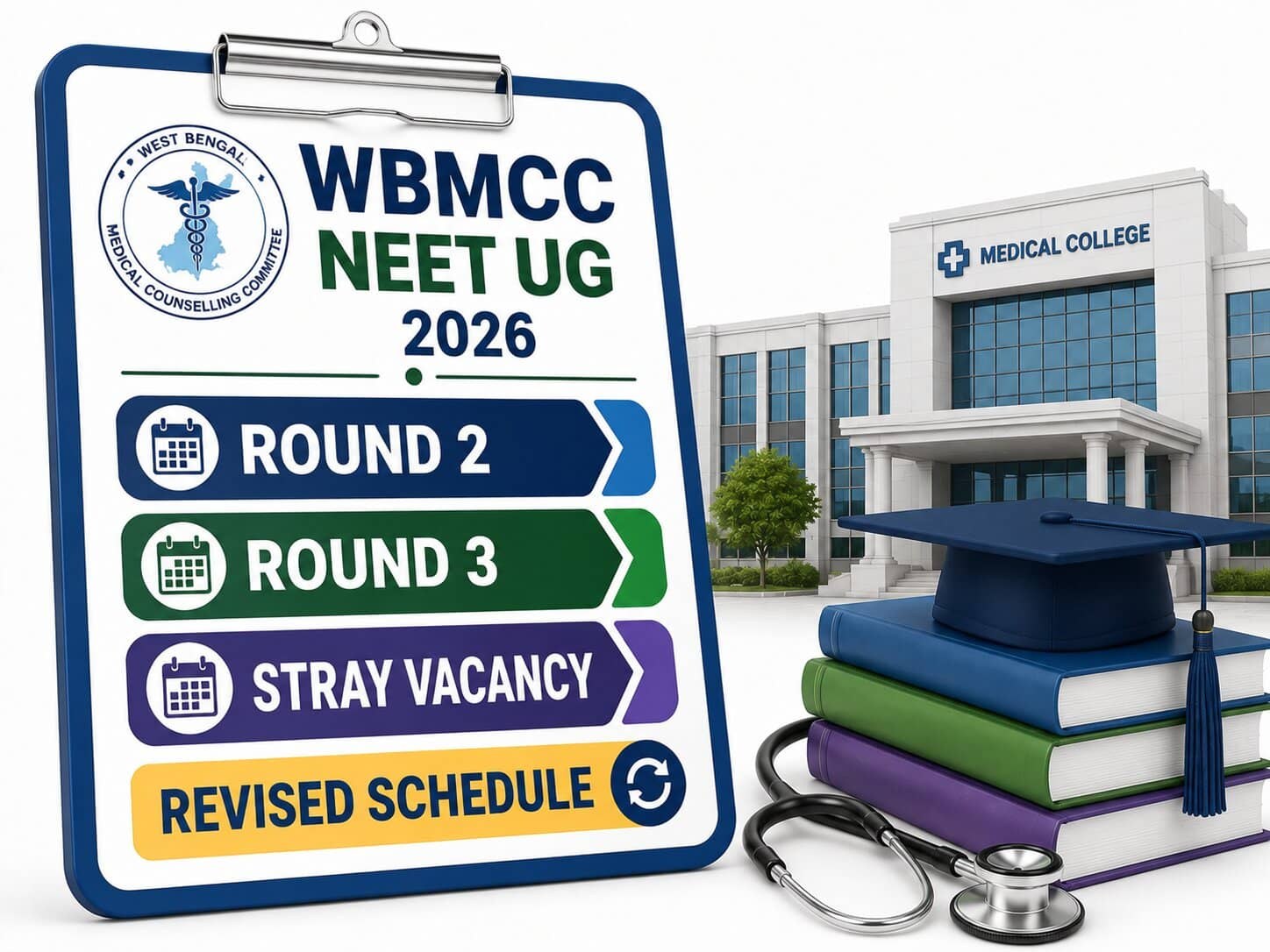
Round 1 — The First Shot:
- Eligible registered candidates fill in their college and course preferences online
- Preferences must be ranked — most preferred at the top, least preferred at the bottom
- The WBMCC algorithm processes all candidates simultaneously, sorting by NEET rank, category, and stated preferences
- Round 1 allotment results are published; candidates who receive a seat must decide within the deadline whether to accept, pay the required fees, and proceed
Round 2 — The Second Chance:
- Candidates who did not get a seat in Round 1 get another opportunity here
- Candidates who received a Round 1 seat but want something better can also participate
- Fresh choice filling is permitted — preferences can be revised
- Upgradation to a better allotment is possible, but only if a better seat is actually available and the candidate's rank supports it
Mop-Up Round — Filling the Gaps:
- After Round 2 concludes, some seats inevitably remain vacant
- These could be seats nobody chose, or seats where allotted candidates failed to report
- The mop-up round opens these vacancies to candidates who are still without a seat
- This is often the last realistic opportunity for candidates with lower ranks to secure an allotment
Stray Vacancy Round — The Final Window:
- Any seats still unfilled after the mop-up round enter the stray vacancy stage
- This round is conducted directly by individual colleges, not through the central WBMCC portal
- Candidates interested in stray vacancy seats must contact the respective college directly, as per instructions issued at that time
One rule applies across all rounds without exception: deadlines are final. The WBMCC does not grant extensions for individual candidates. If you miss a reporting deadline, your seat goes to the next person in line.
Reservation Policy: Categories Recognised Under WBMCC
West Bengal's state quota seat reservation follows the state government's official framework. The categories covered under WBMCC counselling are:
SC— Scheduled Caste
ST— Scheduled Tribe
OBC-A— Other Backward Classes, Category A
OBC-B — Other Backward Classes, Category B
EWS— Economically Weaker Section
PwD — Persons with Disabilities
Two important points here. First, West Bengal has two OBC sub-categories — OBC-A and OBC-B — which is different from the central OBC framework. Candidates must ensure their certificates reflect the correct West Bengal state category. Second, certificates issued by authorities in other states are not valid for West Bengal state quota reservation. Your certificate must be issued by the appropriate West Bengal government authority and must be current and valid.
Private college seat reservations may follow different rules. The bulletin will specify the exact matrix.
Documents You Must Prepare Right Now
This is where many candidates make the mistake of waiting until the last minute, and then scrambling when something is missing or has expired. Start gathering these documents today:
- NEET UG 2026 scorecard
- NEET UG 2026 admit card
- Class 10 marksheet and passing certificate (for date of birth verification)
- Class 12 marksheet and passing certificate
- West Bengal domicile certificate (for state quota applicants)
- Category certificate — SC, ST, OBC-A, OBC-B, or EWS, issued by West Bengal authority
- PwD certificate from a competent medical board, if applicable
- Valid government-issued photo ID — Aadhaar, Voter ID, or Passport
Check each certificate's validity date. Ensure the name on every document matches exactly. Get clean, high-resolution scans of everything and keep them saved in a dedicated folder. The WBMCC will not accept blurry uploads, and there is typically no provision to resubmit documents after the window closes.
What Does It Cost: The Fee Structure
WBMCC counselling involves two distinct payments that candidates must be prepared for.
Registration fee: Paid upfront when registering on the portal. This is non-refundable — you pay it to participate in the process, and it is not returned regardless of whether you receive a seat.
Tuition fee payment: Once a seat is allotted and a candidate chooses to accept it, a portion of the tuition fee must be paid online to confirm the acceptance. The amount varies considerably depending on the type of institution
Government medical colleges carry significantly lower tuition fees — this is precisely why government seats are so fiercely competed for
Private medical and dental colleges have substantially higher fee structures, which vary from institution to institution
Exact fee figures will be published in the official Information Bulletin. Do not base your financial planning on last year's numbers, fee revisions happen, and only the current year's bulletin is authoritative.
Rules That Can Make or Break Your Admission
The WBMCC process has several hard rules that candidates must understand and respect before entering the process:
Choice locking is permanent. The moment you lock your college preferences, they cannot be changed. There is no undo button. Spend serious time researching every college before you lock, look at infrastructure, faculty, location, hostel availability, past year cutoffs, and any bond conditions attached to government seats.
Reporting deadlines are absolute. After accepting an allotment, you must physically report to the college within the deadline, carrying all original documents. Not showing up means your seat is cancelled automatically.
Upgradation requires active participation. Holding a Round 1 seat does not place you in the queue for a Round 2 upgrade automatically. You need to actively re-enter the choice-filling process. Read the round-specific instructions carefully.
Stray vacancy seats involve direct college contact. By the time the stray vacancy round arrives, the WBMCC portal is no longer the primary channel. Candidates must follow specific instructions issued for each college individually.
What Candidates Should Be Doing Right Now
The NEET UG 2026 results have not been declared yet, and the WBMCC Information Bulletin for 2026 has not been released either. But that does not mean there is nothing to do.
Use this waiting period strategically:
- Research every government and private medical college in West Bengal — their location, seat strength, fee structure, available courses, and reputation
- Study last year's WBMCC cutoff ranks as a reference to understand which colleges are within your realistic range
- Get all your documents in order — gather originals, make digital copies, and ensure category and domicile certificates are valid and current
- Keep monitoring the official WBMCC portal for the bulletin release; do not rely on coaching centre updates or social media as your primary source
The window between results and counselling registration is narrow and moves fast. Candidates who walk into it prepared will have a clear advantage over those who are still figuring out the basics.
For West Bengal's NEET UG 2026 aspirants, the WBMCC Information Bulletin 2026 is not just another government document. It is the rulebook for the most consequential process of their academic lives so far. Every round, every deadline, every document requirement in that bulletin carries real weight.
The official bulletin will go live on the WBMCC portal once results are announced. When it does, read it fully, carefully, and more than once.
Because in a process this competitive, where a single rank can separate a government seat from nothing at all, being fully informed is not an advantage, it is a necessity.
Article Stats