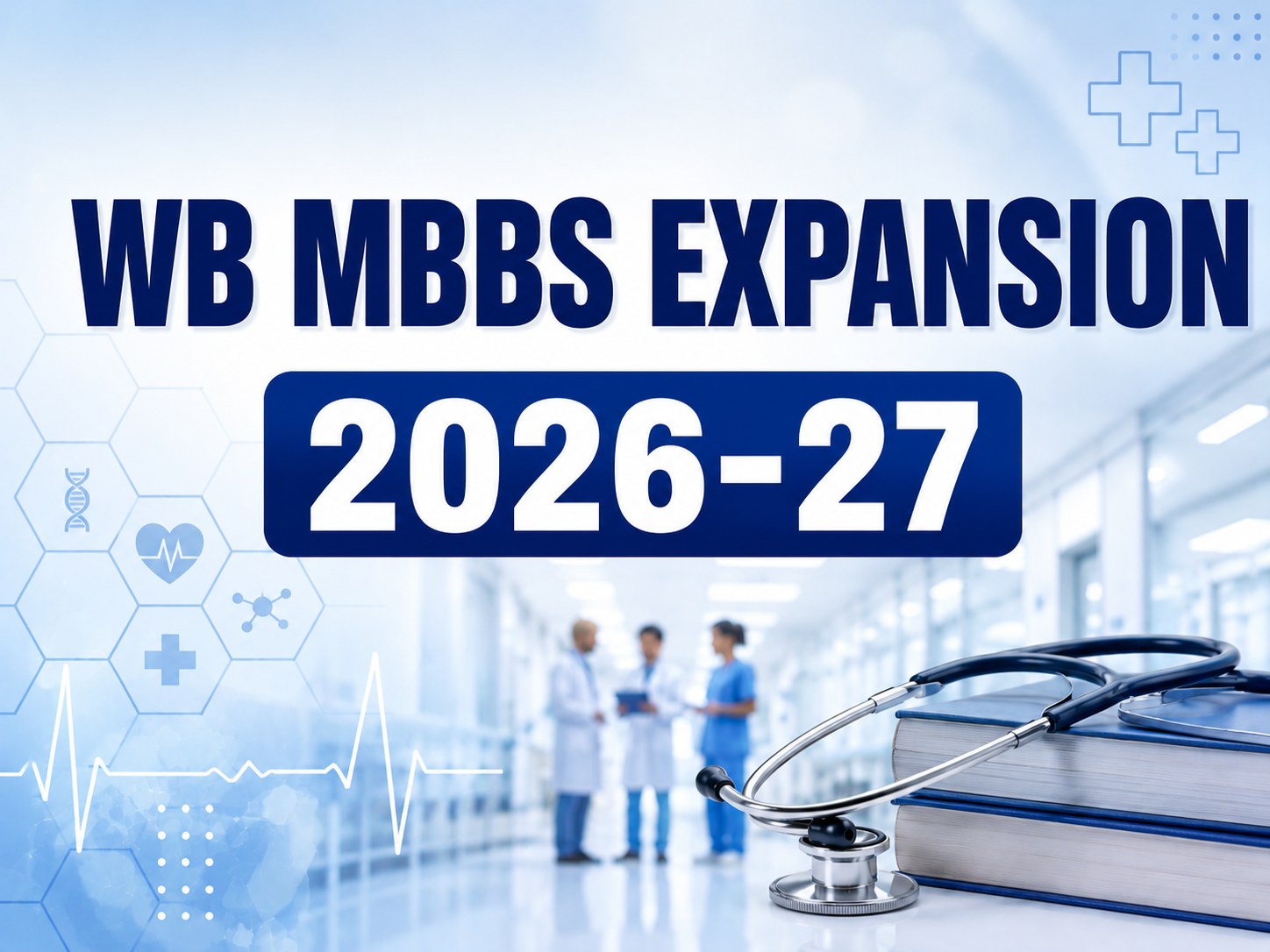
With over 44 medical institutions now operational and six new government colleges established since 2022, West Bengal has significantly widened access to medical education. The National Medical Commission's latest call for applications signals further expansion on the horizon.
West Bengal has long occupied a prominent position in India's medical education landscape. Home to some of the country's oldest and most respected medical institutions, among them the Government Medical College Kolkata, established in 1838, and RG Kar Medical College and Hospital, which has been in operation since 1916, the state combines historical legacy with a rapidly modernising infrastructure.
As of 2026, West Bengal has approximately 44 medical colleges offering MBBS and postgraduate medical programmes across government and private institutions. The state provides more than 5,000 MBBS seats in total — approximately 3,800 under the government sector and around 1,500 in private institutions. Admissions are conducted through the National Eligibility cum Entrance Test (NEET-UG), with the Department of Health and Family Welfare, Government of West Bengal, serving as the state counselling authority.
Why does West Bengal draw medical aspirants?
Several factors have historically made West Bengal an attractive destination for medical education. Government institutions in the state charge among the lowest tuition fees in the country — annual fees at colleges such as Government Medical College Kolkata and RG Kar Medical College and Hospital are approximately ₹9,000, while the Institute of Post Graduate Medical Education and Research charges around ₹6,500 per year. For students qualifying under the state quota, the financial barrier to a government medical education remains exceptionally low.
Beyond affordability, the state's dense hospital network — particularly across Kolkata — provides students with substantial clinical exposure from an early stage. High patient volumes across both urban and district hospitals translate directly into practical learning opportunities. The state also offers a full range of medical programmes spanning MBBS at the undergraduate level, MD and MS postgraduate degrees, DNB courses, and super-speciality programmes.
Annual government college tuition in West Bengal can be as low as ₹6,500 — among the most affordable in the country for a full medical degree.
Established government institutions
The government medical college ecosystem in West Bengal is anchored by a cluster of large, well-resourced institutions in Kolkata, several of which have been operating for over half a century. Each of the major Kolkata colleges offers between 200 and 250 MBBS seats annually. The principal government institutions are as follows.
Government Medical College Kolkata, Kolkata — Est. 1838 · 250 MBBS seats
RG Kar Medical College and Hospital, Kolkata — Est. 1916 · 250 MBBS seats
Nil Ratan Sircar Medical College and Hospital, Kolkata — Est. 1948 · 250 MBBS seats
Calcutta National Medical College, Kolkata — Est. 1948 · 250 MBBS seats
Institute of Post Graduate Medical Education and Research, Kolkata — Est. 1957 · 200 MBBS seats
North Bengal Medical College, Darjeeling — Est. 1968 · 200 MBBS seats
AIIMS Kalyani, Kalyani — Est. 2019 · 125 MBBS seats
The opening of AIIMS Kalyani in 2019 added a centrally funded institution to the state's portfolio, bringing with it the AIIMS standard of education, research infrastructure, and faculty quality — along with 125 MBBS seats allocated under the All India Quota.
Six new government colleges since 2022: a significant shift
Perhaps the most consequential development in West Bengal's recent medical education history has been the establishment of six new government medical colleges in 2022. Located in districts previously underserved by medical infrastructure, these institutions collectively added 600 MBBS seats to the state's capacity — and extended the reach of affordable government medical education well beyond Kolkata. The new colleges are as follows.
Jhargram Government Medical College and Hospital, Jhargram — Est. 2022 · 100 MBBS seats
Barasat Government Medical College and Hospital, North 24 Parganas — Est. 2022 · 100 MBBS seats
Tamralipto Government Medical College and Hospital, Tamluk — Est. 2022 · 100 MBBS seats
Jalpaiguri Government Medical College, Jalpaiguri — Est. 2022 · 100 MBBS seats
Prafulla Chandra Sen Government Medical College and Hospital, Hooghly — Est. 2022 · 100 MBBS seats
Sarat Chandra Chattopadhyay Government Medical College and Hospital, Howrah — Est. 2022 · 100 MBBS seats
The geographic spread of these colleges — from Jalpaiguri in the north to Jhargram in the west and Tamluk in the east — reflects a deliberate policy to decentralise medical education. Students from districts far from Kolkata now have access to government medical colleges within their own regions, reducing the need to relocate and increasing access for those from semi-urban and rural backgrounds. Each college is attached to a government hospital, ensuring clinical exposure from the outset of training.
Private sector: growing but costlier
Alongside the government expansion, West Bengal's private medical college sector has also grown steadily. Several institutions of note have come up across Kolkata, Durgapur, and beyond over the past decade and a half. The principal private medical colleges in the state are listed below.
KPC Medical College and Hospital, Kolkata — Est. 2008 · 150 MBBS seats
Jagannath Gupta Institute of Medical Sciences and Hospital, Kolkata — Est. 2018 · 150 MBBS seats
IQ City Medical College, Durgapur — Est. 2013 · 150 MBBS seats
Gouri Devi Institute of Medical Sciences, Durgapur — Est. 2016 · 150 MBBS seats
JMN Medical College, Nadia — Est. 2023 · 150 MBBS seats
JIS School of Medical Science and Research, Howrah — Est. 2023 · 150 MBBS seats
The fee differential between government and private institutions in West Bengal is stark. While government colleges charge annual tuition in the range of ₹4,500 to ₹10,000, private colleges charge considerably more. State quota seats at private institutions typically cost between ₹2 lakh and ₹4 lakh per semester, while management quota seats can range from ₹8 lakh to ₹11 lakh per semester at several institutions — a multiple of more than a thousand times the government rate at the lower end.
NMC's 2026 call: more expansion ahead
The National Medical Commission has recently invited applications from institutions seeking to establish new medical colleges or expand existing MBBS seat capacity for the 2026–27 academic session, alongside a revised fee structure. The announcement signals that the national regulatory body is actively pushing to increase total medical graduate output — and West Bengal, given its existing institutional density and infrastructure, is well positioned to benefit from this latest expansion cycle.
Should new approvals come through for West Bengal in this round, the state's MBBS capacity — already exceeding 5,000 seats — could increase further before the start of the 2026–27 session. Candidates preparing for NEET-UG 2026 are advised to monitor NMC and state government notifications for any such additions to the college list and seat matrix before counselling begins.
How admissions work: the counselling path
Admission to MBBS programmes in West Bengal follows a two-track counselling structure. Seats under the 15 per cent All India Quota — including those at AIIMS Kalyani — are allocated through the Medical Counselling Committee at the national level. The remaining 85 per cent of seats in state government and private colleges are allocated through West Bengal state counselling, conducted by the Department of Health and Family Welfare.
The process unfolds in the following sequence for a state quota applicant. The candidate must first qualify for NEET-UG with Physics, Chemistry, and Biology at the 10+2 level. They then register for West Bengal state counselling, fill and lock their college preferences based on rank and availability, and await the allotment result. Following allotment, document verification is conducted, after which the candidate must report physically to the allotted institution within the stipulated deadline. Domicile status is a key eligibility requirement — candidates who are not West Bengal residents may compete for All India Quota seats, but are generally ineligible for the state quota at government colleges.
Best medical colleges in Kolkata
Among all institutions in the state, a handful of Kolkata colleges consistently rank as the most sought-after by NEET aspirants, owing to their legacy, infrastructure, hospital size, and clinical exposure. These are the institutions that typically see the highest cutoff ranks in state counselling each year.
Government Medical College Kolkata — the oldest medical college in Asia, est. 1838
RG Kar Medical College and Hospital — one of the largest public hospitals in eastern India
Nil Ratan Sircar Medical College and Hospital — strong postgraduate and super-speciality programmes
Institute of Post Graduate Medical Education and Research — premier PG institution, attached to SSKM Hospital
ESIC Medical College Joka, Kolkata — centrally administered, ESI-funded institution
Outlook: a state with growing medical ambition
The trajectory of West Bengal's medical education sector over the past four years points clearly toward sustained growth. The simultaneous opening of six new government colleges in 2022 was one of the most consequential single-year expansions in the state's recent history, adding capacity and geographic reach in one move. The entry of two new private colleges in 2023 widened the overall seat pool further still.
For students targeting MBBS admission in 2026, West Bengal presents a compelling proposition: affordable government seats, expanding district-level infrastructure, deep medical heritage, and strong clinical exposure. With the NMC's latest expansion round still unfolding, the full picture of available seats for 2026–27 will only become clear once official approvals are published. Until then, candidates are advised to track updates from the NMC, the West Bengal Department of Health and Family Welfare, and the Medical Counselling Committee — the three authorities whose decisions will shape the admissions landscape for the coming session.
Article Stats
You Might Also Like
What Is the MS Course? A Complete Guide to Introduction, Eligibility, NEET PG Counselling and Preparation
What Is the MD Course? A Complete Guide to Introduction, Eligibility, NEET PG Counselling and Preparation
Tripura MBBS BDS Round 3 Re-Revised Schedule 2026: Choice Filling, Merit List, Allotment and Admission Dates