Overview
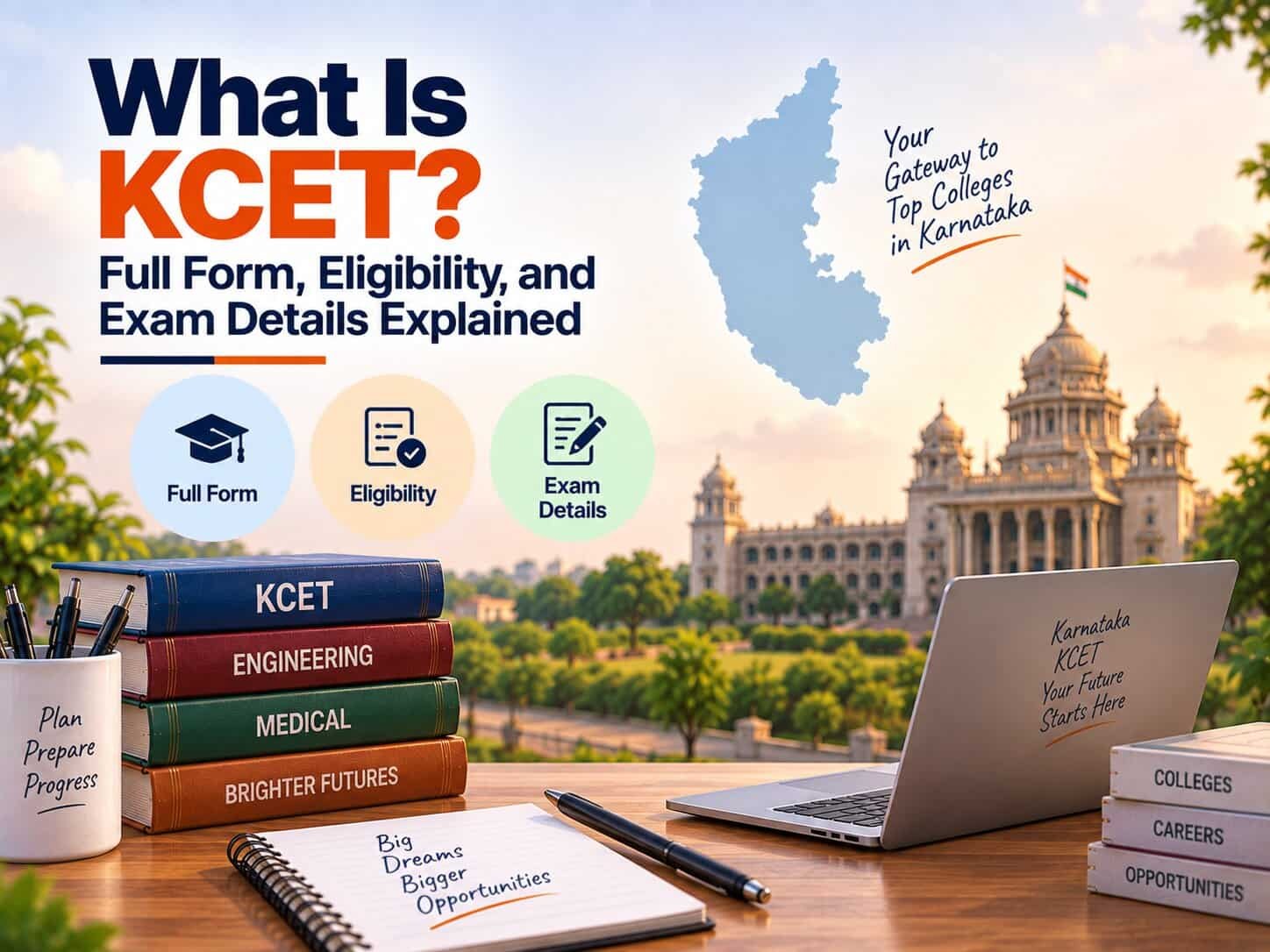
KCET stands for the Karnataka Common Entrance Test, a state-level entrance exam conducted by the Karnataka Examinations Authority (KEA) for admission to undergraduate professional courses in Karnataka. It's also referred to as the KEA UGCET (Karnataka Undergraduate Common Entrance Test). Every year, several lakh students appear for KCET seeking admission to Engineering, Architecture, Pharmacy, Agriculture, Veterinary Science, Farm Science, B.Sc Nursing, and related professional programmes offered by Government, University, Private Aided, and Private Un-Aided institutions across the state.
Candidates aiming for Medical, Dental, Ayurveda, Unani, or Homoeopathy courses must separately qualify NEET-UG, while those seeking admission to Architecture must qualify either JEE Main Paper-2 or NATA, in addition to registering for KCET counselling.
Type
KCET is a state-level undergraduate entrance examination, not a national-level test.
It functions as the gateway to counselling and seat allotment, not merely an eligibility test — qualifying candidates go on to participate in KCET counselling to secure their actual college and course.
The exam is held in offline, pen-and-paper mode, with objective-type (MCQ) questions.
State / Authority
KCET is conducted by the Government of Karnataka, through the Karnataka Examinations Authority (KEA).
It governs admissions to nearly 200 participating institutes across the state, spanning government, government-aided, and private colleges.
Provider
The exam is administered directly by KEA, which is responsible for releasing the notification, conducting registration, holding the exam, declaring results, and running the subsequent counselling process.
The official portal for registration and updates is cetonline.karnataka.gov.in (previously kea.kar.nic.in).
Exam Pattern
KCET is a pen-and-paper, offline exam, conducted in English and Kannada medium.
The test consists of objective-type (MCQ) questions, with 1 mark awarded for each correct answer and no negative marking.
The exam is split into separate subject sessions — Physics, Chemistry, and Mathematics/Biology — each carrying its own dedicated time slot, typically around 80 minutes per subject.
Each subject section generally contains around 60 questions, adding up to roughly 180 questions/marks across the full test.
A separate Kannada Language Test is also conducted for candidates who wish to claim benefits under the Kannada/local-language category.
Key Eligibility Criteria
Candidates must have passed 12th grade (or equivalent) in the Science stream, with Physics, Chemistry, and Mathematics as mandatory subjects for Engineering-related courses. Biology is required in place of, or alongside, Mathematics for Agriculture, Veterinary, and related life-science courses.
A minimum aggregate percentage (commonly around 45–50% for general category, with relaxation for reserved categories) is typically required, as specified in the official KCET brochure each year — candidates should verify the exact cutoff percentage in the current year's notification.
Candidates must be Indian citizens.
For state quota eligibility specifically, an applicant generally needs to satisfy at least one of the following:
Have studied in Karnataka for a specified number of years (commonly cited as around 7 consecutive years in recent cycles), or
Have a parent who is a Karnataka domicile/native, or
Claim Kannada, Tulu, or Kodava as their home/mother tongue, subject to verification.
A minimum age requirement (typically 17 years) applies for certain courses, including some medical/veterinary-linked programmes, though there is generally no strict upper age limit for most engineering and allied courses.
All details submitted - academic records, category certificates, domicile proof — must match official documents exactly, since discrepancies can lead to cancellation of candidature at any stage.
Registration and Exam Process
Registration typically opens in January and closes around late February, with a form correction window and an extended fee-payment deadline often provided shortly after.
Candidates must upload documents in the prescribed format (commonly JPG/JPEG), since incorrect formats or mismatched details are common reasons for application rejection.
The admit card is usually released a few weeks before the exam, and the exam itself is typically held over two to three days in April.
Results are generally declared in early-to-mid June, followed by online KCET counselling, which begins shortly after.
Why KCET Matters
For students aiming to study Engineering, Pharmacy, Agriculture, or allied professional courses within Karnataka, KCET is the primary route to admission — qualifying the exam alone doesn't guarantee a seat, but it is the mandatory first step that opens the door to the state's centralised counselling process. Because eligibility rules — particularly around state quota status, minimum percentage, and subject combinations — can change slightly from year to year, candidates should always cross-check the current year's official KCET brochure rather than relying on a previous year's criteria.
For the latest registration schedule, eligibility brochure, exam pattern, and counselling updates, candidates should refer directly to the official KEA KCET portal.
Article Stats