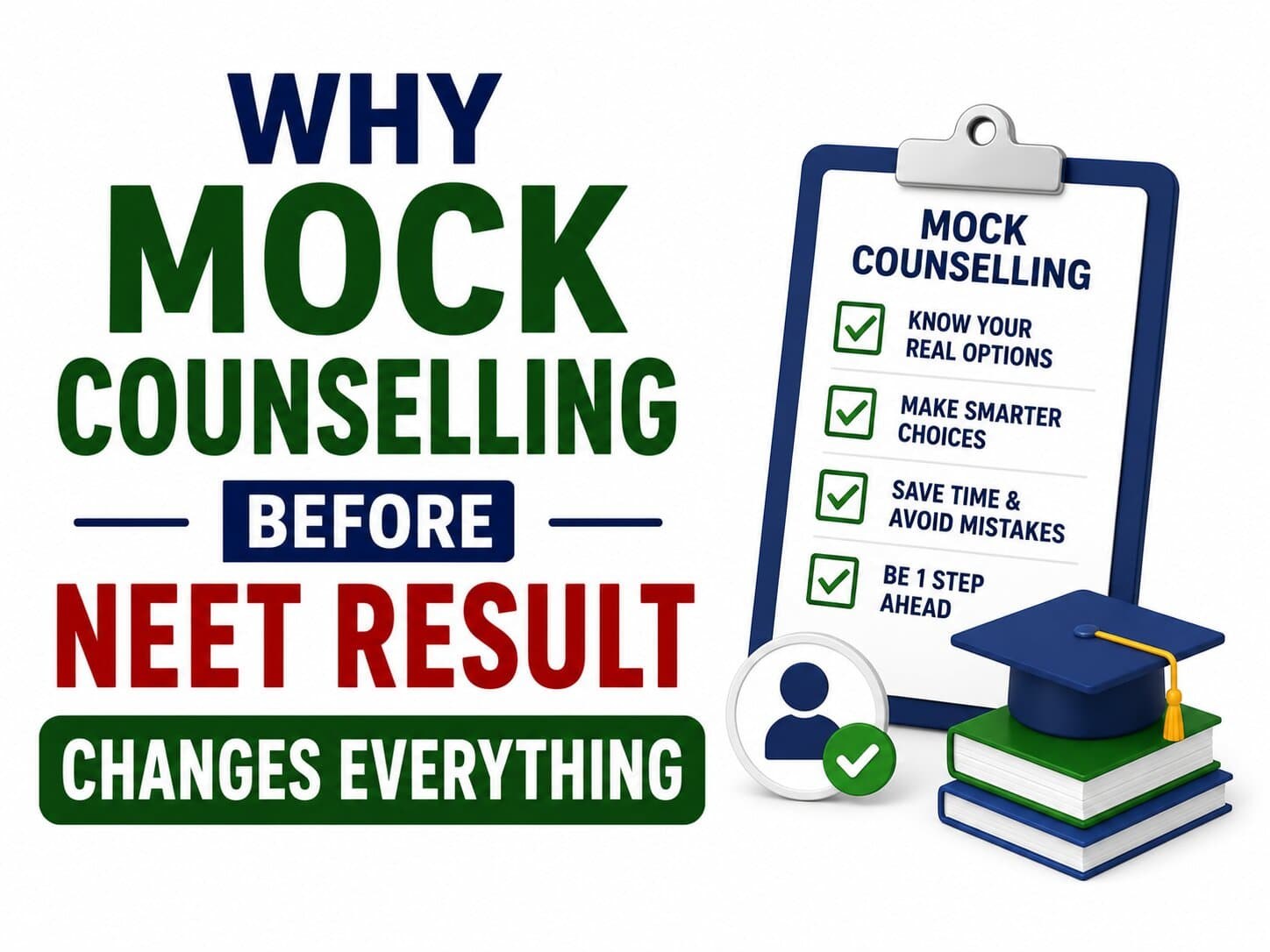
The Re-NEET 2026 exam is over. The answer key is out. And right now, across the country, more than 22 lakh students are doing one of two things: either spiralling into a cycle of refreshing neet.nta.nic.in every few hours, or doing something far more useful with the same period of time.
The result is expected by July 15. MCC counselling for AIQ seats is expected to open in the last week of August. Between today and that counselling window sits roughly seven to eight weeks — the single most valuable, most consistently wasted stretch of time in the entire NEET admission journey. Most students treat it as a waiting room. The ones who consistently come out with better seats treat it as preparation time.
What separates these two groups is not luck. It is not a better rank. It is whether or not they ran mock counselling before the official process began.
The Problem With Waiting for the Result to Start Planning
There is a deeply embedded assumption in how students approach NEET counselling: that serious planning should begin after the result is declared. The logic sounds reasonable. Why plan around a number you do not officially have yet?
The flaw in this reasoning becomes obvious the moment you understand how compressed the counselling timeline actually is. Once NTA declares the result, here is what happens in rapid succession: MCC opens AIQ counselling registration. Candidates have a few days to register, pay the fee, and upload documents. The choice-filling window then opens — typically for four to five days — during which candidates must shortlist, rank, and lock their college preferences. The mock allotment result follows. Then another brief window to revise. Then final locking. Then the actual allotment result.
From result declaration to choice-filling deadline, in a normal year, is approximately three to four weeks. In 2026, given the Re-NEET timeline compression, it could be even shorter. Three weeks sounds sufficient until you realise what needs to happen inside that window: researching over a thousand participating colleges, understanding category-wise closing ranks across multiple counselling years, mapping AIQ options against state quota options, calculating financial feasibility across institutions, and building a choice list of 80 to 100 colleges in a deliberate, strategic order.
Students who start this from scratch after results are declared consistently run out of time. They fill choices under pressure, make ordering errors, miss institutions they would have preferred, and discover during the mock allotment — or worse, after the final allotment — that their list had fundamental problems they could have caught weeks earlier.
Mock counselling before the result exists specifically to prevent this.
What Mock Counselling Before the Result Actually Means
Mock counselling, in the pre-result context, is not a formal process run by MCC or any state authority. It is the practice of simulating your own counselling round using your estimated score, before the official result arrives.
The sequence looks like this. You calculate your expected marks from the provisional answer key. You use a rank predictor calibrated to 2026 data — accounting for this year's paper difficulty, the candidate count of 22.79 lakh, and the Re-NEET specific competition patterns — to estimate your probable All India Rank and category rank. With that predicted rank in hand, you run your profile through a college predictor to generate a personalised list of institutions realistically within reach across AIQ and state quota. You then study the historical cutoff data for those specific colleges, compare fee structures, assess location preferences, and begin building a working version of your choice list.
This is mock counselling. It is not guesswork. It is structured, data-driven preparation built on the same inputs the actual algorithm will use — just three to four weeks ahead of when most students begin the same process.
The single most important thing it does is give you time. Time to research colleges properly. Time to identify errors in your preliminary list. Time to understand which institutions consistently close within your rank range and which consistently fall just above it. Time to have an informed conversation with someone who knows the process before you are already in it.
Why the Window Between Exam and Result Is Uniquely Valuable
Students who have just given the exam and are waiting on results exist in a specific psychological state: they know roughly how they performed, they have a rough sense of whether their score is strong, moderate, or a concern, and they have weeks of enforced waiting ahead of them.
This state is actually ideal for counselling preparation, for a reason that sounds counterintuitive. Because the result has not been declared yet, there is no time pressure. No registration deadline is counting down. No choice-filling window is ticking. There is time to think carefully, research thoroughly, and build a list that reflects actual preferences rather than panicked defaults.
Compare this to the experience of the same student three weeks later. Result declared. Rank in hand. MCC registration opens. Every action now has a deadline attached to it. College research that would have taken a week of comfortable reading now has to happen in an evening. A preliminary choice list that could have been revised five times in the waiting period is being built from scratch at 11 PM the night before the locking deadline.
The quality of decisions made under time pressure is measurably worse than the quality of decisions made with adequate preparation time. This is not specific to NEET counselling — it is a basic feature of how humans process complex, high-stakes choices. Mock counselling before the result is the mechanism for moving the cognitive work to a period where it can be done properly.
What Changes When You Run Mock Counselling Early
The practical difference between a student who ran mock counselling before results and one who did not becomes visible at several specific moments in the actual counselling process.
At the choice-filling stage, the student who did pre-result mock counselling already has a working list of 60 to 80 colleges, researched and ranked by genuine preference. They spend the choice-filling window refining an existing list rather than building one from zero. They are comparing options they understand, not options they are encountering for the first time under deadline pressure.
At the mock allotment stage, they can read the result intelligently. If the simulated allotment shows a college lower in their list than expected, they know why — because they understand where that college sits in terms of historical closing rank versus their predicted rank. They can make targeted corrections rather than panic-revisions.
At the AIQ vs state quota decision point, they already know which track is stronger for their specific rank and category combination. For a West Bengal student at a given rank, the choice between pursuing a seat through WBMCC state quota counselling versus competing for AIQ seats nationally is not a straightforward one. The right answer depends on the specific rank, the specific category, and the specific colleges in each pool. Students who have modelled both scenarios in advance make this call with data. Students who have not make it with instinct.
At the mop-up and stray vacancy rounds, students who planned early understand their options better. They know which seats typically become available in later rounds, whether holding their current seat and upgrading makes strategic sense, and what the risk calculus looks like for a free exit versus a retention. These are not decisions anyone makes well when they are encountering the concepts for the first time.
The Specific Steps of a Pre-Result Mock Counselling Session
Running your own mock counselling session before the result requires four inputs and a structured approach. None of the inputs require an official result.
Step 1 — Calculate your expected score. Use your OMR recorded responses (available via candidate login on neet.nta.nic.in) against the provisional answer key. Apply the standard marking scheme: +4 for correct, −1 for incorrect, 0 for unattempted. Build a range — not a single number — that accounts for possible answer key revisions after objections. If your calculation shows 595, plan for 585–605.
Step 2 — Predict your rank range. Use a rank predictor calibrated to 2026 data. In a year where the Re-NEET paper was moderate to slightly easier than 2025, with 22.79 lakh candidates, the competition is compressed at the mid-range. A predicted rank from a well-calibrated tool gives you a directional AIR and your category rank — both of which you need for the next step.
Step 3 — Run a college prediction for your specific profile. Enter your predicted rank, category, domicile state, and quota preference into a college predictor. The output is a personalised list of institutions where you have a realistic chance based on previous counselling closing data. Do this for AIQ separately and for your state quota separately. The two lists will not be identical, and the overlap and differences between them are important information.
Step 4 — Build your working choice list. From the college prediction output, research the institutions that appear. Look at their historical closing ranks across two to three years — not just last year, because cutoffs shift. Compare fee structures using a fees comparison tool. Compare infrastructure and clinical exposure where two colleges fall at similar rank points. Begin building a preference order that reflects your actual priorities: proximity to home, fee affordability, government vs private preference, specialty exposure. This is your working list — not your final list, but a working version that you can refine over the next few weeks.
Step 5 — Identify gaps and questions. What does your working list reveal? Are there rank ranges in your list where you have no realistic options and need to add more colleges? Are there colleges you have listed purely because they are well-known, even though they consistently close 15,000 ranks above your predicted position? Are there financial assumptions in your list that need to be verified? These are the questions that mock counselling surfaces — and they are far easier to address three weeks before the deadline than three days before.
The Rank and Score That Already Exists — Without the Official Result
One of the persistent hesitations students express about pre-result counselling is the feeling that planning around a predicted rank is somehow speculative — that there is no point building a strategy around a number that has not been officially confirmed.
This hesitation misunderstands what a well-calibrated rank prediction actually is. The 2026 Re-NEET had a single shift, with no inter-shift normalisation. The marking scheme is fixed. The candidate count is known. Previous-year marks-to-rank distributions are available. A rank prediction built on an accurate expected score, using tools that account for 2026-specific paper difficulty and candidate distribution, is not a guess. It is a statistically grounded estimate with a defined accuracy range — typically within 1,000 to 2,000 ranks for mid-range scores.
That is accurate enough to identify which colleges are comfortably within reach, which are genuine stretch options, and which are outside realistic range. Those three categories are all you need to begin building a sensible choice list.
And for the portion of uncertainty that remains — the possibility that your actual rank comes in slightly better or slightly worse than predicted — the solution is not to wait. The solution is to build a choice list that is robust across a rank range, rather than one that only works at a single specific number. Mock counselling helps you do exactly that.
What a Good Counselling Strategy Looks Like, Built Before Results
A counselling strategy built through pre-result mock counselling has three essential layers.
The first layer is your realistic target colleges — institutions where your predicted rank range has a genuine probability of securing a seat based on historical closing data, under either AIQ or state quota. These are not fantasy options. They are institutions you have researched, understand, and would accept.
The second layer is your safe options — colleges where your rank is comfortably above historical closing ranks, meaning you have a high probability of a seat regardless of moderate rank variations on result day. Every serious choice list needs this layer. Students who skip it because they only want to aim for top colleges end up with a "not allotted" mock result and no time to add colleges before final locking.
The third layer is your stretch options — colleges where your rank sits slightly below historical closing ranks but where year-on-year variation creates a realistic chance. These go at the top of your list. They are worth including precisely because NEET cutoffs are not fixed: a year where the paper was slightly easier than usual often sees cutoffs shift, and a student with a strong score in a moderate paper can sometimes access colleges that closed above their rank in previous years.
West Bengal students building this three-layer strategy need to run it twice — once for AIQ and once for WBMCC state quota — because the college options in each pool are different and the rank thresholds for the same institution can differ substantially between the two. Understanding how WBJEE 2026 counselling timelines interact with NEET counselling is also relevant for students tracking both streams simultaneously.
The Cost of Not Doing This
Students who do not run any form of mock counselling before official results are not simply starting later. They are starting the same process under fundamentally worse conditions — less time, more anxiety, higher cognitive load, and less room to course-correct.
The errors that result from this are well-documented and consistent across counselling cycles. Choice lists that are too short and produce a "not allotted" result in the mock round. Preference orders that are reversed from actual preference because the student never had time to think carefully about what they actually want. Financial commitments made in the heat of the moment that families later struggle to sustain. Institutions chosen based on name recognition or social media reputation rather than any structured comparison. Seats lost not to better-ranked students but to better-prepared ones who simply had their documents ready, their list built, and their strategy formed before the pressure began.
None of these errors are inevitable. Every one of them is preventable with three to four weeks of structured preparation during the exact window that is currently open.
The Right Time to Start Is Right Now
The objection window for the Re-NEET 2026 provisional answer key closes June 28. After that, the final answer key will be published, and with it, a reasonably precise expected score for every candidate. That is the trigger point. From that moment, there is no legitimate reason to wait.
Use your calculated score to predict your rank. Use your predicted rank to run a college prediction for your profile — accounting for your category, your state domicile, and your quota eligibility. Begin building your choice list with the weeks of preparation time that exist before the counselling deadline compresses everything. Research the colleges realistically within your range. Understand whether AIQ or state quota is your stronger track. Map the fee structures that matter to your family's financial planning.
And if the counselling process — the quota structures, the category-wise cutoffs, the AIQ vs state quota decision, the choice list ordering, the round-wise strategy — feels like a lot to navigate alone with a high-stakes result arriving in two weeks, that is not a reflection of your ability. It is a reflection of how genuinely complex this process is.
A free 1:1 counselling session is the fastest way to take everything you know about your expected score and turn it into a structured, defensible plan before the result arrives. The session costs nothing. The clarity it provides — before every deadline is compressed, before every decision is under pressure — is worth considerably more than the same conversation held three days before the choice-filling window closes.
The result is coming. The question is whether you will be ready for it.
All timeline estimates in this article are based on MCC counselling patterns from previous years and Re-NEET 2026 result projections. Official counselling schedules will be published by MCC at mcc.nic.in following the NTA result declaration. Always verify active deadlines from official sources before acting.
Article Stats
You Might Also Like

What Is the MS Course? A Complete Guide to Introduction, Eligibility, NEET PG Counselling and Preparation

What Is the MD Course? A Complete Guide to Introduction, Eligibility, NEET PG Counselling and Preparation
Tripura MBBS BDS Round 3 Re-Revised Schedule 2026: Choice Filling, Merit List, Allotment and Admission Dates