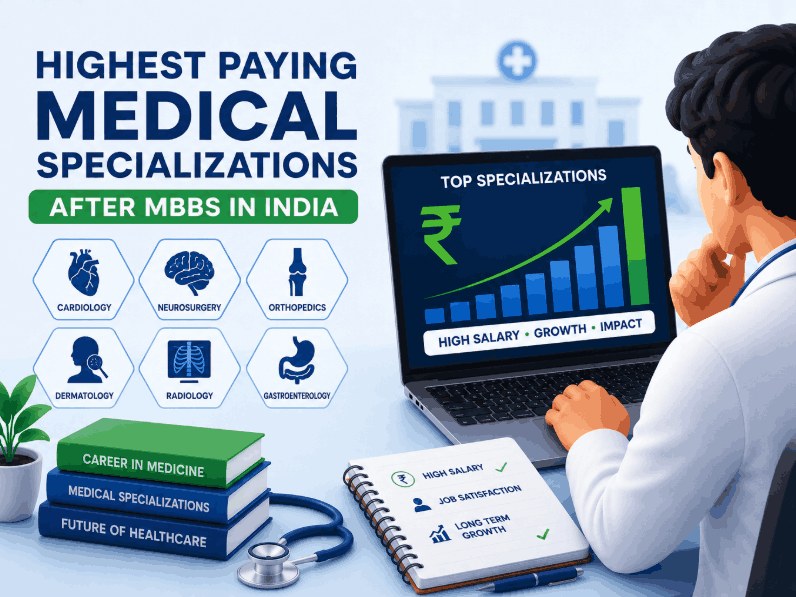
Completing an MBBS degree is a massive milestone, but it is only the first step toward a highly lucrative clinical career. As thousands of fresh junior residents enter the healthcare ecosystem every year, relying on a basic undergraduate degree severely limits your long-term income potential.
In India's highly competitive medical market, real financial scaling happens exclusively through specialized postgraduate training. Corporate hospital chains, diagnostic groups, and premium wellness networks look specifically for advanced clinical skill sets, making specialized consultants the top earners in the industry.
That’s why staying informed is crucial.
Choosing the right post-graduate path requires balancing your personal clinical interests with realistic revenue trends. By matching your career roadmap to the highest paying medical specializations after mbbs, you can secure an excellent return on investment for your years of hard academic work.
In this guide, we break down the top-earning medical fields, their average annual revenue brackets, and the specific factors driving their commercial growth in India.
Why Choosing a Post-Graduate Specialization Shifts Your Revenue Scale
While an experienced MBBS doctor typically earns a stable, baseline income, a postgraduate specialist (MD/MS) or a super-specialist (DM/MCh) operates on a completely different financial level. Advanced corporate hospitals treat general practice as a primary intake layer, routing all high-value diagnostic tests and major surgeries to specialized staff.
The core structural factors that elevate a specialist's earning index include:
The Ability to Perform High-Value Procedures: Procedure-heavy fields like advanced diagnostics or open surgeries naturally command premium individual fees.
Independent Private Practice Potential: Fields with minimal emergency hours allow doctors to scale their personal clinics seamlessly in high-income urban neighborhoods.
Corporate Hospital Retainer Models: Top-tier multi-specialty chains offer highly competitive guaranteed annual packages to retain rare surgical talent.
Direct Access to Global Consultation Markets: Digital diagnostic pathways like teleradiology allow local specialists to consult for global health networks comfortably from home.
Failing to specialize early can leave your career stuck in basic shift-duty structures, missing out on the exponential growth driven by the modern healthcare boom.
Top 5 Highest Paying Medical Specializations After MBBS
The financial landscape across advanced specialties favors fields driven by elective cosmetic demands, high-end diagnostics, or critical emergency interventions. Review these top-tier medical branches categorized by their market value and growth metrics:
1. Radiology (MD / DNB)
Average Annual Package: ₹20 LPA to ₹50 LPA+ for established consultants.
Earning Driver: The diagnostic demand across urban diagnostic loops makes Radiology an absolute cash powerhouse. Because every surgical branch requires high-end CT, MRI, and ultrasound imaging before operating, a radiologist operates as the critical backbone of modern medicine.
2. Dermatology and Aesthetic Medicine (MD / DNB)
Average Annual Package: ₹15 LPA to ₹50 LPA+ with high private practice margins.
Earning Driver: The massive boom in elective cosmetic procedures like laser treatments, hair transplants, and advanced anti-aging therapies makes this branch incredibly lucrative. Because these are premium, out-of-pocket expenses not dependent on insurance caps, private dermatological clinics achieve exceptional profit margins.
3. Neurosurgery and Cardiothoracic Surgery (MS followed by MCh)
Average Annual Package: ₹25 LPA to ₹1 Crore+ in premium super-specialty networks.
Earning Driver: These hyper-specialized surgical pathways handle incredibly complex, high-stakes, life-saving procedures daily. Senior neurosurgeons and cardiac specialists are in massive corporate demand due to rising chronic health pressures across metro cities.
4. Orthopedics and Sports Medicine (MS / DNB)
Average Annual Package: ₹18 LPA to ₹80 LPA+ depending on surgical volume.
Earning Driver: Elective joint replacements, robotic knee surgeries, and high-revenue arthroscopic sports injuries offer a highly repeatable, structured business model. Orthopedic surgeons command premium individual fees per procedure, resulting in highly predictable and consistent monthly revenue.
5. Gastroenterology and Interventional Cardiology (MD followed by DM)
Average Annual Package: ₹20 LPA to ₹75 LPA+ in corporate hospital pools.
Earning Driver: Advanced endoscopy procedures, cardiac stent placements, and high-tech minimally invasive interventions allow these specialized medical branches to scale revenue rapidly. They avoid the long recovery cycles of open surgeries while handling massive daily patient volumes.
Step-by-Step Strategy to Maximize Your PG Earning Potential
Securing a high-paying specialty slot requires planning long before the counseling portals open.
Follow this clinical career layout to optimize your professional trajectory:
Step 1: Target Top-Tier Training Centers Early
Aim for high-volume government medical colleges or premium central institutes during your NEET PG or INI-CET preparation cycles.
Training at high-case-load hospitals ensures superior practical skill acquisition, making you highly valuable to corporate recruiters upon graduation.
Step 2: Track Future Private Practice Scalability
Evaluate if your chosen branch allows you to open an independent clinic without requiring multi-crore equipment investments.
Branches like Dermatology and Pediatrics require lower initial capital to set up private practices compared to building a full-scale diagnostic center.
Step 3: Pursue Targeted Fellowship Certifications
If you enter general branches like MS General Surgery or MD Internal Medicine, add specialized fellowships in advanced niches like robotic surgery or critical care.
These targeted sub-specializations elevate your profile above standard consultants, unlocking elite corporate salary bands much earlier in your career.
Which medical branch offers the highest starting salary immediately after post-graduation in India?
Radiology and Dermatology generally command the absolute highest immediate starting salaries for fresh postgraduates. Corporate hospital chains, diagnostic networks, and specialized skin clinics pay premium retainers to secure these specific clinical assets early.
Do surgical branches (MS/MCh) earn more than medical branches (MD/DM) in India?
In the long run, senior super-specialized surgeons (like neurosurgeons or plastic surgeons) can earn higher individual procedure fees, often scaling past ₹1 Crore annually. However, medical specialists like dermatologists and radiologists typically achieve a highly stable and premium income much earlier with a better work-life balance.
Is it possible to build a high income after MBBS without doing a super-specialization?
Yes. Doctors can build strong income trajectories without an MCh or DM by focusing on high-demand standalone PG fields like MD Radiology or MD Dermatology. Alternatively, diving into critical care ICU management, emergency medicine, or opening a well-located private general practice scales income effectively.
Professional Checklist for Medical Career Planning
Following a structured, analytical routine helps you align your academic effort with actual industry demand:
Assess Long-Term Lifestyle Preferences: Balance your income expectations with lifestyle preferences; fields like Radiology offer fixed hours, while Neurosurgery demands intense emergency duties.
Track Evolving Technology Sectors: Monitor fields integrating AI diagnostics, digital health infrastructure, and advanced teleradiology channels to future-proof your skill set.
Secure Category and Merit Data Early: Review past years' NEET PG cutoff brackets to understand exactly what rank is required to clear entries into these elite fields.
Conclusion
For medical professionals mapping out their future pathways, picking among the highest paying medical specializations after mbbs is a vital strategic decision.
From analyzing the cosmetic procedure boom to evaluating the corporate demand for elite surgical talent, entering your post-graduate studies with accurate market insight ensures your long-term efforts convert into financial success.
The smartest approach is simple:
Focus your entry preparation strictly on high-yield, premium clinical branches.
Pick a field that matches both your clinical interest and long-term lifestyle goals.
Look past initial entry-level stipends and focus on long-term private practice scalability.
Keep updating your surgical and diagnostic skill sets via global fellowship models.
Remaining methodical, business-conscious, and highly proactive keeps your healthcare path fully optimized, guiding you smoothly toward a premium and rewarding medical career.
Article Stats